



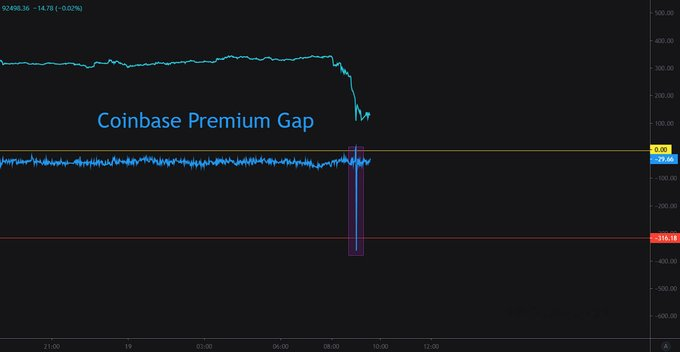
Bitcoin markets are flashing a signal that seasoned traders rarely ignore. The Coinbase Premium Gap—a long-watched indicator of U.S. investor behavior—has slipped deep into negative territory, marking one of its most aggressive selling phases in recent periods.
What makes this move striking is not just the magnitude of the gap, but when and how it is happening: much of the pressure is emerging outside ETF trading hours, pointing directly at large U.S.-based holders rather than retail flows or passive ETF investors.
This development is reshaping how analysts interpret the current correction and raising fresh questions about institutional positioning in Bitcoin.
Key Takeaways
- The Coinbase Premium Gap turning sharply negative signals strong selling pressure originating from U.S.-based large investors rather than retail traders.
- Persistent selling during ETF market closures indicates that institutional activity is occurring through non-ETF channels such as direct exchange trades and OTC desks.
- On-chain and derivatives data suggest the current sell pressure reflects strategic portfolio repositioning rather than panic-driven liquidation.
- Historical patterns show that sustained negative Coinbase premiums often precede market consolidation or corrective phases.
- Despite increased selling, lower leverage and a healthier market structure reduce the risk of a disorderly market breakdown.
A Premium Gap That’s Hard to Ignore
The Coinbase Premium Gap measures the price difference between Bitcoin on Coinbase and offshore exchanges such as Binance. Historically, Coinbase has served as a gateway for U.S. capital, particularly institutional money.
When Bitcoin trades at a premium on Coinbase, it usually reflects strong domestic demand. When that premium flips negative, it signals selling pressure from U.S.-linked participants.
Recent data reviewed by market analyst and Bitcoin commentator Mignolet shows the gap widening sharply to the downside, even during periods when U.S. spot Bitcoin ETFs were not trading.
“Selling pressure intensified even when ETF markets were closed, suggesting activity outside traditional ETF structures.”
That single observation carries weight. ETFs have become the most visible channel for institutional exposure, but they are far from the only one. The timing alone suggests that large players are using other routes to reduce exposure.
Why ETFs Don’t Explain This Move

Since the approval of spot Bitcoin ETFs, daily inflow and outflow data has often been used as a proxy for institutional sentiment. But the current market behavior exposes a limitation of that approach.
If ETFs were the main driver, selling pressure would align closely with U.S. market hours. Instead, Bitcoin has faced notable sell-side activity during ETF downtime, pointing to alternative execution paths.
These include:
- Direct spot selling on Coinbase
- Over-the-counter (OTC) desk transactions
- Structured unwinds by funds holding Bitcoin on balance sheets
“Large investors are moving substantial Bitcoin holdings through channels outside conventional ETF structures.”
This distinction matters. ETF flows are transparent and easy to track. OTC trades and direct exchange selling by institutions are not. The Coinbase Premium Gap is capturing that hidden activity in real time.
Whale Behavior Looks Familiar
Seasoned market participants have seen this pattern before. In past cycles, sustained negative Coinbase premiums often appeared when institutions were quietly reducing risk after extended price rallies.
During the 2021 bull run, prolonged positive premiums signaled aggressive U.S. accumulation. The opposite is now unfolding.
“The scale of selling suggests participation from large, sophisticated investors rather than retail traders.”
Retail traders rarely move the premium in a sustained way. Their trades are fragmented and often driven by momentum. What we are seeing instead resembles coordinated selling—measured, persistent, and size-heavy.
This lines up with other data points. Blockchain analytics over the past month show increased transfers from known institutional wallets to exchange-linked addresses. At the same time, derivative markets suggest more defensive positioning, with hedging activity picking up and leverage remaining muted.
Not Panic Selling — Strategic Repositioning
It would be misleading to frame the current move as panic. Unlike past stress events, on-chain metrics do not show a surge in fresh exchange inflows. That detail is crucial.
It implies that much of the selling is coming from Bitcoin already sitting on exchanges, not from holders rushing to deposit coins in fear. This is more consistent with planned distribution than emotional exits.
Several motivations may be overlapping:
- Profit-taking by early institutional entrants
- Portfolio rebalancing as macro risks resurface
- Regulatory caution ahead of policy shifts
- Reduced appetite for volatile assets in the short term
“The selling follows traditional patterns observed in previous market cycles.”
In other words, this looks like institutions doing what they often do best: adjusting exposure before conditions change, not after.
Historical Signals Offer a Warning—and Some Reassurance
History gives context, though not certainty. There have been clear moments when a deeply negative Coinbase Premium Gap preceded extended drawdowns.
- In early 2018, sustained negative readings appeared ahead of a steep multi-month decline.
- In early 2020, extreme negative premiums marked COVID-era liquidation before recovery began.
- In late 2022, negative gaps accompanied forced selling during major exchange failures.
But there is an important difference today. Leverage across derivatives markets is significantly lower than during prior cycle peaks. Exchange balances are also far from historical highs.
“Current market structure appears healthier than during previous extreme selling periods.”
That does not rule out further downside, but it reduces the probability of disorderly collapse driven by cascading liquidations.
Regional Markets Tell a Different Story
The sell pressure appears concentrated in U.S.-linked venues. Exchange premium data from Asia and parts of Europe show less aggressive selling, with some regions maintaining neutral or even mildly positive spreads.
These differences reflect structural factors:
- Distinct regulatory environments
- Varying investor profiles
- Currency and capital flow dynamics
- Regional trading hour effects
Bitcoin remains a global market, but U.S. capital still exerts outsized influence on price discovery. When American whales sell, the impact ripples outward.
Why the Coinbase Premium Gap Matters Right Now
Analysts often warn against relying on a single indicator, and that caution applies here as well. Still, the Coinbase Premium Gap offers something many metrics do not: a window into who is acting, not just what price is doing.
“The indicator provides valuable insight into geographic and investor-class behavior.”
When paired with ETF flow data, on-chain movements, and derivatives positioning, a clearer picture emerges. ETFs are no longer the dominant force shaping short-term pressure. Instead, large U.S. holders operating beyond ETF wrappers are taking the lead.
What Comes Next
Whether this selling marks a temporary reset or the early stage of a deeper correction remains unresolved. Much will depend on macro conditions, regulatory developments, and whether institutional selling slows or accelerates.
What is clear is that Bitcoin’s market structure has grown more complex. ETF flows alone no longer tell the full story. Indicators like the Coinbase Premium Gap are regaining relevance, especially during periods when visible data sources fall quiet.
For now, the message from the premium gap is direct: U.S. whales are active, they are selling, and they are doing it outside the spotlight. Markets would be wise to pay attention.