




In 2025, the IRS increased crypto tax audits by 52% compared to 2024 and sent 758% more warning letters in just 60 days. New Form 1099-DA reporting started this year, which means the agency now receives direct transaction data from your exchanges.
Getting your crypto taxes wrong can cost you up to $250,000 in penalties and five years in federal prison.
This is not a niche problem. The IRS collected $235 million in unpaid crypto taxes in 2024 alone. Blockchain analytics tools like Chainalysis mean the agency can trace wallet activity even on decentralised exchanges. The idea that crypto holdings are invisible to regulators is simply not true anymore.
The best crypto tax accountants for 2026 are Gordon Law Group (an audit defence specialist with dual CPA and Tax Attorney credentials), TokenTax (software combined with a VIP accountant service for active traders), and Count on Sheep (reconciliation specialists for complex or incomplete records).
But the right choice depends on your transaction volume, DeFi activity, and whether you have already received an IRS notice.
This article covers 15+ firms, breaks down costs ($200–$800 per hour or $1,500–$30,000+ in flat-fee packages), and shows you how to verify credentials and spot unqualified preparers before they cause problems.
What this article covers:
- 15+ crypto tax accountants and firms compared with honest pros and cons
- A practical credential verification guide
- Exact questions to ask before you hire anyone
- Real red flags with case study examples
- A clear framework for deciding between DIY, software, or professional help
- Form 1099-DA compliance and what it means for your 2025 return
Why You Need a Crypto Tax Accountant
The enforcement environment changed significantly in 2025. Form 1099-DA now requires crypto exchanges to report your transaction gross proceeds directly to the IRS.
The agency has used this alongside blockchain analytics for years, but now it has direct data feeds from centralised exchanges, the same platforms where most people hold and trade crypto.
The numbers tell the story:
- 52% increase in crypto-focused audits from 2024 to 2025 (CoinLaw)
- 758% surge in IRS warning letters (Letters 6174/6174-A) in a single 60-day period in 2025
- $235 million in unpaid crypto taxes collected by the IRS in 2024
- $10,000–$250,000 in penalties for serious non-compliance cases
- Criminal prosecution for egregious crypto tax fraud, including a Pennsylvania resident who underreported $13 million in NFT sales and an individual charged with hiding $2.6 million in crypto income
If your tax return does not match the data the IRS receives from exchanges, you will be flagged. There is no grey area here.
Also Read: All Countries Where Crypto Is Tax-Free in 2026: The Complete Global Guide
What Triggers a Crypto Audit
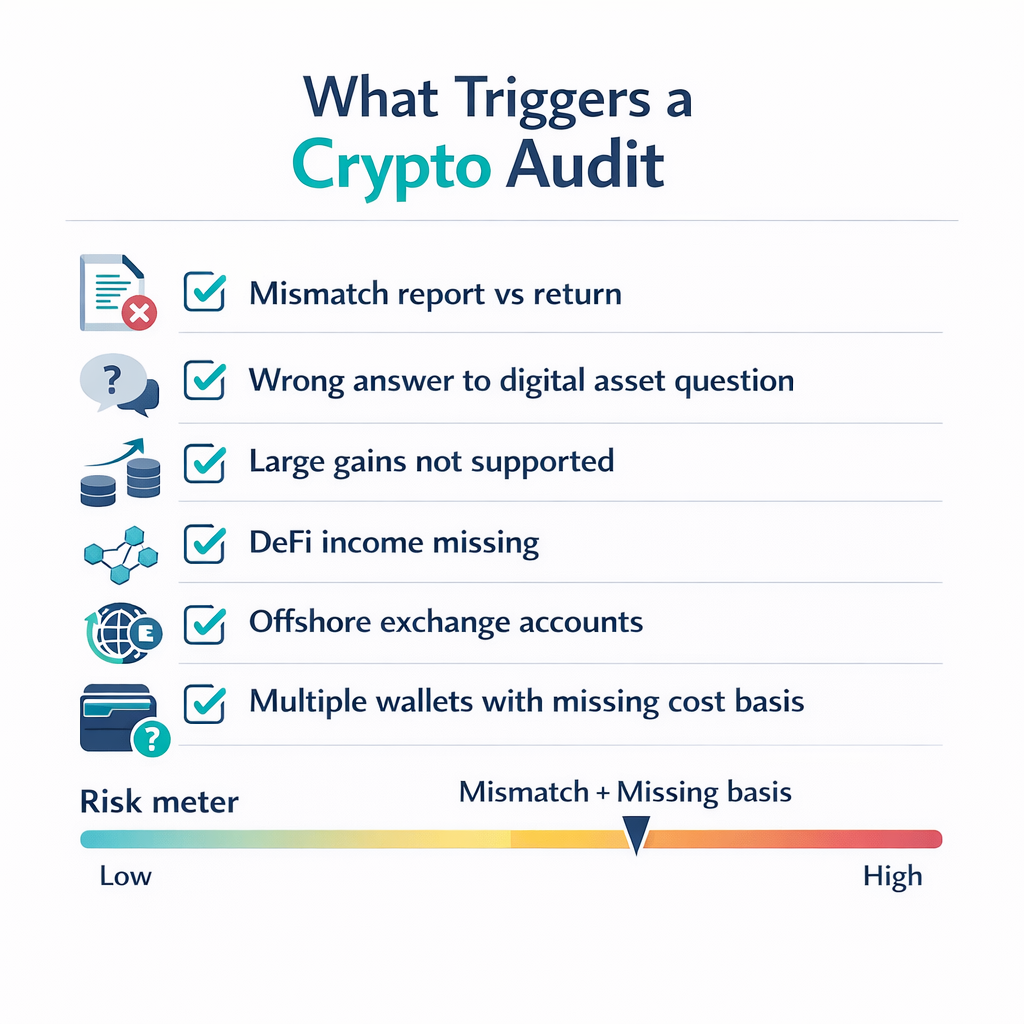
The IRS looks for specific patterns when selecting crypto returns for audit:
- A mismatch between the 1099-DA data from your exchange and what you reported
- Answering “No” to the digital asset question on Form 1040 when exchanges have already reported your activity
- Large unreported gains identified through blockchain analytics
- DeFi income (yield farming, liquidity rewards) with no corresponding income on your return
- Foreign exchange holdings, such as Binance, KuCoin, and others without an FBAR filing
Why a General CPA Is Not Enough
Most Certified Public Accountants have no crypto-specific training. A general CPA handling your return can create serious problems:
- They may treat crypto-to-crypto swaps as non-taxable events (they are not each swap is a taxable disposal)
- They are unlikely to understand DeFi complexity, including liquidity pool entries and yield farming income
- They often cannot reconcile Form 1099-DA data with your actual cost basis
- They may not know FBAR rules apply to offshore exchange holdings
One client hired a general CPA with no crypto background, who treated all crypto-to-crypto trades as non-taxable. The IRS found $65,000 in unreported gains. The resulting penalties and interest cost more than three times what a specialist would have charged.
When a Professional Is Not Optional
You need professional help if:
- You have more than 1,000 transactions per year
- You use DeFi protocols including yield farming, liquidity provision, or lending
- You trade or create NFTs with sales above $50,000
- You mine crypto as a business or earn staking rewards above $10,000 per year
- You hold accounts on non-US exchanges (FBAR requirement kicks in above $10,000 aggregate balance)
- You have received any IRS notice or are under audit
- You owe back taxes for multiple years
What a Crypto Tax Accountant Actually Does
A qualified crypto tax professional handles:
- Transaction reporting on Form 8949 and Schedule D
- Cost basis tracking using FIFO, HIFO, or specific identification
- Form 1099-DA reconciliation with your actual cost basis records
- DeFi and NFT classification
- FBAR and FATCA international filings
- Tax-loss harvesting identification
- Estimated quarterly tax payment calculations
- IRS audit representation
- Penalty abatement negotiation
The Real Cost of Getting It Wrong
Even without criminal exposure, mistakes are expensive. IRS penalties for crypto non-compliance include a 5% per month failure-to-file penalty (capped at 25%), a 20% accuracy-related penalty on underpayment, a 75% fraud penalty for willful evasion, and interest at around 8% compounding annually. On $50,000 in unreported gains, that can mean $19,000 or more on top of the original tax owed. A qualified accountant charging $4,000 is not expensive by comparison.
What Makes a Good Crypto Tax Accountant
There is no official crypto tax certification. Anyone claiming to hold a “Certified Cryptocurrency Accountant” or similar title is using a designation that does not exist. The only credentials that matter are:
1. CPA (Certified Public Accountant)
A state-issued licence requiring 150 credit hours, a four-part exam, and supervised experience. CPAs can provide the full range of accounting and tax services including attestation. Typical rate: $300–$800 per hour. Best for business crypto taxes and high-net-worth situations.
2. EA (Enrolled Agent)
A federal credential issued by the IRS, requiring a three-part exam covering all areas of federal taxation. EAs have unlimited representation rights before the IRS. Typical rate: $200–$400 per hour. Best for individual crypto traders and audit defence at a lower cost than a CPA.
3. Tax Attorney
A licensed lawyer with a tax specialisation. The key advantage is attorney-client privilege, which CPAs and EAs do not have. This matters in criminal investigations or when communications need legal protection. Typical rate: $400–$800+ per hour.
The rare combination a dual CPA and Tax Attorney offers the broadest coverage. Gordon Law Group is one of the few firms in the crypto space with this combination.
Verifying Credentials
Always verify before you hire:
- CPA: Search your state’s accountancy board directory
- EA: Use the IRS Enrolled Agent directory at irs.gov
- Tax Attorney: Search your state bar association
Check for active status, licence issue date, and any disciplinary actions on record. Fake credentials exist in this space. A legitimate professional will give you their licence number immediately when asked.
Minimum Experience Standards
Ask any candidate how many crypto tax returns they have filed. The minimum acceptable answer is 50 or more in the past three years, with clear experience in your specific situation DeFi, NFTs, mining, international exchanges, or whatever applies to you.
Look for someone who can explain Form 1099-DA reconciliation, knows the difference between FIFO, LIFO, and HIFO, and understands constructive receipt doctrine for staking rewards. If they cannot answer these questions specifically, keep looking.
Other Standards That Matter
- Written engagement letter before any work begins
- Professional liability (errors and omissions) insurance
- Response time under 48 hours during tax season
- Year-round availability, not just February through April
- Transparent, itemised fee structure
Quick Comparison: Top Crypto Tax Accountants 2026
| Firm | Location | Est. | Rate | Specialties | Best For | Credentials |
| Gordon Law Group | Chicago, IL (virtual) | 2014 | $300–$500/hr | Audit defence, DeFi, high-net-worth investors | Complex portfolios, IRS audits, legal exposure | CPA + Tax Attorney |
| TokenTax | Virtual | 2017 | $3,499+ (VIP package) | Software + accountant combo, DeFi, NFTs | Active traders who want automation and expert review | CPA/EA team |
| Count on Sheep | San Diego, CA (virtual) | 2022 | By transaction volume | Multi-exchange forensics, record reconstruction | Incomplete or multi-year messy records | CPA, former Big 4 |
| Founder’s CPA | Virtual | – | Custom | Blockchain startups, R&D tax credits, crypto funds | Crypto businesses and institutional clients | CPA firm |
| Acuity Accounting | Atlanta, GA | 2004 | $479–$2,179/month | Full-service bookkeeping, tax, CFO support | Ongoing crypto business accounting | CPA firm |
| Indinero | Virtual | 2009 | Custom | SMB accounting, corporate tax, international | Small businesses with crypto activity | CPA firm |
| Integra Global | US, Canada, Europe, Asia | 2004 | Custom | Digital currency bookkeeping, cross-border tax | International crypto tax coordination | CPA firm |
| The 10X Accountant | Virtual | – | Custom | Tax planning, IRS compliance, portfolio support | Individual traders wanting hands-on guidanc | Accounting firm |
| Aurum FSG | Virtual (global) | 2017 | Custom | DeFi, NFT, blockchain, worldwide tax | International portfolios and DeFi specialists | Crypto-specialist firm |
| Genesis Tax Consultants | Virtual | – | $175/hr bookkeeping | Koinly-based workflow, cost-transparent model | Organised traders who handle their own software | Tax professionals |
1. Gordon Law Group
Location: Chicago, IL (serves all 50 states, fully virtual)
Founded: 2014
Lead credentials: Andrew Gordon, CPA and Tax Attorney
Experience: 1,500+ crypto tax returns since 2014
Estimated hourly rate: $300–$500 (custom quotes)
Best for: Complex portfolios, IRS audits, high-net-worth investors
Gordon Law Group is one of the oldest and most documented crypto tax practices in the US. Andrew Gordon holds both a CPA licence and a Tax Attorney licence a rare combination that matters when a case crosses from tax compliance into legal territory. Most CPAs cannot provide attorney-client privilege. Gordon Law can.
The firm serves retail investors up to institutional clients and celebrities, and has been featured in the New York Times, Bloomberg, CNBC, and the Washington Post. Their audit defence track record includes multiple documented cases with favourable outcomes.
They work with any major crypto tax software Koinly, CoinLedger, TokenTax, and custom solutions and handle the full range of crypto activities: DeFi, NFTs, mining, staking, and blockchain businesses.
Gordon Law also has a proprietary crypto tax methodology, which became notable when it was the subject of a trade secrets lawsuit against Founder’s CPA in 2024. Whether or not that outcome matters to you, it signals the depth of their technical approach.
Pros:
- Dual CPA and Tax Attorney credentials provide tax prep and legal protection in one firm
- 1,500+ crypto returns since 2014 means deep pattern recognition for audit risk
- Documented audit defence experience with favourable outcomes
- Works with all major crypto tax software
- Handles both individual and business returns
- Year-round availability
- Featured in national media as a reference point for crypto tax matters
Cons:
- Premium pricing reflects the dual-credential model; simpler situations may not need this level of coverage
- High demand means potential wait times during peak tax season
- Complex case focus means less cost-efficient for straightforward buy-and-hold portfolios
Best for: Portfolios above $500,000, anyone who has received an IRS notice, DeFi power users, blockchain businesses, and anyone with potential criminal exposure who needs attorney-client privilege.
Not ideal for: Simple situations with under 100 transactions and no DeFi activity. More cost-effective options exist for straightforward cases.
How to work with them: Start with a free consultation at gordonlaw.com. Be prepared to describe your exchanges, transaction volume, and any IRS correspondence you have received.
2. TokenTax
Location: Virtual (serves all 50 states)
Founded: 2017
Leadership: Zac McClure, Co-Founder (ex-JPMorgan, Bain)
Base service: Crypto tax software starting at $65/year
VIP accountant service: $3,499+ includes a dedicated crypto CPA
Best for: Active traders who want software and human oversight together
TokenTax operates as both a crypto tax software platform and a professional accountant service. The software handles automated transaction syncing across 600+ exchange integrations, real-time cost basis calculations, and generation of Form 8949. The VIP tier adds a dedicated crypto CPA who reviews, prepares, and files your return.
The team includes CPAs, enrolled agents, and tax attorneys. Their software has built-in DeFi and NFT support, which is stronger than most dedicated tax platforms. VIP clients also get audit support included in the package.
For active traders particularly those with DeFi positions, multi-exchange activity, or NFT transactions the combination of automated tracking and expert oversight is efficient. You get the accuracy of software plus the judgement of a specialist for a predictable annual cost.
Pros:
- Software and accountant in one place, no manual data transfer
- 600+ exchange integrations cover most trading setups
- DeFi and NFT handling is built into both the software and the CPA review
- VIP service includes audit support
- Predictable flat-fee pricing at the VIP level
- TurboTax, H&R Block, and TaxACT integration available
Cons:
- VIP service starts at $3,499, which is on the higher end for standard individual returns
- Software-first model works best for organised traders; those with incomplete historical records may find it harder to use
- Less suited for complex legal situations requiring attorney-client privilege
Best for: Active traders with organised records, DeFi users who want software automation and professional review, and anyone comfortable using a tech-forward platform.
Not ideal for: Those needing forensic reconstruction of years of incomplete records, or anyone facing criminal-level IRS issues who needs a Tax Attorney.
Website: tokentax.co
3. Count on Sheep
Location: San Diego, CA (fully virtual)
Founded: 2022
Leadership: Greyson Waller, Co-Founder (former Big 4 blockchain manager)
Pricing: Tiered by transaction volume
Best for: Traders with messy or incomplete records, multiple exchanges, years of back data.
Count on Sheep focuses specifically on crypto tax reconciliation the process of taking incomplete, scattered, or contradictory transaction data and turning it into clean, accurate records that a CPA can file. This is a different model from full-service tax preparation. Their output is either a CPA-ready report you can take to your own accountant, or they can file directly.
The team includes CPAs and former Big 4 blockchain professionals who specialise in stitching together records from multiple exchanges, missing CSVs, DEX activity, and wallet transfers. If your records are a mess and you do not know where to start, this is where to go.
They handle Bitcoin, NFTs, DeFi tokens, airdrops, Forms 8949 and Schedule 1. They offer a free initial consultation and paid detailed sessions.
Pros:
- Specialist in the hardest part of crypto tax preparation: incomplete records
- Former Big 4 experience means genuine technical depth
- CPA-ready report option is useful if you already have a general accountant for non-crypto matters
- Works with CoinLedger, Koinly, and other major platforms
- Free initial consultation
- Honest about what they can and cannot fix
Cons:
- Newer firm (founded 2022), so shorter track record than Tier 1 competitors
- Reconciliation-focused; not a full-service annual tax practice for everyone
- Pricing details require a consultation to confirm
Best for: Anyone whose records span multiple exchanges and wallets, anyone with years of un-filed crypto activity, and anyone whose previous accountant gave up or gave incorrect results.
Website: countonsheep.com
4. Founder’s CPA
Type: Crypto-native public accounting firm
Founded: N/A
Specialties: Blockchain startups, crypto funds, high-net-worth investors, miners
Best for: Crypto businesses and institutional clients
Founder’s CPA positions itself as a crypto-first accounting firm aimed at blockchain startups, SaaS companies in the crypto space, and institutional clients. Beyond tax preparation, they offer R&D tax credits, state income tax filing, payroll taxes, and tax planning a broader scope than most crypto tax specialists.
For a blockchain startup that needs accounting services beyond just annual tax prep, Founder’s CPA covers that range. Their federal income tax filing and crypto-specific R&D credit expertise are particularly relevant for technology companies built on blockchain infrastructure.
Note: The firm was involved in a 2024 trade secrets lawsuit with Gordon Law Group. This does not imply any wrongdoing the dispute concerned methodology, not client outcomes but it is publicly documented and worth knowing before you engage.
Pros:
- Crypto-first positioning, not an afterthought service
- Full-service scope beyond just taxes (R&D credits, payroll, planning)
- Relevant for startups and institutional clients who need year-round accounting
- Up-to-date regulatory guidance on a fast-changing environment
Cons:
- Medium risk rating due to 2024 litigation (though cases are still proceeding)
- Pricing details require direct contact
- Less documented audit defence track record than Gordon Law
Best for: Blockchain businesses, crypto funds, and startups that need a full-service accounting partner rather than a one-off tax preparer.
5. Acuity Accounting
Location: Atlanta, GA (virtual services available)
Founded: 2004
Founder: Kenji Kuramoto
Pricing: Monthly packages: $479/month ($400K–$600K revenue), $1,029/month ($600K–$1M revenue), $2,179/month ($1M+ revenue)
Best for: Crypto businesses needing ongoing bookkeeping and tax combined
Acuity has been operating for over 20 years, primarily serving SaaS, e-commerce, and crypto businesses. They offer a genuinely integrated service bookkeeping, tax preparation, and CFO-level guidance together, rather than annual tax prep in isolation.
Client reviews on Clutch.co are consistently strong on thoroughness and proactive communication. For a crypto business that wants a long-term accounting relationship rather than a seasonal filing service, Acuity’s monthly model makes the cost predictable and the relationship continuous.
Pros:
- 20+ years in operation with documented client satisfaction
- Monthly pricing model means year-round support is built in
- Covers bookkeeping, tax, and financial reporting in one package
- Strong reviews on Clutch.co citing communication and attention to detail
- Relevant for crypto businesses at multiple revenue levels
Cons:
- Monthly retainer model is expensive for individuals who only need annual tax filing
- More suited to businesses than individual traders
- Atlanta base means time zone considerations for some remote clients
Best for: Crypto businesses that need ongoing bookkeeping plus tax, not just an annual return. Strong for companies in the $400K–$2M+ annual revenue range.
Website: acuityaccounting.com
1. Indinero
Founded in 2009, Indinero provides cloud-based accounting, tax, and CFO services primarily for small and medium businesses. Their crypto offering covers tax preparation, corporate tax, international tax regulations, and general cryptocurrency compliance. They combine proprietary software with human accountants.
With over 15 years of operation and a consistent focus on SMBs, Indinero is a lower-risk choice for a small business that has crypto as one part of its broader financial picture. Their international tax capability is a genuine differentiator if your business has both US operations and cross-border crypto activity, they can handle the coordination across jurisdictions.
Where they fall short is specialisation depth. Their crypto expertise is broader than it is deep. Complex individual portfolios with heavy DeFi activity or NFT creation would be better served by a firm where crypto is the core focus, not one additional service line.
Pros:
15+ years operating, solid SMB infrastructure, international tax capability, software plus human model
Cons:
Crypto is not the primary focus; complex DeFi situations need a specialist
Best for: Small businesses with crypto transactions as one part of broader financial activity.
2. Integra Global Solutions
Founded in 2004, Integra operates globally with offices in the US, Canada, Europe, and Asia. Their crypto services include digital currency bookkeeping, tax consulting, and they use AI automation and cloud-based tools.
Their strongest differentiator is international reach. For a business running crypto operations across multiple countries, or an individual with accounts on exchanges in different jurisdictions, Integra can handle the coordination that smaller US-only firms cannot. Their AI-assisted bookkeeping tools also make them suited to high-volume transaction environments where manual review alone would be impractical.
The limitation is that their crypto specialisation is less defined than firms that focus on crypto exclusively. If you need someone who lives and breathes DeFi taxation, a crypto-native practice will go deeper.
Pros:
Global offices, strong international tax infrastructure, AI-assisted tools for high-volume work, established reputation since 2004
Cons:
Less crypto-specific focus than dedicated practices; complex individual crypto cases may get less depth
Best for: Businesses needing international crypto tax coordination across multiple jurisdictions.
3.The 10X Accountant
A crypto-focused accounting firm serving individual traders and investors. Services include crypto tax planning, IRS compliance, portfolio analysis, and personalised support.
The firm positions itself on the personalised service aspect individual clients who want a dedicated relationship and consistent point of contact throughout the year.
Public information on case volume and detailed credentials is limited compared to the Tier 1 firms. If you go this route, apply the full 15-question verification process from this guide before committing.
Pros:
Individual trader focus, personalised approach, year-round availability claimed
Cons:
Limited publicly available track record data; verify credentials rigorously before engaging
Best for: Individual crypto traders who want ongoing personalised guidance from a dedicated accountant.
4. Aurum FSG
Founded in 2017, Aurum FSG is a global accounting firm specialising in crypto, NFT, DeFi, and blockchain taxation. Their international scope makes them relevant for investors with holdings across multiple jurisdictions. They have been operating in the crypto space since 2017, which gives them a longer track record than many crypto-specialist competitors.
Their DeFi and NFT focus is a genuine differentiator for the right client. For someone with international exchange holdings, DeFi positions across multiple protocols, and NFT activity all at once Aurum’s combination of specialisation and global reach is hard to match.
Pros:
Crypto-native since 2017, genuine DeFi and NFT depth, international scope
Cons:
Limited public reviews; pricing requires direct contact
Best for: International crypto portfolios, active DeFi users, and NFT creators who need worldwide tax expertise.
5. Genesis Tax Consultants
Genesis charges $175 per hour for bookkeeping and requires a $2,000 upfront retainer. Their model encourages clients to use third-party software they partner with Koinly and manage their own transaction categorisation where possible, then bring the cleaned data to Genesis for professional review and filing.
This structure keeps costs down for clients who are willing to put in the software work themselves. Transparency on pricing and expectations is a genuine positive. If you are organised, comfortable with Koinly or a similar platform, and simply want a qualified professional to sign off on your final return, Genesis is worth considering.
Pros:
Clear pricing, honest about time and cost expectations, Koinly partnership, good for cost-conscious organised traders
Cons:
Limited public information beyond their model; the retainer requirement ties up cash upfront
Best for: Cost-conscious clients who are comfortable using crypto tax software and want a professional to review and file their output.
Software + Accountant Hybrid Platforms
CoinLedger (formerly CryptoTrader.Tax): Software platform ($65–$299/year) with an accountant directory and VIP concierge service. Strong TurboTax, TaxACT, and H&R Block integration.
Koinly: Software ($49–$279/year) with 700+ exchange integrations and an accountant directory. Jurisdiction-specific reports for IRS Form 8949 and other countries.
ZenLedger: Crypto tax software ($49–$349/year) with access to a CPA network and audit support services.
How Much Do Crypto Tax Accountants Cost?
Pricing models of crypto tax accountants
Hourly rates are the most common structure for complex or unpredictable situations:
- General CPA with no crypto training: $150–$300/hour not recommended
- Crypto-specialised CPA: $300–$500/hour
- Crypto CPA with advanced credentials: $400–$650/hour
- Crypto Tax Attorney or CPA plus Attorney: $500–$800/hour
New York City and San Francisco rates run 20–30% higher than national averages.
Flat-fee packages are priced by transaction volume and are often better value for high-volume traders:
| Transaction Volume | Typical Cost Range | Who It Suits |
| Under 500 transactions | $1,500 – $2,500 | Simple traders, mostly buy-and-hold |
| 500 – 1,000 transactions | $2,500 – $4,000 | Moderate activity, one or two exchanges |
| 1,000 – 2,500 transactions | $4,000 – $7,500 | Active traders, some DeFi |
| 2,500 – 5,000 transactions | $7,500 – $12,000 | Heavy traders, multiple exchanges |
| 5,000 – 10,000 transactions | $12,000 – $20,000 | Power users, complex DeFi activity |
| 10,000 – 30,000 transactions | $20,000 – $30,000+ | Professional-level traders |
| 30,000+ transactions | Custom pricing | Institutional and high-frequency traders |
Note: These are market estimates, not fixed rates. Your actual cost depends on how many exchanges you use, whether you have DeFi or NFT activity, any international holdings requiring FBAR, and whether back years need filing. Always get a written quote before you commit.
Monthly retainers for ongoing business services range from $500–$1,500 per month for small businesses up to $5,000–$15,000 per month for larger companies.
Hybrid software plus accountant packages run $3,500–$5,000 per year for a dedicated CPA combined with a software subscription.
Seven Factors That Drive Your Cost Up
1. Transaction volume: Every transaction requires classification, cost basis calculation, and reconciliation. Volume is the single biggest driver of professional fees.
2. Exchange count: One exchange is straightforward. Five or more adds reconciliation work. DEX platforms without CSV exports can add 50–100% to the baseline cost.
3. DeFi activity: Yield farming adds $500–$1,500. Liquidity pool entries and exits add $750–$2,000. Flash loans are highly complex and can add $1,000 or more.
4. NFT involvement: Trading adds $500–$1,500 due to collectible classification questions. NFT creation and royalties add $750–$2,000.
5. Mining and staking: Hobby mining adds $300–$800. Business mining, with Schedule C and equipment depreciation, adds $1,500–$3,000.
6. International holdings: FBAR filing adds $500–$1,500. FATCA (Form 8938) adds $300–$800. Multiple foreign exchanges can add $1,000 or more.
7. IRS issues: Responding to an IRS notice adds $1,000–$3,000. Audit representation adds $3,000–$10,000. Criminal investigation defence can cost $15,000–$50,000 or more.
Hidden Costs to Watch For
Upfront retainers: Some firms require $2,000–$5,000 before they begin. Ask whether this is refundable if you terminate early.
Rush fees: Filing within 30 days of the deadline adds 25–50%. Within 15 days adds 50–100%.
State returns: Each state return costs $100–$500 extra. California and New York are at the higher end.
Amended returns: $500–$2,000 per year. If the error was the accountant’s fault, it should be corrected at no charge.
Phone and email consultations: Some firms charge $50–$150 per 15-minute call beyond a set number. Clarify this in the engagement letter.
When Paying More Saves You Money
A tax accountant who charges $4,000 can pay for themselves in several ways:
Tax-loss harvesting: A professional identifies $10,000 in harvestable losses you missed. At a 24% tax bracket, that is $2,400 in tax savings.
Correct classification: Mining classified as a business (not a hobby) unlocks equipment depreciation. A $15,000 deduction at 32% saves $4,800, more than most accountant fees.
Penalty avoidance: An incorrect DIY return that leads to a $50,000 unreported gains finding costs $15,000+ in penalties and interest. The accountant’s $5,000 fee was cheaper.
15 Questions to Ask Before You Hire
Use this list during every consultation. Do not hire anyone who cannot answer these clearly.
1. “How many cryptocurrency tax returns have you filed in the last three years?”
Look for a specific number above 50. Vague answers like “a few” or “some” are a red flag.
2. “What percentage of your practice is cryptocurrency-focused?”
You want at least 50%. A general CPA who occasionally handles crypto is not a specialist.
3. “Have any of your crypto clients been audited? What were the outcomes?”
A good answer is honest and specific ideally describing cases where they represented clients and reduced or eliminated penalties. “None have ever been audited” is suspicious for a large practice.
4. “Which crypto activities do you have experience with?”
Ask about your specific situation: DeFi, NFTs, mining, staking, international exchanges. Get specific technical answers, not generic reassurance.
5. “Which crypto tax software do you use or recommend?”
A good answer names multiple platforms (Koinly, CoinLedger, TokenTax) and shows flexibility.
6. “Do you handle FBAR and FATCA filings for international exchange holders?”
If you use Binance, KuCoin, or any non-US exchange, this is mandatory. A “What’s FBAR?” response disqualifies them.
7. “How will you handle Form 1099-DA reconciliation?”
This is the critical question for 2025. They should explain reconciling exchange-reported gross proceeds against your actual cost basis. If they do not know what Form 1099-DA is, end the conversation.
8. “Can you represent me before the IRS if I am audited?”
Only CPAs, EAs, and Tax Attorneys have unlimited representation rights. An answer like “I’ll help but can’t formally represent you” means they lack the credential.
9. “What is your typical response time during and after tax season?”
Look for 24–48 hours during tax season and year-round availability. “I’m only really available February through April” is a warning sign.
10. “What is your fee structure and what is included versus additional?”
A good accountant gives you a written, itemised quote. Vague pricing is a sign of hidden costs ahead.
11. “Do you carry professional liability (E&O) insurance?”
A legitimate professional says yes immediately and can provide a certificate. No insurance means no recourse if they make a costly mistake.
12. “Can you provide references from other cryptocurrency clients?”
If they cannot name a single client who has agreed to serve as a reference, or point you to verified reviews on Clutch.co or Google, that tells you something.
13. “What is your process for reducing audit risk?”
They should describe a systematic review software checks, manual verification, and peer review before filing. “I’m thorough” is not a process.
14. “Do you offer year-round support or only during tax season?”
IRS notices can arrive in July. You need someone reachable outside of filing season.
15. “What is your CPA or EA licence number and which state is it issued in?”
Any legitimate professional answers this immediately. Hesitation is a warning sign.
Before Your Consultation
Prepare in advance: know your approximate number of transactions, which exchanges and wallets you use, whether you have any DeFi or NFT activity, and whether you have received any IRS correspondence. You do not need full records yet just a summary of your situation.
Interview at least three accountants before deciding. Many offer a free 15–30 minute introductory call. Paid detailed consultations at $200–$500 are worthwhile for high-complexity situations.
Also Read: Lowest Fee Crypto Exchanges in 2026
Red Flags: Crypto Tax Accountants to Avoid
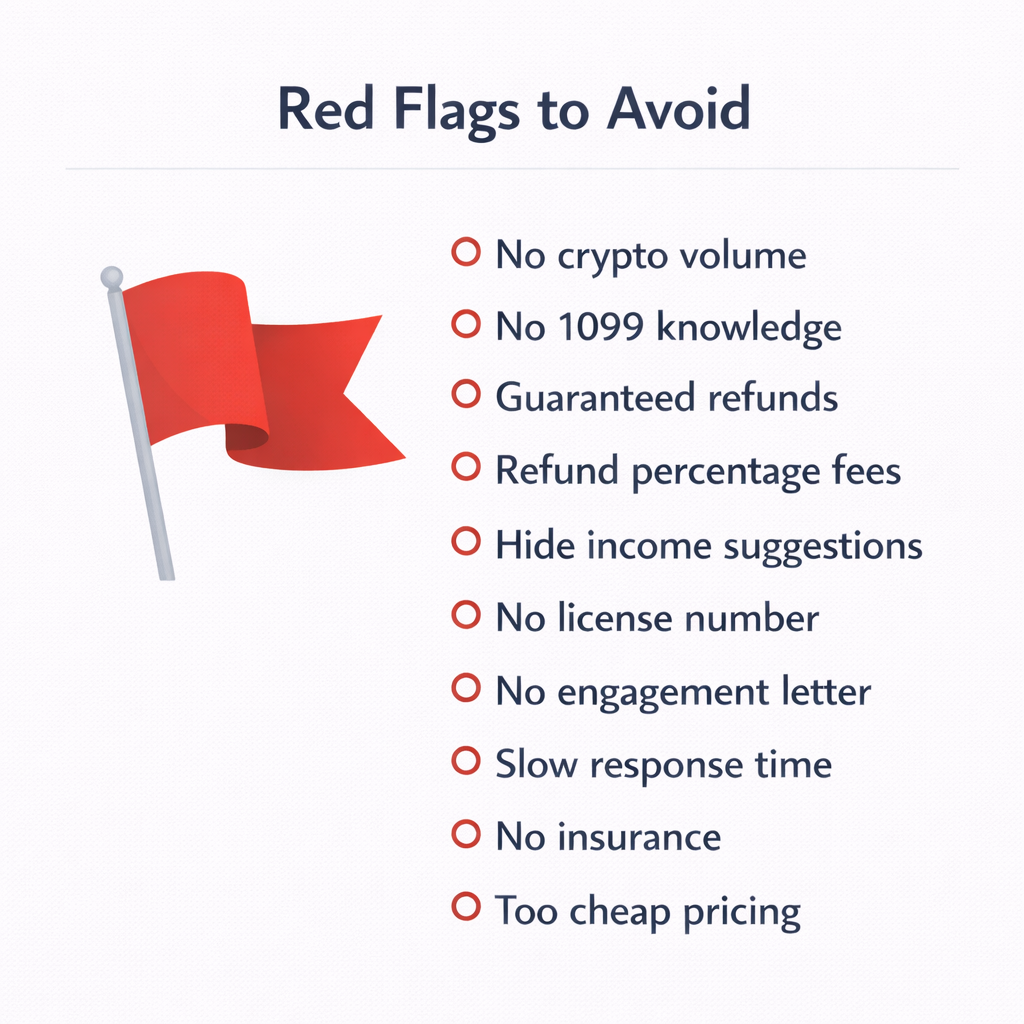
The warning signs to avoid;
1. No crypto-specific experience.
A general CPA who claims they can handle crypto is the most common mistake people make. Crypto taxation has unique rules constructive receipt for staking, disposal events for DeFi, collectible classification for NFTs that general tax training does not cover. Minimum requirement: 50 crypto returns filed.
2. Cannot explain Form 1099-DA.
This form is the central compliance change of 2025. If a supposed crypto tax professional does not know what it is, or says “we’ll deal with it when it comes,” they are not qualified for 2025 returns.
3. Guarantees a specific refund or tax reduction.
No accountant can guarantee a tax outcome. It depends on your facts. Anyone who promises a specific result is either lying or willing to fabricate figures to deliver it. This also violates professional standards CPAs and EAs are prohibited from guaranteeing outcomes.
4. Charges a percentage of your refund.
Fees based on a percentage of the refund or tax savings create an incentive to inflate deductions. This is listed by the IRS as a sign of an unscrupulous preparer and can result in the accountant losing their licence.
5. Suggests hiding income.
Any accountant who tells you that DEX transactions are invisible to the IRS, that you should not report crypto-to-crypto trades, or who makes vague comments about “managing” your numbers is encouraging you to commit tax fraud. You are the one who faces criminal liability not just the accountant.
6. Refuses to provide their licence number.
A legitimate professional gives you this without hesitation. Reluctance suggests a suspended, inactive, or nonexistent licence.
7. No written engagement agreement.
Professional CPAs provide engagement letters before starting work. Without one, you have no recourse if they make mistakes, no clarity on fees, and no defined scope of work.
8. Poor response time before you even hire them.
If it takes five or more days to respond to your initial inquiry, that reflects how they will respond when you have an IRS deadline.
9. No professional liability insurance
Without E&O insurance, a costly mistake leaves you with no practical recourse against the accountant.
10. Prices far below market
“$299 for any crypto return” when market rates start at $1,500 means either the accountant is not licensed, does not understand the complexity, or is operating a volume-based churn model with minimal review. Low-cost errors cost significantly more to fix.
11. Accepts your data without detailed questions.
A diligent accountant asks about every exchange, every wallet, every type of activity. If they just take your word for things and start filing, expect errors.
12. Claims a “crypto certification” that does not exist
There is no official “Certified Cryptocurrency Accountant” or similar designation as of 2025. Only CPA, EA, and Tax Attorney licences are real.
Also Read: Best Cryptos to Buy in 2026: A Beginner’s Honest Guide to the Top Coins
Case Study: The General CPA Disaster
A trader with 3,000 transactions across five exchanges hired a general CPA who had no crypto experience. The CPA treated all crypto-to-crypto swaps as non-taxable. The IRS found $65,000 in unreported gains.
Total damage: $15,000 in penalties, $5,200 in interest, and $4,000 to hire a specialist to amend the return. The original specialist would have cost around $4,500.
Case Study: The Guaranteed Refund
A client with significant mining income was promised a $12,000 refund. The accountant fabricated business expenses and inflated deductions to deliver that result.
IRS audit: $28,000 in disallowed deductions, $7,000 accuracy-related penalty, plus interest and attorney fees. The accountant faced fraud charges and lost their licence.
Case Study: The Disappearing Act
A client received an IRS CP2000 notice with a 30-day response deadline. Their accountant stopped returning calls after receiving payment. The deadline passed, the IRS assessment became final: $22,000 in liability plus a 20% accuracy penalty. A timely response could have reduced this to around $8,000.
Before you hire anyone, send an inquiry and time the response. Ask a substantive question and evaluate the quality of the answer. Test communication before you commit.
DIY vs. Professional: How to Decide
When DIY Software Is Enough
Software-only tax preparation works for genuinely simple situations:
- Fewer than 100 transactions total for the year
- A single centralised exchange (Coinbase, Kraken, Gemini)
- Only buy-and-hold activity no trading, no DeFi, no staking
- No crypto used to purchase goods or services
- No mining, airdrops, or NFTs
- US-based exchanges only (no FBAR requirement)
- Portfolio value below $50,000
- Comfortable using technology and willing to research IRS rules
If all of these apply, software at $49–$349 per year is a reasonable starting point.
The main software options:
- CoinLedger: $65–$299/year. Strong TurboTax integration. Best for beginners.
- Koinly: $49–$279/year. 700+ exchange integrations. Good for multi-exchange users.
- TokenTax: $65–$349/year. Best DeFi coverage. For advanced traders using the software tier.
- ZenLedger: $49–$349/year. Includes access to a CPA network for questions.
When Professional Help Is Not Optional
Hire a professional immediately if:
- You have received an IRS notice or are under audit
- You have over 5,000 transactions per year
- You use any DeFi protocols yield farming, liquidity provision, lending
- You create or sell NFTs above $50,000 per year
- You mine crypto as a business (Schedule C required)
- You earn staking rewards above $10,000 per year
- You use non-US exchanges such as Binance or KuCoin (FBAR required)
- You owe back taxes for years you have not filed
- You have multiple business entities involved in crypto activity
The Hybrid Approach
For moderate complexity situations, the hybrid model gives you professional oversight at roughly half the cost of full-service accounting:
- Use Koinly, CoinLedger, or TokenTax to import and classify transactions
- Generate a draft Form 8949 from the software
- Hire a CPA for a 2–3 hour review and sign-off ($600–$1,500)
- The CPA checks for classification errors, optimises cost basis method, and files
- You save approximately 50% compared to full-service preparation
This works best for organised, tech-comfortable traders with 1,000–5,000 transactions and moderate DeFi activity. It does not work well if your records are incomplete or your situation involves significant DeFi complexity.
The True Cost of DIY Mistakes
1. Missed tax-loss harvesting
A DIYer does not identify $15,000 in harvestable losses. Tax saved if caught: $3,600 at a 24% bracket. Professional cost: $3,000. Net loss from DIY: $600 plus audit risk.
2. Wrong cost basis method
Default FIFO used when HIFO would have reduced taxable gains by $8,000. Extra tax paid: $1,920. Professionals would have identified this.
3. DeFi misclassification
Liquidity pool entry treated as a non-taxable contribution. IRS position: disposal event triggering capital gains. Audit result: $45,000 in unreported gains, $15,000 in penalties, $3,600 in interest, $5,000 to fix. Total damage: $23,600.
The question is not whether you can afford a professional. It is whether you can afford an audit resulting from a DIY error.
State-Specific Considerations
Federal crypto tax rules are consistent across the US, but state rules vary significantly. Your accountant must know both.
This matters more than most people realise failing to file correctly with your state can create separate penalties on top of federal ones, and some states have rules specific to crypto that differ from the federal treatment.
1. California
State income tax runs from 1% to 13.3%, one of the highest in the US. The Franchise Tax Board is aggressive in its enforcement and has been increasing audit activity on crypto gains.
For high earners in California, state crypto tax liability alone can be substantial capital gains are taxed as ordinary income at your marginal rate. Factor in $200–$500 extra for California return complexity, and make sure your accountant has dealt with the FTB specifically, not just the IRS.
2. New York
State tax (4%–10.9%) plus New York City tax (3.078%–3.876% for city residents) creates a multi-layer obligation. BitLicense requirements also affect which exchanges can legally operate for NY residents, which creates reporting complications.
If you live in New York City, you are effectively filing three separate tax obligations federal, state, and city all of which need to reflect your crypto activity accurately. Budget $300–$700 extra for multi-jurisdiction filing, and confirm your accountant knows NYC residency allocation rules.
3. Texas
No state income tax on crypto gains. Federal obligations still apply in full, but there is no additional state layer to manage. For most Texas residents, the federal return is the primary concern, and a CPA with strong federal crypto expertise is sufficient without needing additional state specialisation.
4. Florida
No state income tax. Florida has positioned itself as crypto-friendly, and for tax purposes, it is genuinely simpler than CA or NY. Federal compliance remains the entire focus for most Florida residents.
5. Washington
No income tax but a capital gains tax of 7% on gains above $250,000 per year, which started in 2022. The distinction between “income tax” and “capital gains tax” matters for how your accountant classifies and files.
Not all CPAs recognise Washington’s capital gains tax as applying to crypto. Confirm your accountant understands Washington’s specific treatment and has filed returns for Washington residents before.
6. Illinois
State income tax is a flat 4.95% on all income including crypto gains. No preferential long-term capital gains rate unlike the federal system, Illinois taxes short and long-term gains at the same rate.
An accountant who assumes state treatment mirrors federal treatment will make errors on Illinois returns.
7. Colorado
Colorado follows federal treatment for most crypto activity, with a flat 4.4% state income tax. Relatively straightforward compared to CA or NY, but still requires accurate reporting of all the same federal categories.
Questions to ask your accountant about state taxes:
- Have you filed crypto returns for residents of my state?
- What is the additional cost for my state return?
- If I moved during the year, can you handle the apportionment?
- Are you familiar with my state’s specific crypto or capital gains rules?
Multi-state situations: If you moved states during the tax year, worked remotely while travelling, or have income sourced from multiple states, the complexity increases significantly.
Apportionment rules determine how income is allocated between states, and crypto complicates this further because the income does not have a physical location. A specialist in multi-state crypto taxation is worth seeking out in these cases.
The Top 10 Common Crypto Tax Mistakes That Trigger Audits
1. Not reporting crypto-to-crypto trades.
The most common and costly error. BTC to ETH is a taxable disposal of BTC and an acquisition of ETH at the current market value. Every swap creates a taxable event. Form 1099-DA will make these mismatches visible to the IRS.
2. Answering “No” to the crypto question on Form 1040.
Every US taxpayer must now answer whether they received, sold, or exchanged digital assets during the year. Answering “No” when you had any activity is perjury if intentional, and creates a clear audit trigger when exchange data does not match.
3. Ignoring Form 1099-DA mismatches.
Starting in 2025, your exchange reports gross proceeds to the IRS. If your return does not show matching sales activity, the IRS sees unreported income they do not know your cost basis, so they may assess the full proceeds as gains. Reconciling these forms is critical.
4. Not tracking wallet-to-wallet transfers.
Moving crypto between your own wallets is not a taxable event, but you must track the cost basis through each transfer. Without this, your basis becomes untraceable when you eventually sell.
5. Misclassifying DeFi transactions.
Entering a liquidity pool is a disposal of the tokens you contribute not a non-taxable “deposit.” Yield farming rewards are ordinary income when received, not when sold. These misclassifications are among the most expensive errors in crypto taxation.
6. Not reporting airdrops and hard fork tokens.
The IRS position is that these are income at fair market value upon receipt. “I did not ask for it” is not a defence.
7. Missing FBAR for international exchange accounts.
If your aggregate balance in foreign exchange accounts exceeded $10,000 at any point during the year, you must file FinCEN Form 114. The penalty for non-compliance starts at $10,000 per violation and is criminal for wilful failure.
8. Using the wrong cost basis method.
Default FIFO is not always the most tax-efficient choice. In 2025, there is a special window to adjust how you allocate cost basis across your wallets a one-time opportunity that expires at year end.
9. Not reporting staking rewards until you sell.
The IRS treats staking rewards as ordinary income when received (constructive receipt doctrine), not when you sell the tokens. The Jarrett v. United States case is challenging this, but the safe approach is to follow current IRS guidance.
10. Claiming unsupported deductions.
Miners claiming 100% business use of equipment also used personally, or home office deductions without qualifying use, are common audit triggers. All deductions need documentation.
What was the DeFi tax situation in 2025?
DeFi remains one of the most technically complex areas of crypto taxation and the one where DIY errors are most costly. The IRS treats liquidity pool entries as taxable disposals of the tokens you contribute.
Yield farming and liquidity mining rewards are ordinary income when received. Impermanent loss creates a complex gain and loss calculation when you exit a pool.
Flash loans require tracking the economic substance of the transaction. DAO governance tokens, wrapped tokens like WETH and WBTC, and lending protocol interactions each have their own treatment.
If you have any meaningful DeFi activity, you need a professional who can demonstrate specific DeFi experience not just general familiarity with the concept.
Conclusion
IRS enforcement of crypto taxes is more serious in 2025 than it has ever been. Form 1099-DA gives the agency direct transaction data from exchanges. Blockchain analytics tools trace DEX activity and wallet transfers. Warning letters increased by 758% in a 60-day period. The IRS collected $235 million in unpaid crypto taxes in 2024 alone.
The main takeaways from this article:
General CPAs without crypto experience create audit risk, not protection. Minimum standard: 50 crypto returns filed, with experience in your specific situation.
Verify every licence through the relevant state board or IRS directory. Ask the 15 questions in this guide before you sign anything. Get a written engagement agreement and confirm professional liability insurance.
Form 1099-DA reconciliation is the key test question for 2025. If an accountant cannot explain how they will reconcile your exchange-reported proceeds with your actual cost basis, they are not qualified for this year’s returns.
Cost ranges from $1,500 for simple situations to $30,000+ for complex ones. A professional often saves more in identified deductions and avoided penalties than their fee costs.
Recommended by situation:
- Complex portfolios, IRS audits, or legal exposure: Gordon Law Group
- Active traders with organised records: TokenTax VIP
- Incomplete records or multi-exchange forensics: Count on Sheep
- Blockchain businesses: Founder’s CPA
- Ongoing crypto business accounting: Acuity Accounting
If your situation is simple, use software and answer the Form 1040 crypto question honestly. If your situation is not simple, and most active crypto users’ situations are not, the cost of getting it wrong is higher than the cost of a qualified accountant.
Frequently Asked Questions
1. Do I need a crypto tax accountant?
You need one if you have over 1,000 transactions, any DeFi activity, NFT trading or creation, mining or staking income, international exchange accounts, back taxes from prior years, or an IRS notice.
For simple situations under 100 transactions, one exchange, buy-and-hold only software may work. But even then, a professional review costs less than fixing an error.
How much does a crypto tax accountant cost?
Hourly rates run $200–$800 depending on credentials and complexity. Flat fees range from $1,500 for under 500 transactions to $30,000+ for traders with 10,000–30,000 annual transactions.
DeFi, NFTs, mining, international holdings, and audit defence each add to the baseline cost. Use a fee calculator to estimate your specific situation before committing.
What is the difference between a CPA, EA, and tax attorney for crypto?
CPAs hold state accountancy licences and can handle the broadest range of accounting services. They typically charge $300–$800 per hour. EAs hold a federal IRS credential with unlimited representation rights before the IRS and typically charge $200–$400 per hour.
Tax attorneys bring legal protection including attorney-client privilege, which matters for criminal exposure.
All three can prepare crypto tax returns and represent you before the IRS. For most individual traders, a crypto-specialised EA offers strong coverage at lower cost than a CPA.
How do I verify an accountant’s crypto expertise?
Ask how many crypto returns they have filed (minimum 50), what percentage of their practice is crypto-focused (aim for 50%+), and ask specific technical questions about your situation DeFi classification, Form 1099-DA reconciliation, FBAR. Verify their licence through the relevant state board, IRS EA directory, or state bar association.
Can a crypto tax accountant help if I am already being audited?
Yes. CPAs, EAs, and Tax Attorneys all have unlimited representation rights before the IRS. If you are under audit, hire a specialist immediately.
An experienced crypto accountant can review the IRS’s position, respond to information requests, present documentation, and negotiate on your behalf. The earlier in the process you get professional help, the more options you have.
Do I need an accountant if I only bought and held crypto?
If you never sold, traded, or disposed of any crypto during the year, you do not have a taxable gain. However, you must still answer “Yes” to the digital asset question on Form 1040. Software or a straightforward self-prepared return may be sufficient for pure buy-and-hold.
What if I cannot afford a crypto tax accountant?
Consider the hybrid approach: use software for tracking and filing, then pay a CPA for a 2–3 hour review ($600–$1,500 total). For very simple situations, software alone at $49–$299 per year is an option. What you cannot afford is an audit from an incorrect DIY return penalties and interest make that far more expensive.
Should I use a local or remote crypto tax accountant?
The best crypto tax specialists work virtually with clients nationwide. Location matters less than credentials and experience. A well-qualified remote accountant in another state is a better choice than an under-qualified local firm.
How do crypto tax accountants handle Form 1099-DA?
They reconcile the gross proceeds figures reported by your exchange against your actual transaction records and cost basis. Discrepancies are common exchanges may report incorrect data, missing transactions, or figures that do not account for your cost basis.
Your accountant reviews each 1099-DA against your own records and resolves mismatches before filing.
Can an accountant help with past years I did not report?
Yes. This involves filing amended returns for prior years. For situations where you have significantly under-reported, some accountants also advise on voluntary disclosure programs, which can reduce penalties for taxpayers who come forward before the IRS contacts them.
Do crypto tax accountants handle international reporting?
Not all do. Ask specifically about FBAR (FinCEN 114) and FATCA (Form 8938) experience. If you use any non-US exchange, this is mandatory to ask. A specialist who does not handle international reporting is not the right fit if you have offshore holdings.
What records do I need to give my accountant?
Transaction export files (CSV format) from every exchange and platform you use, wallet addresses for any non-custodial wallets, records of any mining or staking activity, IRS correspondence if any, and prior year tax returns if you are amending or for context. The more organised your data, the lower your bill.
What happens if my accountant makes a mistake?
If they have E&O insurance, you have a path to recovery for losses caused by their error. Always confirm insurance coverage before you hire. If the error was their fault, they should correct it at no additional charge. Get the amendment process included in your engagement letter from the start.
Should I use the same accountant for my business taxes and crypto taxes?
Only if your existing accountant also has genuine crypto expertise. Do not assume a business accountant understands DeFi, NFT classification, or FBAR requirements. Ask the same questions you would ask any new crypto specialist.
Can I switch accountants mid-year?
Yes. You can change at any point. Request all your records from your current accountant before making the switch they are legally required to provide them. Give your new accountant your prior year return and all source data. If you are changing due to a dispute, document the issue in writing first.
How long does crypto tax preparation typically take?
A straightforward return with under 1,000 transactions from one or two exchanges usually takes two to four weeks from data submission to a reviewed draft.
Complex situations 5,000+ transactions, multiple exchanges, DeFi, or multiple back years can take six to twelve weeks. Start in January or February to avoid rush fees and give your accountant enough time to do the job properly.
What records should I keep and for how long?
Keep all exchange transaction history, wallet addresses, records of mining, staking, and airdrop income, IRS correspondence, and copies of filed returns for at least six years.
The IRS has three years from the filing date to audit a standard return, but this extends to six years if you underreported income by more than 25%. For FBAR violations the statute of limitations is also six years. When in doubt, keep records permanently.