Cryptocurrencies are making headlines and changing the finance market catching the interest of many to start trading. But for beginners, it can feel intimidating. Prices of popular cryptocurrencies can swing dramatically, making it challenging to trade without risk.
This is where stablecoins come in. Unlike typical cryptocurrencies, stablecoins are designed to maintain a steady value, often linked to traditional currencies like the US dollar or the euro. This stability makes them a practical and accessible option for anyone new to digital assets.
Stablecoins are more than just a safer way to invest. They can be used for everyday transactions, earning interest through digital finance platforms, sending money internationally, or even as a safe place to park funds during volatile market periods.
By bridging traditional finance with the digital space, they offer beginners a way to experience the benefits of cryptocurrencies while minimizing risk.
Key Takeaway
- Stablecoins can be used for trading, earning interest, making fast international payments, and protecting funds during market volatility.
- Consider factors like transparency, reserve audits, regulation, liquidity, and security before deciding which one to use.
- Hot wallets are convenient for daily use, while cold wallets provide maximum security for long term holdings.
- Even stablecoins carry risks such as de-pegging, centralization, regulatory changes, and smart contract vulnerabilities, so informed choices are important.
What Are Stablecoins?
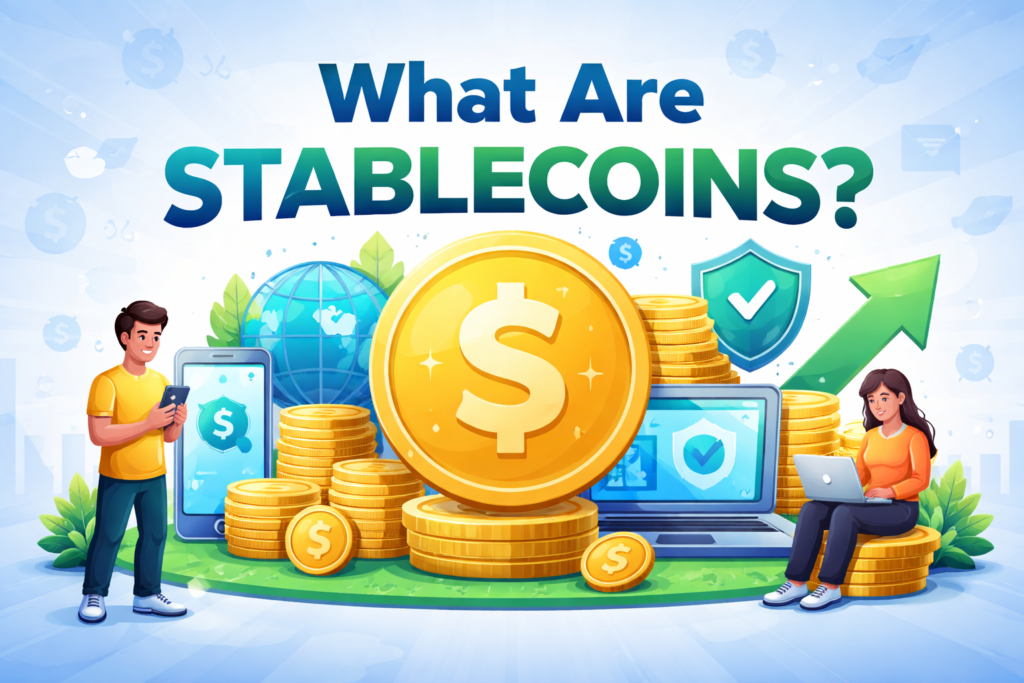
Stablecoins are cryptocurrencies designed to maintain a stable value by being linked (or pegged) to another asset, most commonly a fiat currency like the U.S. dollar.
Unlike cryptocurrencies such as Bitcoin or Ethereum, whose prices fluctuate constantly, stablecoins aim to keep their value close to $1 per coin or the equivalent value of another underlying asset.
For example, If a stablecoin is pegged to the U.S. dollar, 1 stablecoin ≈ $1. If it is pegged to the euro, 1 stablecoin ≈ €1. This stability makes them useful for everyday financial activities like payments, saving, and trading.
Why Stablecoins Are Pegged to Fiat Currencies
Stablecoins are pegged to fiat currencies because traditional money already provides a widely accepted measure of value.
By linking their price to established currencies like the U.S. dollar, stablecoins can avoid the extreme price swings that affect many cryptocurrencies. This peg is maintained through several mechanisms:
- Fiat-backed reserves: Issuers hold real dollars or cash equivalents in reserve for every stablecoin issued.
- Crypto collateral: Some stablecoins are backed by other cryptocurrencies locked in smart contracts.
- Algorithmic mechanisms: Supply and demand adjustments help maintain price stability.
The Role of Stablecoins in the Crypto Market
Stablecoins serve as a bridge between traditional finance and decentralized finance (DeFi). Because they maintain a predictable value, they are widely used across the crypto industry. Key roles stablecoins play include:
- Trading pairs on exchanges: Most cryptocurrency trades are executed against stablecoins.
- Liquidity in DeFi platforms: Lending, borrowing, and yield farming often rely on stablecoins.
- Global payments: Stablecoins enable fast cross-border transfers without banks.
- Store of value during volatility: Investors move funds into stablecoins during market downturns.
How Stablecoins Work
Stablecoins are designed to maintain a consistent value, usually equal to a traditional currency such as the U.S. dollar. Achieving this stability requires specific mechanisms that control supply, collateral, and market incentives.
Unlike volatile cryptocurrencies, stablecoins rely on structured systems that ensure their price remains close to the intended value. Understanding how these mechanisms work helps beginners evaluate which stablecoins are safer and more reliable.
The Peg Mechanism Explained
A stablecoin’s most important feature is its price peg. The peg ensures that the value of the coin stays close to the asset it represents. For most stablecoins, that asset is the U.S. dollar.
Maintaining this peg requires a combination of collateral backing, market incentives, and automated systems. When a stablecoin is pegged to the U.S. dollar, it means the issuer or protocol aims to keep the value of one coin equal to one dollar at all times.
For example, 1 stablecoin = approximately $1 and 100 stablecoins = approximately $100
This stability is achieved through different methods depending on the stablecoin model. Some issuers hold real reserves such as cash or government bonds, while others rely on cryptocurrency collateral locked in smart contracts.
The peg is not always perfectly exact, but in most cases the price fluctuates only slightly, often between $0.99 and $1.01. These minor variations are normal and typically corrected quickly through market forces.
Types of Stablecoins
Not all stablecoins maintain their value in the same way. Over time, several different models have emerged, each with its own advantages and risks. These models mainly differ in how they maintain the peg and what assets back them.
- FiatBacked Stablecoins
Fiat-backed stablecoins are the most common and beginner-friendly type of stablecoin. They are backed by traditional financial assets held in reserve by the issuing company.
- Crypto Collateralized Stablecoins
Crypto collateralized stablecoins maintain their value using cryptocurrencies as backing instead of fiat currency. In this system, users lock cryptocurrency into smart contracts as collateral in order to generate stablecoins.
- Algorithmic Stablecoins
Algorithmic stablecoins attempt to maintain their peg using automated supply adjustments rather than traditional collateral. Instead of relying heavily on reserves, these systems use algorithms that expand or contract the supply of tokens depending on market demand.
Also Read: Top 10 RWA Tokenization Companies for Investors and Institutions (2026)
Best Stablecoins for Beginners in 2026
| Stablecoin | Type | Market Cap | Backing | Audit Frequency | Regulatory Status | Risk Level | Best For |
| USDC (USD Coin) | Fiat backed | $75-80B | US Treasury bills (77%), cash in regulated banks (23%) | Monthly (Deloitte) | MiCA compliant, GENIUS Act compliant, EMI licensed in EU | Low | Beginners prioritizing safety, institutions, EU users |
| USDT (Tether) | Fiat backed | $185-190B | US Treasuries, cash deposits, loans, corporate bonds, precious metals | Quarterly (BDO attestations) | Regulatory scrutiny, not fully MiCA compliant | Medium | High liquidity trading, emerging markets, global transfers |
| DAI | Crypto backed (decentralized) | $5.3-5.4B | USDC, ETH, WBTC, other crypto and RWAs | On-chain transparency, smart contract audits | Decentralized governance (MakerDAO), not issuer regulated | Medium | DeFi users, decentralization advocates |
| USDe (Ethena USD) | Synthetic stablecoin | $12-13B | ETH collateral + derivative hedging positions | Smart contract audits | On-chain mechanism, regulatory status uncertain | High | Advanced DeFi users seeking yield |
| FDUSD (First Digital USD) | Fiat backed | $2.5-3B | Cash and cash equivalents in Hong Kong banks | Monthly attestations | Hong Kong Stablecoin Ordinance compliant | Medium | Asia-Pacific users, Binance traders |
| PYUSD (PayPal USD) | Fiat backed | $800M-1B | USD deposits, Treasury bills, cash equivalents | Monthly attestations | US regulated via Paxos | Low-Medium | PayPal ecosystem users, merchant payments |
| TUSD (TrueUSD) | Fiat backed | $400-500M | USD reserves held in escrow accounts | Real-time attestations | Regulatory compliance focused | Low-Medium | Users prioritizing transparency |
| EURC (Euro Coin) | Fiat backed (EUR) | $150-200M | Euro reserves in regulated banks | Monthly attestations (Circle) | MiCA compliant in EU | Low | European users, EUR exposure |
For beginners, understanding the leading stablecoins helps determine which ones are safest for storing funds, trading, or participating in decentralized finance.
While thousands of cryptocurrencies exist, only a handful of stablecoins dominate global liquidity and adoption. These stablecoins differ in transparency, regulatory compliance, reserve backing, and risk profile.
USDC (USD Coin)
USDC is widely regarded as one of the most transparent and regulated stablecoins in the crypto industry. It was launched in September 2018 by Circle in partnership with Coinbase through the Centre Consortium.
Since then, it has grown into one of the largest digital dollars used across exchanges, DeFi protocols, and global payments infrastructure. As of 2026, USDC maintains a market capitalization between $75 and $80 billion, with a daily trading volume typically ranging between $8 and $12 billion.
The token maintains a consistent price of $1.00, reflecting its strict one to one backing with U.S. dollar reserves. Unlike many stablecoins that operate in regulatory gray areas, USDC is known for its strong compliance and transparency standards.
USDC can be purchased or traded on virtually all major platforms, including Coinbase, Binance, Kraken, Uniswap, Raydium and Most global centralized exchanges.
Pros
- High transparency: Monthly reserve attestations conducted by Deloitte with detailed reporting.
- Strong regulatory compliance: MiCA compliant in the EU and aligned with U.S. stablecoin regulations.
- Institutional backing: Issued by Circle and supported by major financial institutions such as BlackRock.
- Fully backed reserves: Assets consist mainly of U.S. Treasury bills and cash.
Cons
- Centralized control: Circle can freeze or blacklist addresses when required by regulators.
- Less liquidity than USDT: While highly liquid, it still has lower global trading volume compared to Tether.
- Dependent on banking system: Relies on traditional financial institutions for reserves.
USDT (Tether)
USDT, commonly known as Tether, is the largest and most widely used stablecoin in the world. Launched in October 2014, it was the first stablecoin to gain widespread adoption and remains the dominant digital dollar across global crypto markets.
As of 2026, USDT holds a market capitalization of approximately $185 to $190 billion, making it the largest stablecoin by a significant margin. It also has the highest trading liquidity, with daily volumes frequently reaching $50–70 billion.
USDT operates across more than 15 blockchain networks, including Ethereum, Tron, Solana, Avalanche and BNB Chain.
Pros
- Largest stablecoin by market cap: Dominates global crypto liquidity.
- Highest trading volume: Used as the primary trading pair on most exchanges.
- Widely accepted: Supported by nearly every centralized and decentralized exchange.
- Strong adoption in emerging markets: Popular for cross-border transfers and remittances.
Cons
- Transparency concerns: Reserve disclosures are less frequent compared to competitors.
- Regulatory scrutiny: Faced legal challenges and compliance issues in several jurisdictions.
- Not fully MiCA compliant: Some European exchanges have reduced support.
DAI
DAI is one of the most important decentralized stablecoins in the crypto ecosystem. Unlike USDT or USDC, which are issued by centralized companies, DAI is governed by a decentralized autonomous organization known as MakerDAO.
Launched in December 2017, DAI introduced a new stablecoin model built entirely on blockchain smart contracts. Instead of relying on traditional bank reserves, DAI maintains its stability through a crypto collateralized system.
To generate DAI, users deposit cryptocurrency into smart contracts called Vaults. These deposits act as collateral for the stablecoins created. As of November 2025, DAI maintains a market capitalization of approximately $5.3 – 5.4 billion, with daily trading volumes around $150–250 million.
Pros
- Decentralized governance: Managed by MakerDAO rather than a central company.
- Fully transparent reserves: All collateral can be verified on-chain in real time.
- DeFi integration: Widely used across lending platforms, liquidity pools, and decentralized exchanges.
- Interest opportunities: Users can earn yield through the DAI Savings Rate (DSR).
Cons
- Over collateralization required: Requires more collateral than the value of DAI minted.
- Complex system: Harder for beginners to fully understand compared to fiat-backed stablecoins.
- Exposure to crypto volatility: Collateral value depends heavily on crypto market conditions.
USDE (Ethena USD)
USDe is one of the fastest-growing stablecoins introduced in recent years. Developed by Ethena Labs, it launched in February 2024 and quickly gained attention due to its distinctive design and yield generating potential.
Unlike traditional stablecoins backed by cash reserves, USDe operates as a synthetic dollar. Its stability is achieved through a delta hedging strategy, which combines Ethereum collateral with derivative positions that offset price movements.
By November 2025, USDe’s market capitalization had grown to $12–13 billion, with daily trading volumes between $400 and $600 million.
Pros
- Distinctive design: Uses delta-hedging to maintain a synthetic dollar without relying on banks.
- Yield generation: Staking USDe (sUSDe) can generate attractive APY returns.
- Rapid growth: One of the fastest-growing stablecoins in recent years.
- On chain transparency: Positions and collateral can be verified on the blockchain.
Cons
- Higher risk model: Relies on derivatives and funding rates for stability.
- Complex mechanism: May be difficult for beginners to understand.
- Relatively new: Lacks the long track record of older stablecoins.
FDUSD (First Digital USD)
First Digital USD (FDUSD) is a newer stablecoin that has gained traction primarily in the Asian crypto market.
Launched in June 2023 by First Digital Limited, a Hong Kong-based financial firm, FDUSD was designed to provide a regulated alternative to major stablecoins in the Asia-Pacific region.
By November 2025, FDUSD had reached a market capitalization between $2.5 and $3 billion, with daily trading volumes ranging from $1 to $2 billion. The stablecoin is backed by cash and cash-equivalent reserves held in Hong Kong financial institutions.
However, FDUSD experienced a major challenge in March 2025, when it briefly de-pegged to $0.76 amid solvency concerns. The peg was later restored, but the event raised questions about its risk profile.
Pros
- Strong exchange integration: Widely used on Binance trading pairs.
- Regulatory compliance in Hong Kong: Aligned with new regional stablecoin regulations.
- Fiat-backed reserves: Backed by cash and cash equivalents.
- Growing adoption in Asia: Increasing popularity in Asia-Pacific markets.
Cons
- Past de pegging event: Temporarily fell to $0.76 in March 2025.
- Limited ecosystem: Less integrated with DeFi compared to USDC or DAI.
- Regional adoption: Primarily used in Asian markets.
PYUSD (PayPal USD)
PayPal USD (PYUSD) is a stablecoin introduced in August 2023 by PayPal, one of the largest global digital payment companies. The token is issued by Paxos Trust Company, a regulated blockchain infrastructure provider based in the United States.
PYUSD is fully backed by U.S. dollar deposits, short-term Treasury bills, and cash equivalents. The stablecoin currently operates on Ethereum and Solana, allowing integration with both traditional fintech applications and decentralized finance platforms.
Pros
- Strong corporate backing: Supported by PayPal and issued by Paxos.
- Easy integration: Available directly in PayPal and Venmo apps.
- Regulated reserves: Backed by U.S. dollar deposits and Treasury bills.
- Payment use cases: Designed for everyday payments and digital commerce.
Cons
- Lower adoption: Market cap is still relatively small.
- Limited DeFi presence: Not widely used in decentralized finance.
- Centralized control: Transactions can be restricted by the issuer.
TUSD (TrueUSD)
TrueUSD is one of the earliest regulated stablecoins in the crypto market. Launched in 2018, it focuses heavily on transparency and reserve verification.
TUSD maintains full backing with U.S. dollar reserves held in escrow accounts. One distinguishing feature is its real time attestation system, which allows users to verify reserve balances frequently.
The stablecoin operates across several major blockchains, including Ethereum, Tron, Avalanche, and BNB Chain. With a market capitalization around $400–500 million, TUSD is significantly smaller than major competitors but remains popular among users who prioritize audit transparency.
Pros
- Frequent reserve attestations: Focus on transparency and verification.
- Fully backed by fiat reserves: Held in escrow accounts.
- Multi-chain support: Available across several blockchains.
- Regulatory focus: Structured with compliance in mind
Cons
- Lower liquidity: Not as widely traded as USDT or USDC.
- Smaller market cap: Limits usage in some trading environments.
- Reduced adoption in DeFi: Less integrated compared to major stablecoins.
EURC (Euro Coin)
EURC is a euro-denominated stablecoin issued by Circle, the same company behind USDC. It was launched in June 2022 to provide a digital euro alternative within the crypto ecosystem.
Like USDC, EURC is backed by fully reserved fiat assets and operates under strict regulatory standards. It has also achieved MiCA compliance in the European Union, making it one of the few legally compliant euro stablecoins.
EURC operates across several blockchains including Ethereum, Solana, and Avalanche. Its market capitalization remains relatively small at $150–200 million, but adoption is growing among European crypto users.
Pros
- Euro pegged stablecoin: Useful for users wanting exposure to EUR instead of USD.
- Issued by Circle: Same transparency standards as USDC.
- MiCA compliant: Legally recognized in the European Union.
- Growing European adoption: Increasing use among EU crypto users.
Cons
- Smaller market size: Much lower liquidity than dollar stablecoins.
- Limited exchange support: Not available everywhere.
- Niche demand: Mostly used by European traders.
Factors Beginners Should Consider Before Choosing a Stablecoin

Stablecoins may appear simple because they are designed to maintain a stable price, usually around $1.
However, not all stablecoins offer the same level of security, transparency, or reliability. For beginners entering the cryptocurrency market, choosing the right stablecoin requires evaluating several key factors.
Transparency and Reserve Audits
One of the most important factors to evaluate when choosing a stablecoin is transparency. Since stablecoins claim to maintain a fixed value, users need confidence that the token is actually backed by the assets it claims to hold.
Without transparency, it becomes difficult to verify whether the issuer has enough reserves to support all tokens in circulation.
Regulation and Compliance
Regulation is becoming an increasingly important factor in the stablecoin industry. Governments and financial regulators around the world are developing frameworks to ensure stablecoins operate safely and do not pose risks to the broader financial system.
Stablecoins that comply with regulatory standards often provide greater security for users because they must follow strict financial reporting and operational requirements.
Liquidity and Exchange Availability
Liquidity refers to how easily a stablecoin can be bought, sold, or exchanged without significantly affecting its price.
High liquidity is essential for stablecoins because it ensures that users can quickly convert their holdings into other assets when needed. Stablecoins with strong liquidity tend to be more reliable because they are actively traded across multiple platforms.
Blockchain Compatibility
Stablecoins operate on blockchain networks, and their compatibility with multiple chains can significantly influence their usability. Different blockchains offer varying transaction speeds, fees, and ecosystem integrations. Stablecoins that support multiple networks provide greater flexibility for users.
Security and Smart Contract Risk
Security is another critical factor when evaluating stablecoins. Because stablecoins exist on blockchain networks, they are exposed to both technical and operational risks. Beginners should prioritize stablecoins with well audited smart contracts and long operational track records. Strong security practices help ensure that the stablecoin ecosystem remains resilient even during periods of market stress.
Stablecoin Risks Beginners Should Know
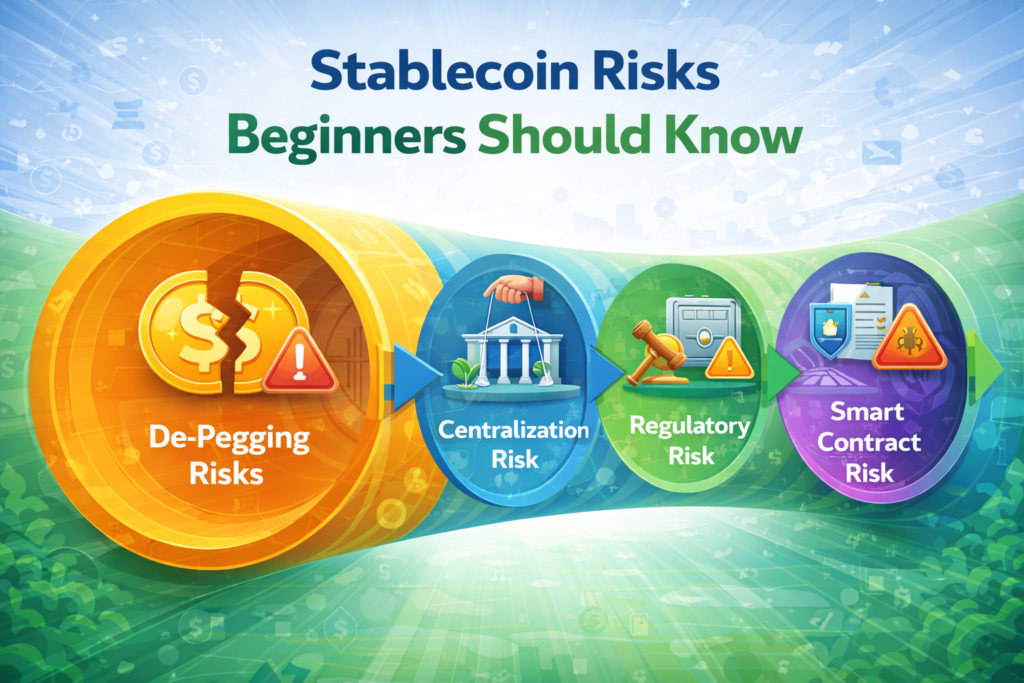
Although stablecoins are designed to maintain a stable value, they are not completely risk free. Several potential risks can affect their stability, security, or long term availability.
De Pegging Risks
The most fundamental risk associated with stablecoins is the possibility of losing their price peg. When a stablecoin deviates significantly from its target value, it is known as a de-pegging event.
Several factors can cause a stablecoin to lose its peg. One common reason is a loss of confidence in the reserves backing the token. If users believe that the issuer does not hold enough assets to support the stablecoin supply, they may rush to sell or redeem their tokens.
Market panic can also trigger de-pegging. During periods of extreme volatility, large numbers of users may attempt to exit a stablecoin simultaneously, placing pressure on liquidity and redemption systems.
Technical failures, flawed algorithms, or insufficient collateral can also lead to instability, particularly for algorithmic or synthetic stablecoins.
Centralization Risk
Many stablecoins are issued by centralized organizations that maintain control over the tokens and their underlying reserves. While this structure can provide regulatory oversight and financial backing, it also introduces certain risks.
Centralized stablecoin issuers often have the ability to freeze or blacklist specific wallet addresses. This capability is typically used to comply with regulatory requirements or to prevent illicit financial activity.
However, the ability to freeze funds also means that users do not have full control over their assets. In rare cases, accounts may be restricted due to regulatory investigations or compliance concerns.
Regulatory Risk
As stablecoins grow in importance within the global financial system, governments are paying closer attention to their regulation. New laws and compliance requirements could impact how stablecoins operate or where they can be used.
Financial authorities around the world are developing rules that govern stablecoin issuance, reserve management, and consumer protection. These regulations aim to reduce financial risk while ensuring that stablecoin issuers maintain adequate backing for their tokens.
While regulation can improve stability and transparency, it may also limit the availability of certain stablecoins in specific jurisdictions.
Smart Contract Risk
Decentralized stablecoins rely on smart contracts to manage collateral, mint tokens, and maintain system stability. Although these automated systems reduce reliance on centralized institutions, they introduce technical risks.
Smart contracts are pieces of code, and like any software, they can contain bugs or design flaws. If vulnerabilities exist within the code, attackers may attempt to exploit them to manipulate the system or steal funds. Even well designed protocols can experience unexpected issues under extreme market conditions.
Where to Buy Stablecoins
Stablecoins are widely available across many crypto platforms, making them one of the easiest digital assets for beginners to purchase. You can buy them through cryptocurrency exchanges, payment platforms, and peer-to-peer marketplaces depending on your location, payment method, and level of experience.
Cryptocurrency Exchanges
Cryptocurrency exchanges are the most common place to buy stablecoins. These platforms allow users to convert fiat currency (such as USD, EUR, or local currencies) into stablecoins or trade other cryptocurrencies for them. These exchanges are grouped into centralized and Decentralized Exchanges.
Centralized exchanges (CEXs) act as intermediaries between buyers and sellers and provide the easiest onboarding process for beginners. Examples include Coinbase, Binance, Kraken, and OKX.
Decentralized exchanges (DEXs) allow users to trade cryptocurrencies directly from their wallets without a centralized intermediary. Popular platforms include Uniswap, PancakeSwap, and Curve Finance.
Payment Platforms
Some fintech platforms now allow users to buy, hold, and transfer stablecoins directly within their apps, simplifying access for beginners. Payment companies such as PayPal and Revolut have introduced cryptocurrency support.
Many crypto wallets now include built-in fiat on-ramps, allowing users to buy stablecoins directly inside the wallet. Examples include MetaMask, Trust Wallet, and Coinbase Wallet.
Peer-to-Peer Platforms
Peer-to-peer (P2P) platforms allow individuals to buy and sell stablecoins directly with other users. These marketplaces are especially popular in regions with limited access to banking services or crypto exchanges. Major P2P marketplaces include Binance P2P and Paxful.
Best Wallets for Holding Stablecoins
After purchasing stablecoins, storing them securely is essential. Crypto wallets allow users to manage their private keys and control their digital assets. Wallets are generally divided into hot wallets (connected to the internet) and cold wallets (offline storage).
Hot Wallets
Hot wallets are software-based cryptocurrency wallets connected to the internet, making them highly accessible and convenient for managing stablecoins.
They are ideal for beginners who want to buy, store, and use their stablecoins for trading, payments, or interacting with decentralized finance (DeFi) applications.
Unlike cold wallets, which prioritize security by keeping private keys offline, hot wallets focus on ease of use, instant access, and integration with various crypto services.
Mobile wallets are the most common form of hot wallets, allowing users to store, send, and receive stablecoins directly from their smartphones. Popular mobile wallets include MetaMask, Trust Wallet, and Coinbase Wallet.
Cold Wallet
Cold wallets, also known as offline wallets, are the most secure method for storing cryptocurrencies, including stablecoins. Unlike hot wallets, which are connected to the internet, cold wallets keep private keys offline, making them significantly less vulnerable to hacks, phishing attacks, and malware.
For beginners who plan to hold stablecoins for long-term purposes, cold wallets provide a level of security that cannot be matched by software-based solutions.
The most common type of cold wallet is the hardware wallet, which is a physical device designed specifically for storing private keys and signing transactions. Popular hardware wallets include devices such as the Ledger Nano X and the Trezor Model T.
Also Read: 10 Signs an Airdrop Is a Scam and How To Avoid Them
Conclusion
Stablecoins are one of the easiest and most practical ways for beginners to trade cryptocurrency. They offer the stability of traditional currencies while allowing users to take advantage of the speed, flexibility, and opportunities of the crypto ecosystem.
Whether used for trading, earning interest, making international payments, or protecting funds during market volatility, stablecoins provide a reliable bridge between traditional finance and digital assets.
Before choosing a stablecoin, beginners should carefully consider factors like transparency, reserve audits, regulatory compliance, liquidity, blockchain compatibility, and security. These elements help ensure that the stablecoin is trustworthy, widely accessible, and safe to use.
Choosing the right wallet is also essential. Hot wallets offer convenience and instant access for trading and DeFi participation, while cold wallets provide the highest level of security for long-term storage.
FAQs
What is a stablecoin and how is it different from other cryptocurrencies?
A stablecoin is a type of cryptocurrency designed to maintain a stable value, usually pegged to a fiat currency like the US dollar or euro. Unlike volatile cryptocurrencies such as Bitcoin or Ethereum, stablecoins are less prone to large price swings, making them ideal for trading, savings, and payments.
Are stablecoins safe for beginners to use?
Stablecoins are generally safer than other cryptocurrencies because of their price stability. However, safety depends on factors like transparency, reserve audits, regulatory compliance, and the type of stablecoin (fiat-backed, crypto-backed, or algorithmic). Beginners should choose reputable stablecoins with strong reserve transparency and regulatory oversight.
How can I buy stablecoins as a beginner?
Stablecoins can be purchased on centralized exchanges like Coinbase, Binance, and Kraken, on decentralized exchanges like Uniswap or Curve, through fintech apps like PayPal, or via peer-to-peer marketplaces. Beginners should start with platforms that are easy to use, well regulated, and widely supported.
What is the difference between hot and cold wallets for stablecoins?
Hot wallets are connected to the internet and offer convenience for trading, payments, and DeFi activities, but are more vulnerable to cyberattacks. Cold wallets, such as hardware wallets, store stablecoins offline, providing the highest level of security for long-term storage but less convenience for frequent transactions.
Can stablecoins lose their value?
Yes, stablecoins can lose their peg, which is called a de-pegging event. This can happen due to insufficient reserves, market panic, or technical failures in algorithmic stablecoins. Choosing stablecoins with transparent reserves and strong backing reduces this risk.
What are the main uses of stablecoins for beginners?
Stablecoins can be used for cryptocurrency trading, earning interest through CeFi or DeFi platforms, making fast and low-cost cross-border payments, and protecting funds during periods of high market volatility. They provide a safe, flexible, and beginner friendly entry point into the cryptocurrency ecosystem.