



A fintech founder spent eight months building a payment app on the wrong blockchain. Fees were too high, speeds too slow, and users left.
He rebuilt it on Polygon in six weeks. The second version processed its first $1 million in transactions within a month.
The stack was never the hard part — knowing how to build a crypto payment app correctly was.
What Is a Crypto Payment App?
A crypto payment app is software that enables users to send and receive cryptocurrency as a form of payment.
In simple terms, it acts as a bridge between blockchain networks and real-world transactions.
Depending on how it is designed, it can serve different purposes. It could allow a merchant to accept Bitcoin at checkout, enable a freelancer to receive payments in USDT from international clients, or allow two businesses to settle cross-border invoices without using a traditional bank.
At its core, the app connects to a blockchain network, manages wallet addresses, and processes incoming and outgoing transactions.
Most crypto payment apps also convert crypto values into local fiat currencies, so users can easily understand how much they are paying or receiving in real terms.
Types of Crypto Payment Apps
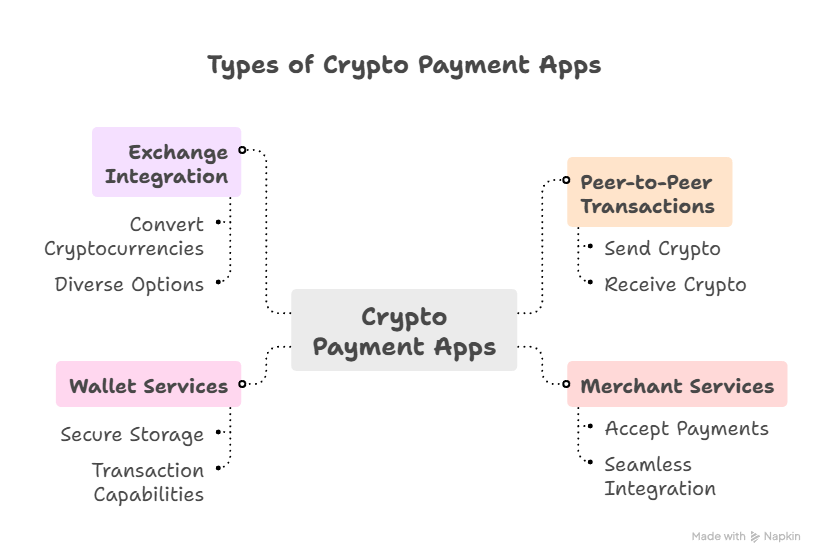
Here are some types of crypto payment apps you should know about before building one:
1. Merchant-Facing Payment Apps
These are designed for businesses that want to accept crypto payments from customers at checkout. They usually focus on payment processing, invoicing, and instant confirmation.
A well-known example is BTCPay Server, which allows merchants to accept Bitcoin payments without intermediaries.
These apps are commonly used by online stores, service providers, and physical retailers experimenting with crypto payments.
2. Consumer Wallet and Payment Apps
These apps combine a personal crypto wallet with payment functionality, allowing users to store assets and spend them directly from the same interface.
They are more user-centric and often feel like traditional fintech apps.
For example, Trust Wallet allows users to store multiple cryptocurrencies and interact with decentralised apps, while UPay integrates wallet features with real-world payment capabilities, making it easier for everyday transactions.
3. B2B Cross-Border Payment Apps
These apps are built for businesses that need to send and receive payments across borders.
They focus on speed, low transaction costs, stablecoin support, and reducing the friction that usually comes with traditional banking systems.
For example, a company in the United States can pay a supplier in Nigeria using USDT or USDC, with settlement taking minutes rather than several business days.
Examples of platforms in this category include tools like RippleNet, which enables financial institutions to move money globally using blockchain infrastructure.
These apps prioritise compliance, auditability, and enterprise-level security because they often deal with larger transaction volumes and regulated business clients.
Read Also: How USDT Payments Work?
How to Build a Crypto Payment App: Step-by-Step Process
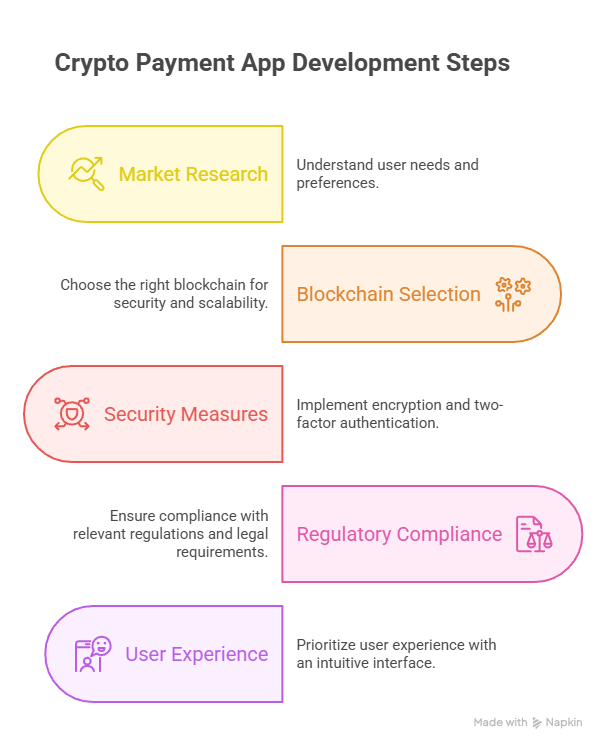
Step 1: Define Your Use Case and Target Users
Before writing a single line of code, you need to define exactly what your crypto payment app is solving and who it is being built for.
This step is where many projects fail. Developers often jump into building features without identifying the payment problem the app is meant to solve.
A crypto payment app designed for global freelancers will look very different from one built for merchants, online gaming platforms, or cross-border remittances.
At this stage, ask questions such as, ‘Will users send crypto directly to one another?
Will businesses accept crypto payments through your platform?
Will your app support fiat deposits and withdrawals? Which countries or regions are you building for?’ Your answers will then shape every technical and business decision moving forward.
Step 2: Choose Your Blockchain Network
The blockchain network you choose will determine transaction speed, scalability, fees, and overall user experience.
If you are researching how to build a crypto payment app for high-volume payments, choosing the wrong blockchain can create serious performance issues later.
Users will quickly abandon platforms with slow settlement times or expensive gas fees.
Different blockchains serve different purposes. For example, Ethereum remains one of the most widely adopted ecosystems because of its strong developer infrastructure and smart contract capabilities.
However, transaction fees can still become expensive during periods of congestion.
Polygon is often used for payment applications because it offers lower fees and faster transaction speeds while remaining compatible with Ethereum tools.
Solana is another popular option for payment-focused apps because of its high throughput and low transaction costs.
Some payment apps also integrate Tron because of its dominance in stablecoin transfers, particularly USDT payments in emerging markets.
When deciding on a blockchain, focus on things such as transaction speed, network fees, and security features. The right blockchain should align with your payment goals, not just industry hype.
Step 3: Pick Your Tech Stack
Your technology stack forms the foundation of your crypto payment app, so choosing scalable tools from the start is critical.
For frontend development, many crypto payment apps use React or Next.js because they support fast, responsive interfaces and integrate well with Web3 technologies.
Mobile applications are often built with Flutter or React Native to support both iOS and Android simultaneously.
On the backend, developers frequently use Node.js, Python, or Go to manage APIs, authentication systems, payment processing, and blockchain interactions.
Databases such as PostgreSQL or MongoDB are commonly used to handle user information, transaction records, and wallet activity securely.
If your app relies on smart contracts, tools like Solidity, Hardhat, and Foundry are widely used within Ethereum-compatible ecosystems.
Essentially, cloud infrastructure, API performance, and server security become just as important as blockchain functionality.
Step 4: Integrate a Crypto Payment API
Crypto payment APIs simplify blockchain interactions and reduce development complexity significantly.
Instead of building every payment function from scratch, developers can integrate APIs that handle wallet transactions, blockchain monitoring, payment requests, and settlement systems.
Popular crypto payment APIs help developers process transactions, generate wallet addresses, track blockchain confirmations, convert currencies, and support merchant payments.
Payment APIs essentially help automate the transaction flow while reducing operational overhead.
This step is especially important for startups trying to reduce development time without compromising functionality.
However, API selection should not be based on convenience alone.
Developers also need to evaluate reliability, security standards, scalability, documentation quality, and compliance support before integrating third-party payment infrastructure.
Step 5: Build and Connect the Wallet
Wallet integration is one of the most important stages in building a crypto payment app because it directly affects how users interact with digital assets.
Your app should make wallet functionality feel effortless, even for users with little or no blockchain experience.
Depending on your model, you may choose custodial wallets, non-custodial wallets, and hybrid wallet systems
Custodial wallets allow platforms to simplify onboarding because users do not need to manage private keys themselves.
Non-custodial wallets provide greater ownership and decentralization but require stronger user education around recovery phrases and security practices.
Your wallet system should support secure wallet creation, multi-currency asset storage, QR code payments, wallet address generation, and transaction history.
The goal is to make crypto payments feel as intuitive as traditional digital banking apps.
Step 6: Add Security Layers
Security is one of the biggest factors that determines whether users trust your crypto payment app. Crypto platforms are constant targets for phishing attacks, account takeovers, wallet exploits, and API abuse.
Without a strong security architecture, even a well-designed app can become vulnerable quickly.
Between 2020 and the end of 2023, nearly 100,000 people in the U.K. fell victim to investment scams, totalling £2.6 billion (approximately $3.3 billion) or about £13 million ($16.5 million) every week.
Your app should include multiple layers of protection, including two-factor authentication (2FA), end-to-end encryption, device verification, withdrawal confirmation systems, anti-phishing protection, and much more.
People are far more likely to trust payment apps that communicate security clearly and make protection feel easy rather than restrictive.
If you want to understand how to build a crypto payment app that lasts long-term, security cannot be treated as an afterthought. It must be integrated into every stage of development.
Step 7: Test, Then Launch
Before launching your crypto payment app publicly, extensive testing is essential.
Blockchain applications operate in high-risk environments where even small technical issues can lead to failed payments, lost funds, or security vulnerabilities.
Thorough testing helps identify weaknesses before users encounter them.
Your testing phase should include functional testing, smart contract audits, and security penetration testing.
It should also include payment flow testing, wallet recovery testing, cross-device compatibility testing, among others.
Testing helps reduce these risks before launch. Once the platform is stable, you can move into deployment, user onboarding, and gradual scaling.
Read Also: How to integrate crypto payments into a website.
Compliance and Legal Considerations
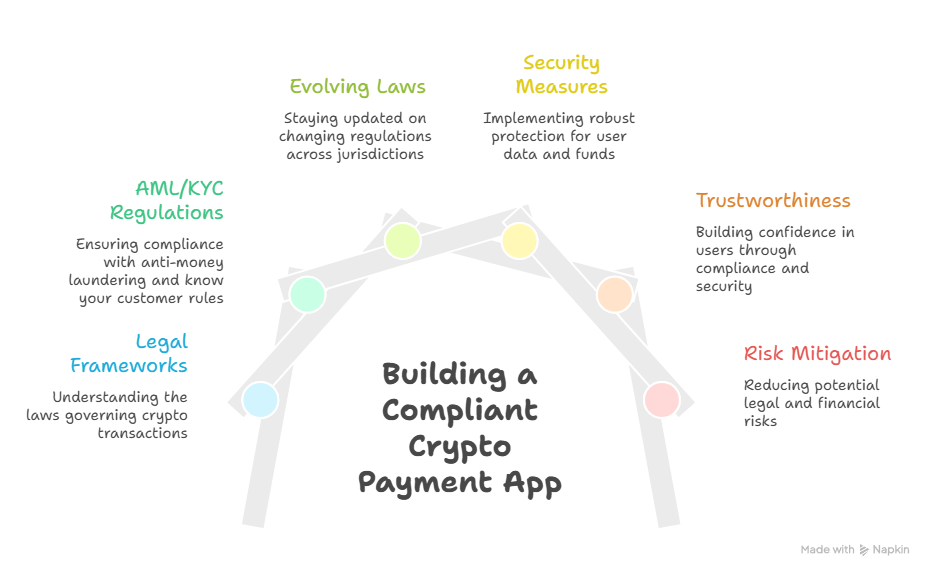
Compliance is a core part of building any crypto payment app, and it should be considered from the earliest stage of development.
Most jurisdictions require some form of KYC (Know Your Customer) and AML (Anti-Money Laundering) compliance, which are designed to prevent fraud, identity misuse, and illicit financial flows.
In practice, KYC involves verifying user identities through documents such as government-issued IDs, proof of address, and sometimes biometric checks, while AML focuses on monitoring transactions for suspicious patterns and flagging or reporting unusual activity.
In the United States, crypto payment platforms are often classified as Money Service Businesses (MSBs), which means they must register with FinCEN and comply with strict AML reporting obligations.
Depending on the specific state, additional money transmitter licenses may also be required, which can significantly affect how quickly a product can scale across different regions.
In the European Union, regulation is becoming more standardised under the MiCA framework (Markets in Crypto-Assets Regulation).
This regulation introduces clearer licensing rules, operational requirements, and consumer protection standards for crypto service providers.
In the United Kingdom, oversight is handled by the Financial Conduct Authority (FCA), and crypto businesses are expected to meet AML registration requirements while also complying with stricter marketing and consumer protection guidelines.
However, it is essential that, in light of a new regulatory framework and major transformation of the crypto-assets sector, Europe is adequately protected from the risks of money laundering and terrorist financing stemming from this sector.
Bruna Szego, Chair of AMLA.
Across several African markets, crypto regulation is not uniform, and this makes compliance both flexible and complex at the same time.
As a result, many crypto payment startups adopt a cautious approach, designing systems that can adapt to different legal requirements depending on where users are based.
Ultimately, the strongest approach is to build compliance into the product from day one rather than treating it as an afterthought.
It is much easier to integrate identity verification, transaction monitoring, and reporting systems early than to retrofit them later as the product scales.
Many successful crypto payment apps also work with regulated exchanges or payment processors to simplify licensing and reduce regulatory friction across regions.
Frequently Asked Questions
Do crypto payment apps need KYC and AML compliance?
Yes. Crypto payment apps often need KYC and AML compliance to meet financial regulations, prevent fraud, and operate legally in different jurisdictions.
Is security important when building a crypto payment app?
Yes. Security is essential when building a crypto payment app because crypto platforms are frequent targets for hacking, phishing attacks, and fraud attempts.
Conclusion
Knowing how to build a crypto payment app goes beyond writing code. It requires a clear understanding of user needs, blockchain infrastructure, and regulatory compliance.
The popular and strongest apps are not just functional; they are also secure and scalable.