




In 2024, global tax authorities collected an estimated $38 billion from cryptocurrency taxes in the United States alone, a 45% increase from 2023. With the OECD’s Crypto Asset Reporting Framework (CARF) set for worldwide implementation in 2026, enabling automatic tax information exchange between 58 countries, the era of “crypto tax havens” as anonymous refugees is coming to an end.
Yet, paradoxically, 15–20 jurisdictions still offer completely legal pathways to zero or minimal crypto taxation in 2025, but only for investors who understand how to properly establish tax residency and comply with the new global reporting requirements.
Cryptocurrency investors now face a complex dilemma: pay potentially 37–55% tax on gains in high tax countries like the U.S., Japan, or Denmark, or navigate the complexity of the international tax law, residency rules, and regulatory frameworks to legally optimize their tax burden.
Attempting to “hide” crypto in offshore accounts without proper residency can lead to severe penalties, particularly with CARF’s full implementation. The right approach, however, can be highly rewarding.
By establishing legitimate tax residency in a crypto-friendly jurisdiction, investors can save hundreds of thousands or even millions in taxes, all while remaining fully compliant with global reporting rules.
Key takeaway
- Some countries charge high taxes on crypto gains, while others legally offer little or no tax.
- Where you officially live and pay taxes determines how your crypto profits are taxed.
- To benefit from crypto tax-free countries, you must legally establish residency and follow local rules.
- With frameworks like CARF, crypto transactions are becoming more transparent between countries.
- Choosing the right country and understanding tax rules can help investors legally reduce their crypto tax burden.
What Does “Crypto Tax Free” Really Mean?
When people hear the phrase “crypto tax-free,” they often assume it means zero tax on anything related to cryptocurrency. In reality, the term is more specific and sometimes more limited than it sounds.
A country described as crypto tax-free may exempt certain types of crypto profits, such as long-term capital gains, while still taxing other activities like staking, mining, or business trading. The key is understanding what kind of activity is being taxed, and under what conditions.
Definitions and Tax Terminology
Before evaluating any “tax-free” jurisdiction, it’s important to understand the core tax concepts governments apply to cryptocurrency.
Capital Gains Tax
Capital gains tax applies when you sell an asset for more than you originally paid for it. In the crypto context, this usually means selling Bitcoin, Ethereum, or another digital asset at a profit.
For example, if you purchase Bitcoin at $20,000 and later sell it at $35,000, the $15,000 profit is considered a capital gain. Many countries tax that gain. However, some crypto-friendly jurisdictions either reduce this rate significantly or eliminate it entirely for individuals.
Income Tax
Income tax, on the other hand, applies when crypto is treated as earned income rather than investment profit. This commonly includes:
- Mining rewards
- Staking rewards
- Getting paid in crypto for services
- Certain airdrops or token incentives
Even in countries with zero capital gains tax, income tax may still apply to these activities. That distinction is critical.
Also Read: Stablecoin Regulation in 2026: Global Laws, Benefits, and Challenges
How Crypto Taxation Works Globally
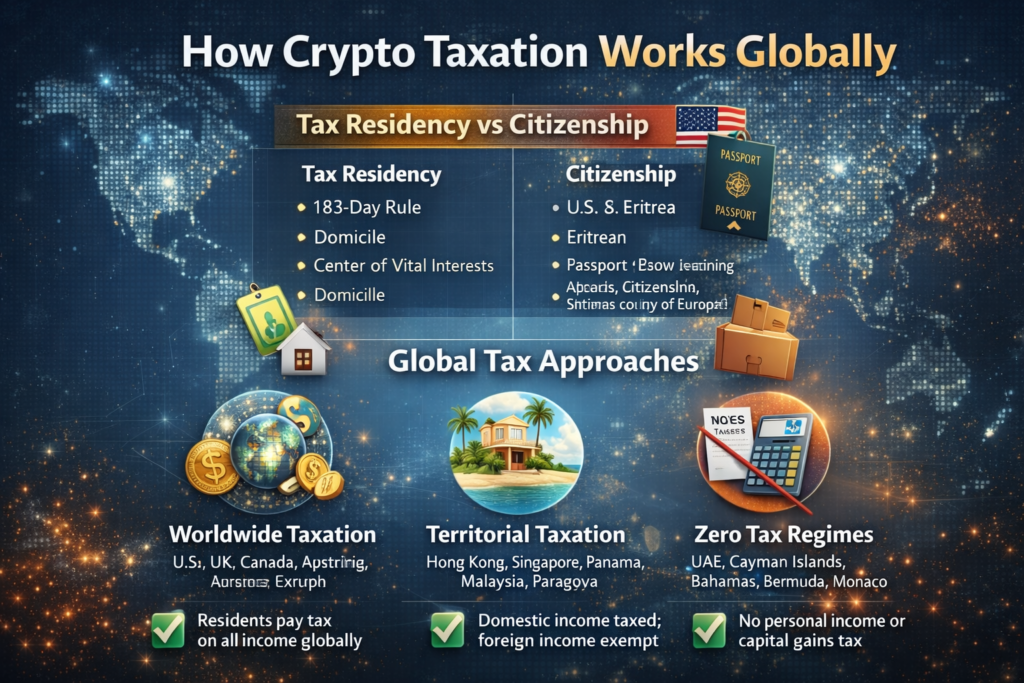
Crypto taxation varies from country to country, but the system behind it follows predictable international tax principles. The most important concept to understand is this: where you pay tax is determined by tax residency, not where your exchange account is located.
Tax Residency vs. Citizenship (Critical Distinction)
Tax residency determines where you are legally obligated to pay taxes. It is usually based on factual connections to a country, not just your passport. Most governments determine tax residency using factors such as:
- The 183-Day Rule
If you spend 183 days or more in a country during a year, you are typically considered a tax resident there.
- Domicile
This refers to your permanent home, where you have long-term living arrangements, property, family, or business ties.
- Center of Vital Interests
If you have connections to multiple countries, authorities may examine where your strongest economic and social ties exist.
Citizenship
Citizenship is your legal nationality. Most countries do not tax citizens who live abroad. However, there are two major exceptions: the United States and Eritrea
These countries tax citizens regardless of where they live. For example, a U.S. citizen living in Thailand may still owe U.S. tax on global crypto gains.
Physical Presence
Where you actually spend your time may differ from where you are officially registered. In many cases, physical presence overrides paperwork.
Three Global Tax Approaches
Countries generally follow one of three major tax systems.
Worldwide Taxation (Residence-Based)
Under this system, tax residents are taxed on all income globally, regardless of where it was earned. Common examples include:
- United States
- United Kingdom
- Australia
- Canada
- Most European countries
If you are a tax resident in one of these countries, your crypto gains are taxable even if:
- You use a foreign exchange
- Your crypto is stored in a foreign wallet
- The transaction happens outside the country
Example:
A U.S. citizen living in Thailand still owes U.S. tax on crypto gains because the U.S. taxes worldwide income.
Territorial Taxation
Under a territorial system, only domestic source income is taxed. Foreign-source income is generally exempt. Countries commonly using territorial systems include: Hong Kong, Panama, Singapore, Malaysia, Georgia and Paraguay. For crypto investors, this system can be particularly attractive.
Example:
A Hong Kong tax resident earns crypto gains from foreign exchange. If those gains are classified as foreign-sourced income, they may not be taxed in Hong Kong.
This creates planning opportunities because cryptocurrency often does not have a clearly defined geographic “source.” Unlike rental income or salary tied to a physical location, crypto transactions occur on decentralized networks.
Zero Tax Regimes
Some countries impose no personal income tax and no capital gains tax at all. Examples include: United Arab Emirates, Cayman Islands, Bermuda, Bahamas, Monaco, and Vanuatu
In these jurisdictions, individuals generally pay no tax on crypto gains because there is no personal income or capital gains tax system in place. However, residency requirements still apply. You typically must qualify as a tax resident to benefit from the zero-tax regime.
Taxable Events in Crypto
Even in tax-friendly countries, certain transactions usually trigger taxation. The core principle is simple: if you dispose of crypto or receive it as compensation, it may trigger tax. Some of the transactions that trigger taxes in most countries are:
- Selling crypto for fiat currency (USD, EUR, etc.)
- Trading one cryptocurrency for another (e.g., BTC to ETH)
- Spending crypto to purchase goods or services
- Receiving crypto as payment for work
- Mining cryptocurrency (taxed as income when received)
- Staking rewards (taxed as income at receipt in many jurisdictions)
- Hard forks that create new tokens (treatment varies)
- Airdrops of new tokens (often taxed as income)
Transactions Generally Not Taxable
The distinction between realized and unrealized gains is important. Most countries only tax gains once they are realized through a disposal event. Certain activities typically do not trigger immediate tax:
- Buying crypto with fiat (this only establishes your cost basis)
- Transferring crypto between your own wallets
- Holding crypto (unrealized gains are usually not taxed)
- Gifting crypto (though gift tax rules may apply in some countries)
Example Calculation
Let’s look at a simple scenario:
- January 2024: You buy 1 BTC for $40,000.
- December 2024: You trade 1 BTC for 20 ETH when Bitcoin’s market value is $50,000.
Even though no fiat was involved, a taxable event occurred because you disposed of BTC.
- Your gain is calculated as: $50,000 (market value at trade) − $40,000 (original cost basis) = $10,000 taxable gain
- Your new cost basis for the 20 ETH becomes $50,000 total, or $2,500 per ETH.
If you later sell ETH, future gains or losses will be calculated from that new cost basis.
Also Read: Best AI Trading Apps in 2026: Top Picks for Crypto and Stock Traders
Top 10 Crypto Tax-Free Countries
| Country | Tax Status | Residency Requirements | Pros | Cons | Cost Analysis (Est. First Year) | 2025 Updates | Best For |
| United Arab Emirates (UAE) | 0% personal income tax; 0% capital gains tax; 9% corporate tax above AED 375k; 5% VAT | Golden Visa via $545k real estate (10 yrs) or $204k property (2 yrs); employment visa; entrepreneur visa; tax residency usually requires 183 days | Zero tax on crypto trading and staking; strong regulation via VARA and ADGM; global crypto hub; strong banking and infrastructure | High cost of living; extreme summer heat; 5% VAT on spending; real estate investment required for long visas | $35k–$80k depending on housing and visa type | VARA Rulebook 2.0 in 2025 tightened market conduct standards and licensing | Full-time crypto traders and Web3 entrepreneurs |
| Cayman Islands | 0% income tax; 0% capital gains tax; 0% corporate tax; no sales tax | Residency via investment ~ $2.9M real estate plus proof of ~$183k annual income; residency certificate programs available | Complete tax freedom; strong offshore finance system; USD-pegged stable currency; popular crypto fund jurisdiction | Extremely expensive living; high import duties, expensive property, and limited job opportunities | $120k–$250k depending on property and lifestyle | Virtual Asset Service Providers Act fully operational licensing regime in 2025 | Crypto hedge funds and high-net-worth investors |
| Bermuda | 0% capital gains tax; 0% income tax for individuals; payroll tax exists for employers | Residency via Work From Bermuda visa, employment, or investment residency programs | Crypto-friendly government; strong digital asset regulation; English-speaking financial hub; stable political system | High living costs; limited housing; small economy; hurricanes risk | $90k–$160k annually | Digital Asset Business Act strengthened licensing oversight in 2025 | Crypto founders and fintech startups |
| El Salvador | 0% capital gains tax on Bitcoin; 0% tax for foreign investors on BTC profits; territorial tax system | Residency via investment or employment; Bitcoin investor residency programs available | Bitcoin-friendly laws; supportive crypto government; low living costs; growing crypto tourism | Economy still developing; limited infrastructure in some areas; volatility tied to BTC adoption | $25k–$50k depending on lifestyle | Continued Bitcoin City development and crypto investment incentives in 2025 | Bitcoin investors and early adopters |
| Singapore | No capital gains tax; crypto taxed only if trading considered business income | Tax residency through employment visa, entrepreneur visa, or permanent residency pathways | Top global financial center; strong regulatory clarity; world-class infrastructure; no tax on long-term crypto gains | High cost of living; strict financial compliance; trading classified as business may be taxed | $70k–$150k annually | MAS expanded digital asset licensing oversight in 2025 | Long-term crypto investors and fintech companies |
| Germany | 0% tax on crypto gains held longer than 12 months; short-term gains taxed up to ~45% | Tax residency usually triggered by 183-day rule or permanent residence | Completely tax-free long-term crypto gains; strong legal system; EU access; large crypto market | High taxes on short-term trades; strict reporting; relatively high living costs | $40k–$80k annually | Clarified staking holding period rules and reporting guidance in 2025 | Long-term crypto holders (HODLers) |
| Portugal | Crypto capital gains tax 0% for holdings over 365 days; short-term trades taxed 28% | Residency via D7 visa, digital nomad visa, or Golden Visa options | Mild climate and high quality of life; favorable tax on long-term holdings; strong expat community; affordable compared to Western Europe | New taxes introduced on short-term crypto trades; property prices rising; bureaucracy slow | $35k–$70k annually | Crypto tax reform clarified long-term holding exemption in 2025 | Digital nomads and long-term crypto investors |
| Switzerland | Private crypto gains generally tax-free; professional traders taxed; wealth tax may apply | Residency through employment, self-employment, or investment programs; some cantons offer tax deals | Crypto Valley in Zug; strong banking system; clear crypto regulations; political stability | High cost of living; wealth taxes; professional trader rules strict | $90k–$180k annually | Crypto Valley expansion and clearer DeFi compliance guidance in 2025 | Institutional investors and blockchain startups |
| Malta | No tax on long-term crypto holdings; trading treated as business income if frequent | Residency through Global Residence Program or employment | Known as “Blockchain Island”; EU membership; supportive crypto regulation; moderate taxes for residents | Regulatory scrutiny increased; banking access sometimes difficult; compliance heavy | $45k–$90k annually | Refinements to digital asset licensing under MFSA in 2025 | Crypto companies operating in Europe |
| Hong Kong | Territorial tax system; foreign-sourced crypto profits generally tax-free | Tax residency through employment visa, entrepreneur visa, or investment | Global financial hub; no tax on foreign crypto income; strong regulatory clarity; access to Asian markets | Very high housing costs; strict licensing requirements; geopolitical uncertainty | $70k–$150k annually | 2025 expansion of retail crypto licensing and ETF approvals | Professional traders and crypto exchanges targeting Asia |
Looking for the best countries to legally minimize or eliminate crypto taxes? We’ve analyzed the most attractive jurisdictions worldwide, focusing on tax rates, residency options, and crypto-friendly regulations.
United Arab Emirates (Dubai & Abu Dhabi)
Best for: Active crypto traders, founders building crypto startups, and high net worth investors seeking a modern tax-free hub.
The United Arab Emirates has become one of the most attractive destinations for crypto investors seeking a fully tax-free environment. Individuals pay 0% personal income tax and 0% capital gains tax, meaning profits from trading, staking, mining, or holding cryptocurrency are not taxed.
The country introduced a 9% corporate tax on profits above AED 375,000 ($102K) in 2023, but many crypto businesses operating in qualifying free zones still benefit from a 0% corporate tax rate. A 5% VAT applies to general goods and services.
Residency is relatively accessible through several pathways. The most popular is the Golden Visa, which can be obtained with a real estate investment.
Pros:
- 0% personal income tax and 0% capital gains tax on all crypto activity.
- Strong regulatory clarity through Dubai’s VARA and Abu Dhabi’s ADGM frameworks.
- A thriving crypto ecosystem with exchanges, startups, and international investors.
- World-class infrastructure, including high-speed internet, modern airports, and reliable banking.
- Tax residency certificates are available, which help with international reporting obligations.
Cons:
- High cost of living, particularly in Dubai and Abu Dhabi.
- 5% VAT on goods and services, which can add up for residents.
- Extreme summer temperatures reaching 40–50°C (104–122°F).
- Real estate investment required for long-term Golden Visa routes.
Cayman Islands
Best for: Ultra-high-net-worth investors, crypto fund managers, and institutional digital asset firms seeking a stable offshore jurisdiction.
The Cayman Islands is widely regarded as one of the world’s most established offshore financial centers and offers complete tax neutrality for individuals. Residents pay 0% income tax, 0% capital gains tax, and 0% corporate tax. There are also no inheritance, estate, or wealth taxes, making it highly attractive for wealth preservation.
The jurisdiction strengthened its crypto framework through the Virtual Asset (Service Providers) Act, which became fully operational in April 2025. The Cayman Islands Monetary Authority (CIMA) oversees crypto exchanges, custodians, and digital asset businesses, aligning the country with international regulatory standards.
Pros:
- Complete tax freedom: 0% personal income tax, 0% capital gains tax, and 0% corporate tax.
- Well-established offshore financial center with strong English common law protections.
- Stable currency pegged to the US dollar, providing financial predictability.
- Strong privacy and asset protection frameworks for individuals and businesses.
Cons:
- Extremely high cost of living, among the highest in the Caribbean.
- Very expensive real estate needed to qualify for residency.
- Limited job opportunities for foreigners outside financial or crypto sectors.
Bermuda
Best for: Crypto entrepreneurs and hedge fund managers seeking a regulated offshore base.
Bermuda is one of the most crypto-forward offshore jurisdictions with 0% personal income tax and 0% capital gains tax. There is also no corporate income tax for most entities, though businesses pay payroll taxes and licensing fees.
Bermuda regulates digital assets through the Digital Asset Business Act (DABA), which provides licensing for exchanges, custodians, and token issuers.
Residency is possible through the Economic Investment Certificate, requiring a minimum investment of $2.5 million in real estate or local businesses. The certificate allows residency and can lead to permanent status after five years.
Pros
- Zero personal income and capital gains tax
- Clear crypto regulatory framework under DABA
- Politically stable financial jurisdiction
- Strong reputation in global finance
Cons
- Extremely high cost of living
- Limited employment opportunities for foreigners
- Small domestic market
- Geographic isolation
El Salvador
Best for: Bitcoin maximalists and early adopters who want to live in a Bitcoin-friendly country.
El Salvador made global headlines in 2021 by becoming the first country to adopt Bitcoin as legal tender, though it removed that legal-tender status in 2025 and made Bitcoin acceptance voluntary. The country still offers 0% capital gains tax on Bitcoin transactions and favorable policies for digital asset companies. Personal income tax still exists, but Bitcoin gains are largely exempt under current policy.
Residency is available through the Freedom Visa Program, requiring a $1 million investment in Bitcoin or USDT. Standard residency options also exist through employment or business formation.
Pros
- Bitcoin gains exempt from capital gains tax
- Pro-crypto government and regulatory support
- Growing Bitcoin infrastructure
- Lower cost of living compared with most tax havens
Cons
- Developing economy with infrastructure gaps
- Regulatory clarity still evolving for non-Bitcoin assets
- Political and economic volatility concerns
- Limited international banking access
Singapore
Best for: Professional investors and crypto entrepreneurs who want a stable Asian financial center.
Singapore does not tax long-term capital gains, meaning individual crypto investors typically pay 0% tax on investment gains. However, frequent trading or crypto business activities may be taxed as income under standard income tax rules.
Residency options include employment visas, entrepreneur passes, or investment through the Global Investor Programme. Singapore is known for its strong regulatory environment through the Monetary Authority of Singapore (MAS) and a thriving fintech ecosystem.
Pros
- No capital gains tax for long-term investors
- Highly stable financial system
- Strong fintech and crypto ecosystem
- World-class infrastructure
Cons
- Very high living costs
- Strict regulatory oversight for crypto companies
- Residency requirements can be demanding
- Active traders may face taxation
Germany
Best for: Long-term crypto investors who prefer regulatory certainty within the EU.
Germany offers one of the most favorable crypto tax rules in Europe. Individuals pay 0% capital gains tax if cryptocurrency is held for more than one year. Short term sales within one year may be taxed as income.
Residency is straightforward for EU citizens and possible for non-EU nationals through employment or freelance visas.
Pros
- Zero tax on crypto held longer than one year
- Strong legal protections and economic stability
- Clear regulatory framework
- Access to the EU market
Cons
- High income tax rates
- Complex bureaucracy
- High living costs in major cities
- Short-term trading is taxable
Portugal
Best for: Long-term investors seeking a European lifestyle.
Portugal gained popularity as a crypto tax haven because individuals historically paid 0% capital gains tax on crypto. However, new rules introduced in 2023 tax gains from assets held less than one year, while long-term holdings remain tax-free. Residency options include the D7 visa for passive income earners or the Golden Visa investment program.
Portugal offers excellent lifestyle benefits, moderate living costs, and a growing crypto community. However, tax advantages have been reduced in recent years, and frequent traders may still face taxation.
Pros
- Favorable tax treatment for long-term crypto holdings
- Moderate cost of living
- Attractive lifestyle and climate
- Growing crypto and tech community
Cons
- Tax rules tightened recently
- Active traders may face taxation
- Bureaucracy in residency processes
- Rising housing costs in Lisbon
Switzerland
Best for: High-net-worth investors and blockchain founders.
Switzerland treats cryptocurrency as an asset. Private investors typically pay 0% capital gains tax, but wealth tax may apply based on total holdings. Residency requires employment, business formation, or significant financial resources.
Switzerland offers exceptional political stability, strong financial institutions, and a thriving blockchain ecosystem centered in Crypto Valley (Zug). The main drawbacks are high living costs and strict financial compliance requirements.
Pros
- Zero capital gains tax for private investors
- Highly stable financial system
- Home of “Crypto Valley” in Zug
- Strong banking and legal protections
Cons
- Extremely high living costs
- Wealth tax may apply to holdings
- Strict compliance requirements
- Residency difficult without strong finances
Malta
Best for: Crypto startups seeking EU regulatory access.
Malta has positioned itself as a “Blockchain Island.” Long-term crypto investments by individuals may be exempt from capital gains tax, while trading activity may be treated as business income. Residency programs include investment visas and residency by property purchase.
Malta offers EU membership, a crypto-friendly legal framework, and English as an official language. However, regulatory changes have tightened licensing requirements.
Pros
- Crypto-friendly regulatory environment
- English widely spoken
- EU membership benefits
- Growing blockchain ecosystem
Cons
- Regulatory changes increased compliance costs
- Small domestic economy
- Limited banking options for crypto firms
- Rising property prices
Hong Kong
Best for: Professional traders operating in Asian markets.
Hong Kong follows a territorial tax system, meaning only locally sourced income is taxed. Individual crypto investment gains are typically not taxed if they are considered capital gains rather than business income.
Residency can be obtained through employment visas, entrepreneur visas, or investment. Hong Kong offers a strong financial ecosystem and proximity to Asian markets. However, regulatory oversight for exchanges has tightened significantly.
Pros
- Territorial tax system benefits foreign income
- Major global financial hub
- Strong fintech ecosystem
- Access to Asian markets
Cons
- Extremely expensive housing
- Tightened crypto regulations for exchanges
- Political uncertainties
- Complex licensing requirements
How to Determine Crypto Taxes in Tax Free Countries as an Investor
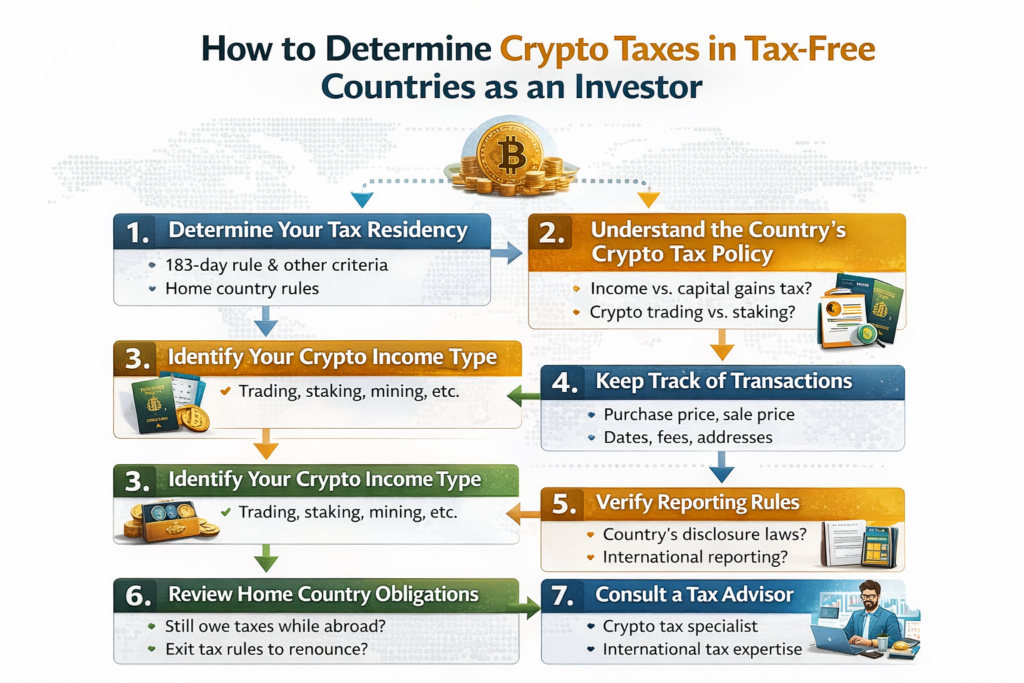
Understanding how your crypto activities are taxed can make the difference between keeping your gains or losing a significant portion to taxes.
Your strategy should reflect your investor type, the jurisdiction you operate from, and the specific crypto activity you engage in. Below is a detailed guide for various investor profiles.
HODLers (Long-Term Investors)
Long-term investors who hold crypto for extended periods rather than trading frequently benefit most from jurisdictions that offer exemptions or reductions on capital gains.
Ideal Countries:
- Germany: Capital gains from crypto held for over 12 months are completely tax-free.
- Portugal: Long-term gains (held >1 year) are tax-exempt since 2023.
- Switzerland: Private investors do not pay capital gains tax.
- Belgium: Generally, private investors are exempt from capital gains tax.
Strategies:
- Establish residency before selling to benefit from local tax advantages.
- Time sales after the required holding period, particularly in Germany where a 12-month holding is mandatory.
- Use market downturns to relocate; lower asset valuations reduce the effective exit tax for U.S. citizens.
Active Traders / Day Traders
Frequent traders face different challenges. Many countries that favor long-term holding tax-free gains will classify daily or professional trading as business income.
Ideal Countries:
- UAE: Zero tax regardless of trading frequency.
- Singapore: No capital gains tax for personal trading, even daily.
- Cayman Islands: Complete tax freedom for all trading activity.
- Malta: May face income tax if classified as a “professional trader” (up to 35%), requiring careful structuring.
Strategies:
- Opt for jurisdictions with pure zero-tax policies, such as the UAE or the Cayman Islands.
- Maintain documentation to demonstrate personal investment rather than professional trading.
- Consider offshore corporate structures for trading in Malta or Switzerland to benefit from corporate tax rates.
DeFi Users (Yield Farming, Liquidity Providing)
Decentralized finance (DeFi) introduces additional tax complexities due to the nature of liquidity pools, yield farming, and LP token trades.
Ideal Countries:
- UAE: No tax on any DeFi activity.
- Singapore: Generally tax-free if considered a personal investment.
- Germany: Gains from LP tokens held >12 months are tax-free, though rewards may be taxed as income.
- Portugal: DeFi taxation is uncertain; professional advice is recommended.
Strategies
Avoid:
- High-tax countries with complex reporting requirements for DeFi (U.S., UK, Australia) and jurisdictions demanding detailed transaction-level reporting.
Miners
Mining is typically taxed as income at the fair market value when rewards are received, and in many jurisdictions, subsequent capital gains apply when the mined crypto is sold.
Ideal Countries:
- UAE: Zero income tax on mining rewards and zero capital gains.
- Belarus: Mining has been tax-exempt under its High-Tech Park regime, though this exemption has been subject to expiry and review.
- Georgia: Offers cheap hydropower (~$0.04/kWh) and 0% individual tax; corporate tax 15% for LLCs.
- Kazakhstan: Mining allowed, but electricity is taxed between 1–24 tenge/kWh.
- El Salvador: Renewable energy initiatives support tax exemptions for tech innovation.
Strategies
- Choose jurisdictions with zero or minimal tax on mining rewards (e.g., UAE, Georgia).
- Factor in electricity costs; cheap hydropower regions like Georgia maximize profitability.
- Consider timing and future regulations, especially in countries like Belarus where exemptions may expire.
- For corporate setups, evaluate LLC or corporate structures to reduce potential tax liability.
Stakers
Staking rewards are commonly taxed as income at the point of receipt.
Ideal Countries
- Germany: Staking rewards are taxed as income when received, but the staked coins become tax-free to sell after a 12-month holding period.
- UAE: Zero tax on staking rewards.
- Singapore: Tax-free if considered personal investment.
- Portugal: Tax treatment is unclear but potentially favorable.
- U.S.: Taxed as ordinary income when received; capital gains tax applies upon sale.
Strategies
- Operate in zero-tax or favorable countries (UAE, Singapore) to avoid income tax at receipt.
- Avoid jurisdictions that tax staking rewards heavily at the point of receipt.
- Track all staking rewards carefully to demonstrate personal investment status if questioned.
- For high-volume staking, consider professional advice to optimize tax treatment and ensure compliance.
NFT Creators
NFT taxation varies depending on whether the activity is personal or business.
Ideal Countries:
- UAE: Zero tax on all NFT activities.
- Singapore: Generally tax-free for personal investment.
- Portugal: NFTs are not classified as crypto-assets; treatment is favorable.
- U.S.: Some opportunities exist via installment sales and QBI deductions if business activity applies.
Strategies
- Focus on jurisdictions with zero tax on NFT activities (e.g., UAE, Singapore).
- Maintain clear records of minting and sales, distinguishing between personal hobby and business activity.
- Plan for royalty income reporting; structure NFT sales to benefit from favorable tax regimes if possible.
- Explore installment sales or QBI deductions in the U.S. if classified as business for additional savings.
Common Mistakes & Tax Traps When Relocating for Crypto Tax Efficiency

Relocating to a crypto friendly country can unlock significant tax advantages but only if done correctly. Many investors fall into avoidable traps that lead to unexpected liabilities, reporting obligations, or outright penalties.
Below, we break down the most common mistakes and the proper approach to avoid them.
Moving Without Establishing Proper Tax Residency
Some investors assume that simply buying crypto on a foreign exchange or temporarily moving abroad is enough to avoid taxes in their home country. Under the Common Reporting Standard (CARF), your crypto activity is still visible to your home country.
Why It Fails:
Tax residency is determined not just by where you physically buy or hold crypto, but by the 183-day rule, domicile, and “center of vital interests.” If you maintain significant ties to your home country, such as bank accounts, property, or family, the authorities may claim you never truly left.
Proper Approach:
- Live in your new country for 183+ days per year.
- Sever ties with your home country: close bank accounts, cancel leases, and move family if possible.
- Obtain a Tax Residency Certificate from your new country.
- Document everything: lease agreements, utility bills, travel receipts, and even social media posts showing your life abroad.
US Citizens Assuming Foreign Residency Eliminates Tax
Many US citizens relocate to zero-tax countries like the UAE, Singapore, or Portugal, believing they are free from US taxation. In reality, the US taxes its citizens on worldwide income, regardless of residence. Simply moving abroad does not eliminate federal tax obligations.
Proper Approach:
- Understand the Foreign Earned Income Exclusion (FEIE), which is around $132,900 for 2026, but note it applies only to earned income, not crypto gains.
- Consider Puerto Rico Act 60, offering 0% on crypto gains purchased after establishing residency, or 4% for new decree holders from April 2025.
- Renouncing citizenship is another option, but it may trigger an exit tax if net worth exceeds $2M.
- File IRS returns annually, no matter where you live.
Ignoring Exit Tax in High-Tax Countries
Investors accumulate large crypto gains in the US, UK, or France, then relocate and immediately sell, assuming they avoid prior tax obligations.
Why It Fails:
- US: Exit tax applies if net worth >$2M or average annual tax >$201K, marking crypto to market as if sold.
- UK: Temporary non-residence rules may still tax certain gains within 5 years.
- France: Unrealized gains >€800K for shares (crypto treatment uncertain but risky).
Proper Approach:
- Research exit tax rules before relocating.
- Time relocation during bear markets to reduce taxable valuations.
- For US citizens, Puerto Rico residency can avoid exit tax.
- Engage a CPA specializing in expatriation.
Not Documenting Cost Basis Before Moving
Relocating without records of crypto purchase prices and dates can create serious tax liabilities.
Why It fails
- New countries may not recognize prior cost bases.
- You could be taxed on full sale value instead of gains.
- The burden of proof rests on the taxpayer.
Proper Approach:
- Download full transaction histories from all exchanges.
- Use crypto tax software like Koinly or TokenTax for detailed reporting.
- Carry these records when establishing residency.
- Consider selling and immediately rebuying crypto to reset the cost basis (consult your tax advisor first).
Assuming “Tax-Free” Means “No Reporting”
Investors often believe that relocating to a tax-free country removes all reporting obligations. In reality CARF requires exchanges to report activity to your tax residency country.
- US citizens must still file FBAR for accounts >$10K, Form 8938 for assets >$200K, and Schedule B for interest/dividends.
- Failure to report can incur penalties even if no tax is owed.
Proper Approach:
- Understand reporting requirements separately from taxation.
- File all required forms, even if no tax is due.
- Update tax residency with exchanges to ensure proper CARF reporting.
- Keep records to prove compliance.
Conclusion
Relocating to a crypto-friendly country can unlock incredible tax benefits, but it requires careful planning and attention to detail. From establishing proper tax residency to documenting your crypto cost basis, every step matters.
Mistakes like assuming “tax-free” means no reporting, ignoring exit taxes, or forgetting state obligations can cost you dearly. The key is to plan ahead, stay informed, and work with trusted professionals. Choose the right country for your investor type, follow the relocation steps diligently, and maintain thorough documentation.
When done correctly, you can enjoy the benefits of tax efficiency while remaining fully compliant with global regulations. Ultimately, the goal is simple: maximize your crypto gains, protect your assets, and build a secure financial future, without unnecessary surprises.
FAQs
What are crypto tax-free countries?
Crypto tax-free countries are places where individuals can legally pay little or no tax on cryptocurrency profits, depending on the country’s tax laws and residency rules.
Can I avoid crypto taxes just by opening an account on a foreign exchange?
No. Taxes are usually based on where you live and pay taxes, not where your crypto exchange is located.
Do I have to move to another country to benefit from crypto tax-free laws?
In most cases, yes. You usually need to establish tax residency in that country by living there for a certain number of days each year.
Are crypto transactions still reported if I live in a tax-free country?
Yes. Under global rules like CARF, exchanges may report crypto activity to tax authorities, so proper residency and compliance are important.
Which countries are known for low or zero crypto taxes?
Some examples include the UAE, Singapore, Switzerland, Germany (for long-term holders), and Portugal, depending on the type of crypto activity.
Is moving to a crypto tax-free country legal?
Yes, it is legal as long as you follow immigration rules, establish proper tax residency, and report your finances correctly.