


AI trading apps are significantly impacting how people invest and trade in 2026. What once required years of experience, constant market monitoring, and complicated technical analysis can now be simplified with artificial intelligence.
From automated crypto bots to AI-powered stock analysis platforms, modern trading apps are helping users analyze markets faster, manage risks more efficiently, and make smarter investment decisions.
However, despite the growing popularity of AI trading platforms, many people still misunderstand how these systems actually work. Some believe AI can predict the market perfectly or guarantee profits, while others assume all AI trading apps are the same. In reality, different platforms are built for different types of traders, investment goals, and levels of experience.
At the same time, it is equally important to understand the limitations and risks of AI trading. While artificial intelligence can improve speed, analysis, and automation, it cannot completely remove market uncertainty or eliminate losses.
Financial markets remain unpredictable, and even advanced AI systems can make mistakes during volatile conditions.
In this guide, we’ll break down how to choose the best AI trading app in 2026, the factors traders should consider before selecting a platform, and the major risks and limitations every investor should understand before relying on AI powered trading systems.
Key Takeaway
- AI trading apps in 2026 help traders automate strategies, analyze markets faster, and reduce emotional decision making.
- Different AI trading platforms are designed for different users, including beginners, day traders, long-term investors, and advanced traders.
- Popular AI trading apps like Pionex, 3Commas, TrendSpider, and Trade Ideas offer features such as automated bots, real time alerts, and AI-powered market analysis.
- While AI trading apps can improve efficiency and risk management, they cannot guarantee profits or eliminate market risk completely.
What are AI Trading Apps?
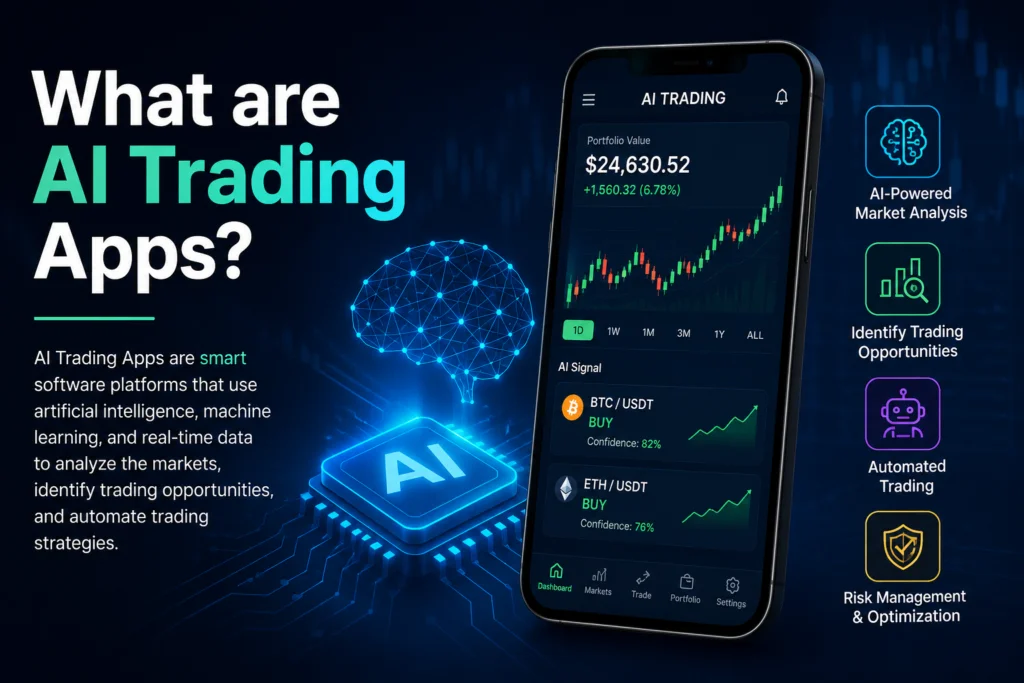
AI trading apps are software platforms that use artificial intelligence, machine learning, and advanced algorithms to analyze financial markets and assist with trading decisions.
Some apps simply provide AI-generated insights and signals, while others can fully automate trades without human intervention.
Unlike traditional trading tools that rely only on static indicators or manual analysis, AI systems continuously learn from market behavior and adapt over time.
At their core, these platforms aim to answer three critical questions:
- What asset should be traded?
- When should the trade happen?
- How much risk should be taken?
The AI processes enormous amounts of information faster than any human trader ever could.
Machine Learning, Predictive Analytics, and Algorithmic Execution Explained
Modern AI trading apps combine several advanced technologies to make predictions and execute trades efficiently.
Machine Learning
Machine learning allows AI systems to study historical market data and identify patterns that humans may overlook.
Over time, the system “learns” which patterns often lead to bullish or bearish market movements.
The more data the AI processes, the smarter its predictions can become.
Predictive Analytics
Predictive analytics is the process of forecasting future market behavior using statistical models and AI-driven analysis.
These predictions are generated by analyzing both historical and real time market conditions.
Algorithmic Execution
Algorithmic execution refers to automated trade placement based on predefined rules or AI generated signals.
Instead of manually buying or selling assets, the AI executes trades automatically according to market conditions.
These actions happen instantly, often within milliseconds. This speed matters because financial markets move incredibly fast in 2026, especially crypto and forex markets that operate 24/7.
Key Benefits of AI Trading Apps
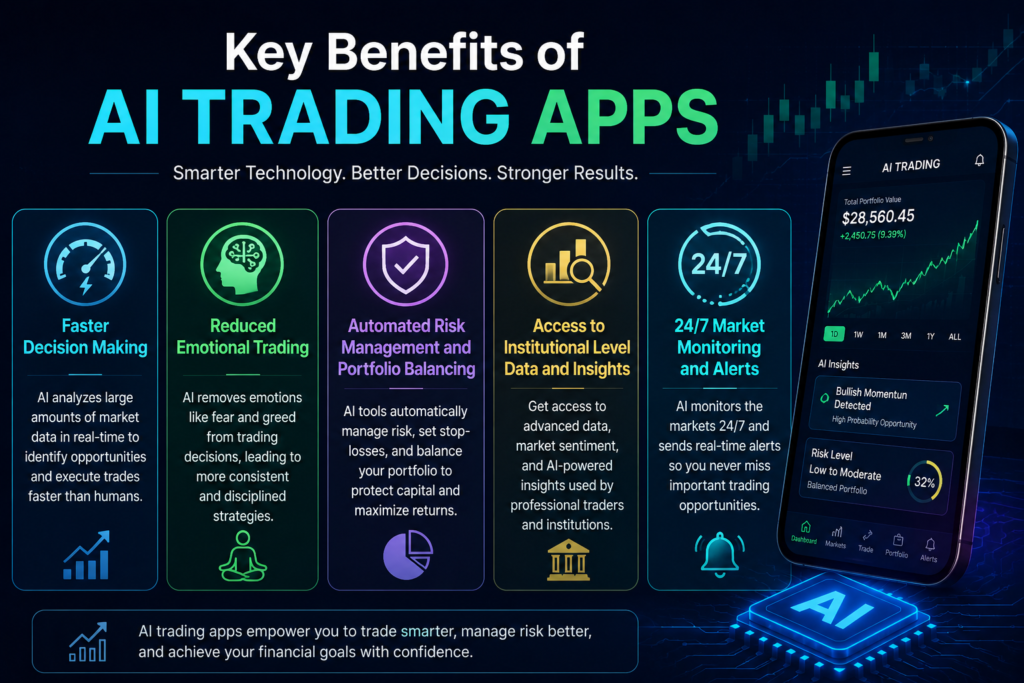
AI trading apps offer several advantages compared to traditional manual trading.
While they are not perfect and cannot eliminate risk, they can significantly improve efficiency, consistency, and decision making.
Faster Decision Making and Reduced Emotional Trading
One of the biggest reasons traders lose money is emotional decision making. Fear and greed often cause people to panic during market crashes, chase hype driven trends, or hold losing trades for too long.
In crypto markets, emotions can easily lead to impulsive decisions that increase risk and reduce profits. AI trading apps help reduce this problem by relying on data instead of emotions. These systems analyze market trends, price movements, trading volume, and real time news within seconds before making decisions.
Automated Risk Management and Portfolio Balancing
AI trading apps help traders manage risk automatically by setting stop losses, adjusting trade sizes, and reducing exposure during unstable market conditions. Instead of relying on emotional decisions, the AI responds to real time market data and changing volatility levels.
Many platforms also rebalance portfolios automatically by shifting investments based on market trends, risk tolerance, and economic conditions. This helps traders maintain a more diversified and efficient investment strategy while reducing the chances of major losses.
Access to Institutional Level Data and Insights
In the past, advanced market data and professional trading tools were mostly available to hedge funds and large financial institutions. In 2026, many AI trading apps now give retail traders access to powerful features such as advanced charting, order flow analysis, options activity, sentiment tracking, and AI-driven market insights.
This has helped reduce the gap between professional and everyday traders. With better data and smarter analysis tools, retail investors can now make more informed trading decisions and identify opportunities more effectively than ever before.
24/7 Market Monitoring and Alerts
Unlike human traders, AI trading apps can monitor the markets 24/7 without interruption. This is especially useful for fast-moving markets like cryptocurrency and forex, where prices can change at any time of the day.
Modern AI systems can instantly detect sudden volatility, breakout opportunities, trend reversals, and unusual trading activity, then alert users in real time. Some platforms can even execute trades automatically while the user is offline, helping traders stay active in the market without constantly watching charts all day.
Also Read: Stablecoin Regulation in 2026: Global Laws, Benefits, and Challenges
How AI Trading Bots Work
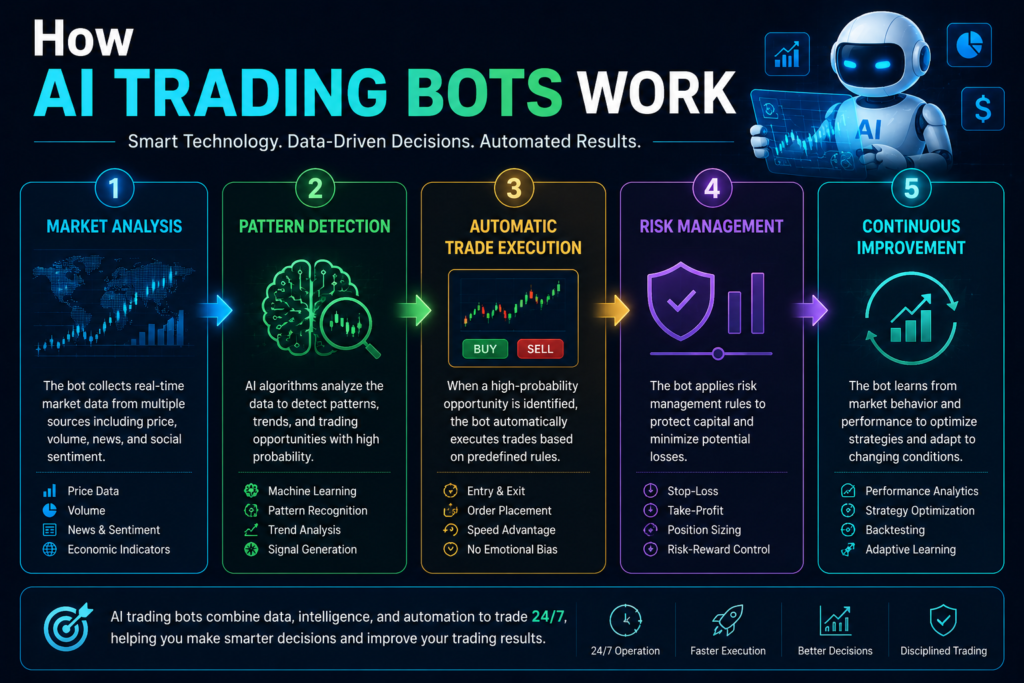
AI trading bots are designed to analyze the market, identify trading opportunities, and execute trades automatically.
In 2026, these bots have become more advanced, using artificial intelligence and real time market data to make faster and more accurate trading decisions than traditional trading software.
Market Analysis
AI trading bots constantly collect and analyze market data such as price movements, trading volume, market trends, news, and social sentiment. This helps the system understand what is happening in the market in real time before making any trading decision.
Pattern Detection
Using machine learning, the bots look for patterns and trends that may signal a buying or selling opportunity. They can detect momentum changes, trend reversals, and market volatility much faster than most human traders.
Automatic Trade Execution
Once the AI detects a trading opportunity, the bot can automatically place trades through connected exchanges or brokerage accounts. This allows traders to react quickly to market movements without manually monitoring charts all day.
Many AI bots can also use different trading strategies such as grid trading, arbitrage, trend-following, and dollar-cost averaging (DCA).
Risk Management
Modern AI trading bots also help manage risk by setting stop-losses, adjusting trade sizes, and reducing exposure during highly volatile market conditions. This helps traders avoid emotional decisions and maintain better control over losses.
Continuous Improvement
Advanced AI bots continuously learn from new market data and adjust their strategies over time. As market conditions change, the AI can refine its analysis and improve decision-making to adapt to different trading environments.
Best AI Trading Apps 2026
| AI Trading App | Best For | Free or Paid | Starting Price (2026) | Supported Markets | Pros | Cons |
| Pionex | Free crypto trading bots | Free with trading fees | Free to use | Crypto | Built-in bots; beginner-friendly; low fees | Limited advanced customization; crypto-only focus |
| Trade Ideas | AI-powered stock day trading | Paid | Around $118/month | Stocks | Powerful AI stock scanner; real-time alerts; advanced analysis | Expensive; steep learning curve |
| 3Commas | Advanced crypto automation | Paid | Around $37/month | Crypto | Strong automation tools; supports multiple exchanges; smart trading features | Can feel complex for beginners; past API security concerns |
| TrendSpider | Automated technical analysis | Paid | Around $54/month | Stocks, Forex, Crypto | Excellent chart analysis; automated trend detection; strong backtesting | Higher pricing; better suited for experienced traders |
| Tickeron | AI-generated trade ideas | Freemium | Paid plans from around $20/month | Stocks, ETFs, Forex, Crypto | Beginner-friendly insights; AI predictions; pattern recognition tools | Some signals may be inaccurate; premium features locked behind paid plans |
| Cryptohopper | Cloud-based crypto bot trading | Freemium | Paid plans from around $29/month | Crypto | Strategy marketplace; copy trading; beginner-friendly automation | Premium features can become expensive |
| MetaTrader 5 | Advanced and automated trading | Free platform (broker fees apply) | Free | Forex, Stocks, Crypto, Commodities | Advanced charting; automated trading support; customizable tools | Difficult for beginners; some features require technical knowledge |
Pionex
Best For: Free built in crypto trading bots
Pionex is a crypto exchange that became widely known for offering free built in AI trading bots directly inside its platform. Founded in 2019, it simplifies automated trading by allowing users to activate bots without connecting third party software.
Pionex is also one of the best choices for beginners who want easy access to automated crypto trading without paying high monthly subscription fees.
Pros
- Free built in trading bots
- Beginner friendly setup
- Low trading fees
- No external exchange connection needed
Cons
- Primarily focused on crypto
- Fewer advanced customization features than some competitors
- Limited institutional level analytics
Trade Ideas
Best For: AI stock scanning and day trading
Trade Ideas is one of the most respected AI powered stock analysis platforms for active traders. Founded in 2003, the platform uses AI systems like “HOLLY” to scan the stock market for high probability trading opportunities in real time.
It is widely used by day traders and momentum traders in the stock market. Trade Ideas is best suited for serious stock traders who want institutional-grade AI scanning and high-speed market analysis.
Pros
- Extremely powerful AI stock scanner
- Real time market analysis
- Excellent for day trading
- Advanced charting and alert systems
Cons
- Expensive for casual users
- Steeper learning curve for beginners
- Primarily focused on stocks, not crypto
3Commas
Best For: Advanced crypto trading automation and strategy customization
3Commas is one of the most established AI crypto trading platforms in the market. Founded in 2017, the platform became popular for its advanced trading bots, smart trading terminal, portfolio management tools, and multi-exchange integrations.
It supports automated trading strategies such as DCA bots, grid bots, and signal-based trading across multiple crypto exchanges. 3Commas remains one of the most powerful AI trading platforms for crypto traders who want deep customization and automation. It is especially popular among active traders and strategy-focused users.
Pros
- Highly advanced automation tools
- Supports multiple exchanges
- Strong customization and backtesting features
- Suitable for both beginners and advanced traders
Cons
- Can feel overwhelming for beginners
- Monthly subscription pricing may be expensive
- Faced security controversies related to API key leaks in the past
TrendSpider
Best For: AI-powered technical analysis and chart automation
TrendSpider is a modern AI trading platform focused on automated technical analysis. Launched in 2016, the platform helps traders automate chart analysis, identify trends, and create strategy alerts with minimal manual effort.
Its automated trendline detection is one of its standout features.TrendSpider is perfect for traders who rely heavily on charts and technical indicators but want AI to speed up analysis and market scanning.
Pros
- Excellent technical analysis tools
- Automated chart pattern recognition
- Strong backtesting capabilities
- Saves time for technical traders
Cons
- Subscription pricing can be high
- Better suited for technical traders than beginners
- Limited direct trade automation compared to crypto bots
Also Read: What Is a Crypto Whale and Why Whales Matter in Crypto Trading
Tickeron
Best For: AI-generated stock and ETF trading ideas
Tickeron is an AI-driven market analysis platform that provides stock predictions, trading signals, portfolio ideas, and pattern recognition tools. The platform uses machine learning to identify trading opportunities across stocks, ETFs, forex, and crypto markets.
It became popular for simplifying AI-powered trading insights for retail investors. Tickeron works well for traders who want AI-generated trade ideas and simplified market analysis without fully automated trading systems.
Pros
- Beginner-friendly AI insights
- Strong pattern recognition tools
- Covers multiple asset classes
- Helpful educational features
Cons
- Some signals may generate false positives
- Premium plans can become costly
- Less advanced automation than dedicated trading bot platforms
Cryptohopper
Best For: Cloud-based crypto trading automation
Cryptohopper is a popular cloud-based AI crypto trading platform launched in 2017. It allows traders to automate strategies, copy experienced traders, and build custom trading algorithms without coding.
The platform is especially known for its marketplace, where users can buy and sell trading strategies and signals. Cryptohopper is ideal for traders who want flexibility, automation, and access to community-driven strategies without managing complicated infrastructure.
Pros
- Easy-to-use cloud-based system
- Strategy marketplace and copy trading
- Supports multiple exchanges
- Strong educational resources
Cons
- Advanced features require paid plans
- Performance depends heavily on chosen strategies
- Can become expensive with premium tools
MetaTrader 5
Best for: Advanced and Automated Trading
MetaTrader 5 (MT5) is a popular multi-asset trading platform developed by MetaQuotes and launched in 2010. It is widely used for forex, stocks, commodities, and crypto trading, offering advanced charting tools, technical indicators, and automated trading through Expert Advisors (EAs).
The platform is known for its fast execution, strategy testing tools, and customizable trading environment. Traders can analyze markets in real time, create custom indicators, and automate trading strategies directly within the platform.
Pros
- Supports multiple financial markets
- Advanced charting and technical analysis tools
- Allows automated trading with Expert Advisors
- Strong backtesting and strategy testing features
- Available on desktop, web, and mobile
Cons
- Can be difficult for beginners
- Some advanced features require technical knowledge
- Trading quality depends on the broker used
How to Choose the Best AI Trading App in 2026
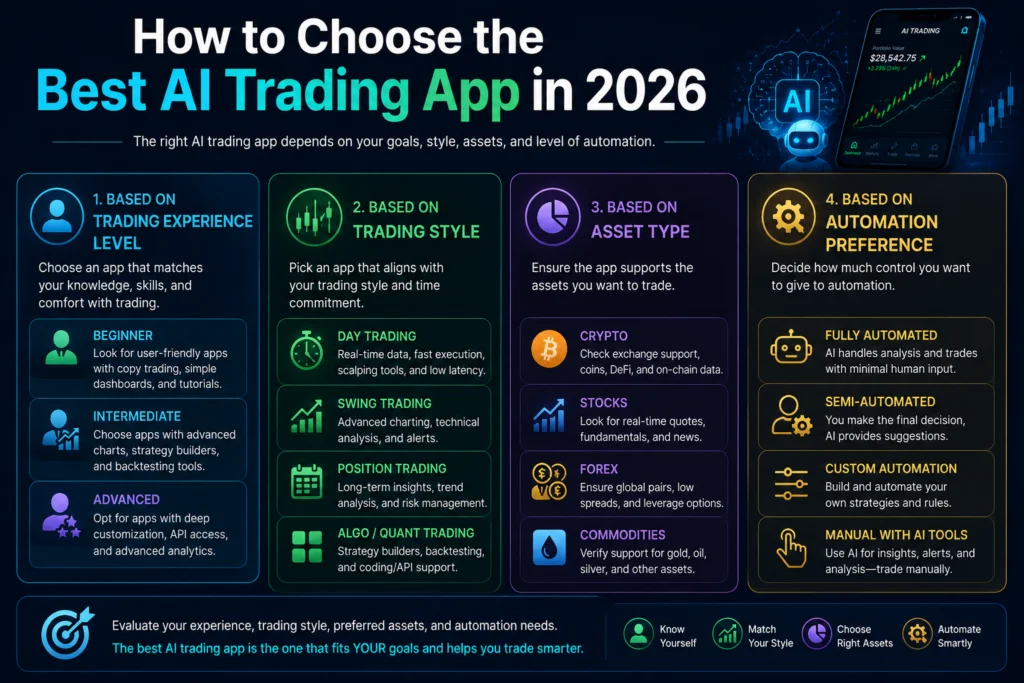
Choosing the best AI trading app in 2026 is not simply about downloading the most popular platform. Different AI trading apps are designed for different types of traders, investment goals, and experience levels.
Some platforms focus on fully automated crypto trading, while others are built for stock analysis, portfolio management, or AI-powered market research.
Understanding these differences can help you avoid choosing the wrong platform and improve your overall trading experience.
Based on Trading Experience Level
One of the first things to consider when choosing an AI trading app is your level of trading experience. Some platforms are built to simplify investing for beginners, while others are designed for experienced traders who want advanced customization and deeper market analysis.
Beginners should focus on AI trading apps that are easy to use and do not require technical trading knowledge. Intermediate traders usually need more flexibility and control. Advanced traders usually prefer highly customizable AI trading platforms with institutional-grade tools and automation systems.
Based on Trading Style
Your trading style is another important factor when choosing an AI trading app. Different AI systems are optimized for different investment strategies, and choosing the wrong type of platform can lead to poor results.
Some traders buy and sell within minutes, while others hold investments for months or years. The AI tools needed for these approaches are very different.
Based on Asset Type
Not every AI trading app supports the same financial markets. Some platforms are designed mainly for cryptocurrency trading, while others specialize in stocks, ETFs, forex, or multiple asset classes. Choosing a platform that matches the assets you plan to trade is extremely important.
Based on Automation Preference
Another major factor to consider is how much control you want the AI system to have over your trading activity.
Some users prefer fully automated systems that handle everything automatically, while others want AI to simply assist with research and analysis while they make the final decisions themselves.
Risks and Limitations of AI Trading Apps
AI trading apps have become incredibly powerful in 2026, helping traders automate strategies, analyze markets faster, and make more data-driven decisions. However, despite their growing popularity, these platforms are not perfect.
Many beginners mistakenly believe that AI trading systems can guarantee profits or completely remove risk from investing. In reality, AI trading apps still have certain limitations that every trader should understand before relying on them.
Market Unpredictability and Model Limitations
One of the biggest limitations of AI trading apps is that financial markets are constantly changing. AI systems are designed to identify patterns and trends based on past market behavior, but markets do not always behave the same way in the future.
An AI strategy that performs extremely well during a bullish market may fail during a market crash or a period of high uncertainty. This is because AI models are only as effective as the data they are trained on. If market conditions suddenly change in a way the system has never seen before, the AI may struggle to adapt quickly.
Execution Risks
Even when an AI trading strategy generates a good signal, problems can still occur during trade execution. In fast-moving financial markets, timing is extremely important, and even small delays can impact profitability.
AI systems rely heavily on internet connections, exchange APIs, server performance, and execution speed. If any part of this process experiences delays or technical failures, the actual trade result may differ significantly from what the AI intended.
Security and Platform Risks
AI trading apps also introduce security concerns, especially when users connect their exchange accounts or financial data to third-party platforms.
Most AI trading systems require API access to execute trades automatically. APIs allow the trading app to communicate directly with crypto exchanges or brokerage platforms. While this makes automation possible, it also creates potential security vulnerabilities if the platform is poorly protected.
Psychological Risks
While AI trading apps are designed to reduce emotional decision-making, they can also create new psychological risks for traders.
Many users become overly dependent on AI systems and stop thinking critically about market conditions. This can lead to dangerous situations where traders blindly follow signals without understanding the actual risks involved.
Conclusion
AI trading apps have made investing and trading more accessible in 2026 by helping users analyze markets faster, automate strategies, and make more data-driven decisions.
From crypto trading bots to AI-powered stock analysis tools, these platforms are changing how both beginners and experienced traders interact with financial markets.
Despite their power, financial markets remain unpredictable, and even advanced AI systems can make mistakes during volatile conditions. This is why traders should use AI as a support tool rather than relying on automation entirely.
The best AI trading app is the one that matches your experience level, trading style, investment goals, and risk tolerance. When used properly alongside good research and risk management, AI trading apps can become powerful tools for smarter and more efficient trading in 2026.
Frequently Asked Questions (FAQs)
Are AI trading apps safe to use in 2026?
Most reputable AI trading apps are generally safe to use, especially those with strong security features like two-factor authentication and encrypted API connections. However, traders should still research platforms carefully and avoid investing more money than they can afford to lose.
Can AI trading apps guarantee profits?
No. AI trading apps can improve market analysis and automate trading decisions, but they cannot predict the market perfectly or guarantee consistent profits. Financial markets are still highly unpredictable.
Which AI trading app is best for beginners?
Beginner friendly AI trading apps are usually those with simple interfaces, automated tools, and educational features. Platforms like Pionex and Composer are often recommended for users who are new to AI trading.
Are AI trading apps only for cryptocurrency trading?
No. While many AI trading apps focus on crypto markets, others are designed for stocks, ETFs, forex, and multi-asset investing. Some platforms even support multiple financial markets within one app.
What is the difference between fully automated and semi-automated AI trading?
Fully automated AI trading apps can analyze markets and execute trades automatically without user involvement. Semi-automated platforms provide AI-generated signals and recommendations, but the trader still decides whether to place trades manually.