



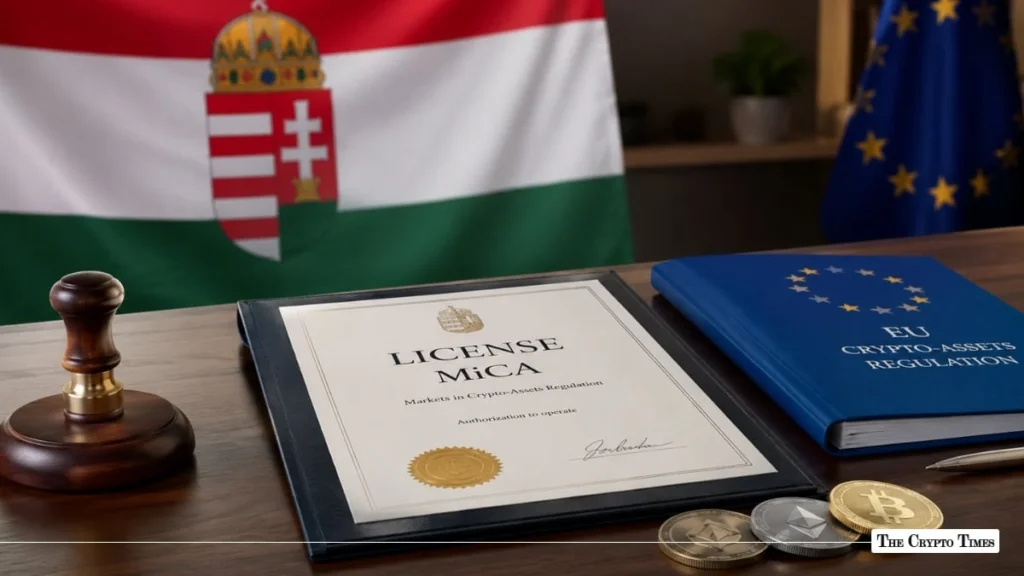
Hungary has rolled back one of Europe’s strictest cryptocurrency transaction requirements, repealing its mandatory third party validation system shortly after issuing its first authorization under the European Union’s Markets in Crypto-Assets (MiCA) framework to Budapest based crypto platform CoinCash.
The move removes an additional compliance layer that industry participants argued disrupted the domestic crypto market while reinforcing Hungary’s transition toward the EU’s harmonized regulatory regime.
Key Takeaways
- Hungary repealed its mandatory third-party validator requirement for certain crypto transactions.
- The National Bank of Hungary granted CoinCash the country’s first MiCA authorization on July 20, 2026.
- The previous validator system required checks on wallet ownership, customer identity, and asset origin before certain crypto conversions.
- CoinCash’s MiCA license covers custody, crypto trading, transfers, investment advice, and portfolio management.
- Hungary is aligning its crypto framework more closely with the EU’s MiCA regulation while maintaining licensing and compliance obligations.
Hungary Removes Transaction Level Crypto Validation
The Hungarian Parliament voted to abolish the country’s mandatory validator requirement, eliminating an additional approval process that applied to certain cryptocurrency transactions. The requirement had been introduced under Hungary’s 2024 Crypto Assets Act and took effect on July 1, 2025.
Under the previous framework, cryptocurrency conversions could only proceed after a licensed validator verified:
- The origin of crypto assets.
- Wallet ownership.
- Customer identity and information.
Once those checks were completed, the validator issued a compliance declaration before the transaction could be finalized. The repeal removes this transaction level approval process while leaving broader regulatory obligations under MiCA intact.
Government cites market disruption
Finance Minister Kármán András said the validator requirement had created significant friction within Hungary’s cryptocurrency market. According to the minister, the additional compliance burden prompted several cryptocurrency service providers to suspend or discontinue operations in Hungary. He said the market is beginning to recover following the government’s decision to eliminate the extra validation layer.
The repeal also removes criminal provisions associated with the previous framework, including penalties related to violations of the validator requirement and unauthorized crypto exchange activities.
Coincash Becomes Hungary’s First Mica Licensed Crypto Firm
The regulatory change comes shortly after the National Bank of Hungary (MNB) granted Tiwala Solutions, operator of CoinCash, the country’s first authorization under the European Union’s MiCA framework. CoinCash voluntarily suspended operations in December 2025 while completing the licensing process.
According to the company, the authorization allows it to provide a broad range of regulated crypto services, including:
- Crypto custody.
- Crypto-to-fiat exchange.
- Crypto-to-crypto exchange.
- Digital asset transfers.
- Investment advice.
- Portfolio management.
CoinCash said it plans to gradually restore services and expand its offerings following the approval.
Hungary Aligns With Mica
Hungary had previously implemented one of the European Union’s strictest crypto compliance regimes by combining MiCA licensing with its own national validator requirement. The country also shortened the MiCA transition period for crypto asset service providers, requiring compliance by July 1, 2025, one year earlier than the EU’s maximum transition deadline of July 1, 2026.
With the repeal, Hungary is removing requirements that went beyond the EU framework while maintaining MiCA’s licensing, governance, and compliance standards.
Market Implications
The repeal is expected to reduce operational friction for cryptocurrency businesses serving Hungarian customers.
Instead of requiring transaction by transaction third party validation, crypto firms will operate primarily under MiCA’s entity level regulatory framework, which focuses on licensing, governance, risk management, consumer protection, and ongoing compliance.
The change could encourage crypto service providers that previously limited or suspended operations in Hungary to re-enter the market.
Conclusion
Hungary has taken a significant step toward aligning its cryptocurrency regulations with the European Union’s MiCA framework by removing its controversial third-party validator requirement while preserving broader licensing and compliance standards.
The repeal, coupled with CoinCash becoming Hungary’s first MiCA authorized crypto asset service provider, marks a shift from transaction level oversight toward a harmonized EU regulatory model that aims to balance market access with consumer protection.