



In recent times, crypto card usage has surged as more people look for smooth ways to spend digital assets like Bitcoin, Ethereum, and stablecoins on everyday purchases. These cards make it easy to swipe at a store or pay online, converting crypto into fiat instantly.
But while they bring convenience, they also raise important questions about taxation that every user needs to understand.
Tax rules have become clearer in 2026, and authorities increasingly treat crypto card payments as taxable events.
This means that every coffee purchase, online subscription, or retail transaction could have capital gains tax implications depending on how much your crypto has appreciated. Understanding this distinction is important for staying compliant and avoiding unexpected liabilities.
In this guide, we break down crypto card tax implications and provide practical strategies for smarter usage.
Key Takeaways
- Crypto debit card transactions are treated as taxable disposals, often triggering capital gains tax based on cost basis and disposal value.
- Spending crypto rewards, airdrops, or staking income can create dual tax obligations, income tax at receipt and capital gains tax on later disposals.
- Long-term holding benefits, such as Germany’s 12-month exemption or Australia’s 50% CGT discount, can significantly reduce tax liabilities.
- Small-value exemptions and crypto-friendly jurisdictions like Portugal, Switzerland, and the UAE allow certain transactions to remain tax-free.
- Effective tax management requires accurate record-keeping, use of crypto tax software, and strategic use of stablecoins or allowances to simplify reporting.
What Are Crypto Cards and How Do They Work?

Crypto cards are payment cards that allow you to spend digital currencies like Bitcoin, Ethereum, and stablecoins just as easily as traditional money. Issued by exchanges and fintech platforms, these cards are usually powered by major networks such as Visa or Mastercard, making them widely accepted at millions of merchants worldwide.
Here’s how they work: when you swipe or tap a crypto debit card, the provider automatically converts your chosen cryptocurrency into local fiat currency (such as USD, EUR, or NGN) at the point of purchase.
This process happens instantly, meaning the shop receives fiat while your crypto balance is reduced. Some providers also offer crypto credit cards, where you borrow against your assets instead of directly spending them.
Beyond payments, many crypto cards offer additional benefits, such as cashback rewards, crypto rebates, or reduced trading fees, making them attractive for everyday use.
Read Also: Crypto Card Limits: Daily, Monthly & ATM Explained
Capital Gains Tax (CGT) and Spending with Crypto Cards
When you use a crypto debit card to pay for goods or services, you’re not just spending digital currency; you’re technically disposing of an asset. This disposal is where capital gains tax (CGT) becomes applicable.
Tax authorities view each transaction as a sale of cryptocurrency, and any profit made from the difference between your purchase price and the disposal price may be subject to taxation.
Why Every Transaction May Trigger a CGT Event
Using crypto to buy a cup of coffee or shop online looks simple on the surface, but behind the scenes, your crypto is converted into fiat at market value.
If the value of your Bitcoin, Ethereum, or stablecoin has increased since you acquired it, this difference counts as a capital gain. Even small, everyday purchases can therefore trigger a CGT event, meaning you may have to report it in your annual tax filings.
Short-Term vs. Long-Term Capital Gains Tax
The length of time you’ve held your crypto makes a significant difference. If you spend crypto you’ve held for less than a year, any gains are typically classified as short-term capital gains, often taxed at your ordinary income tax rate.
By contrast, if you’ve held your crypto for over 12 months, many jurisdictions apply a long-term capital gains tax, which may come with reduced rates or tax discounts. This distinction encourages longer holding periods, but it also complicates tracking when assets are frequently moved or spent through cards.
Tax Authorities’ Perspective in 2026
In 2026, global tax regulators have become far more assertive in addressing crypto transactions, including those made with debit and credit cards.
Authorities now emphasize accurate reporting of each taxable disposal, pushing exchanges and card providers to share transaction data with tax offices.
In many countries, non-compliance may result in penalties, audits, or increased scrutiny. The perspective is clear: crypto card usage is no longer overlooked, and every transaction is expected to be tracked, calculated, and reported like any other taxable event.
How to Calculate Capital Gains and Losses

Understanding how to calculate gains or losses is essential when spending crypto with a debit or credit card. Since every payment is treated as a disposal, you need to know whether you’ve made a profit (capital gain) or a loss.
- Formula: Capital Gain/Loss = Disposal Proceeds – Cost Basis
The basic calculation is straightforward:
Capital Gain or Loss = Disposal Proceeds – Cost Basis
- Disposal Proceeds: The value of your crypto at the time it was converted to fiat.
- Cost Basis: The original amount you paid to acquire that crypto (including transaction fees).
If the result is positive, you’ve made a capital gain. If negative, it’s a capital loss.
Example of Short-Term vs. Long-Term Holdings
Imagine you bought 0.01 BTC for $300 in January 2026. In March 2026, you use your crypto card to pay for a $500 hotel booking, funded by that same 0.01 BTC.
- Cost Basis = $300
- Disposal Proceeds = $500
- Capital Gain = $200
Because you held the crypto for less than 12 months, this $200 is a short-term gain and likely taxed at your ordinary income rate.
Now, if you had purchased that BTC in January 2025 and spent it in March 2026, the $200 would qualify as a long-term gain, and in many jurisdictions, you may receive a lower tax rate or discount on the gain.
Long-Term Holding Benefits and CGT Discounts
When you hold crypto for extended periods before disposing (which includes spending via a crypto card), many jurisdictions offer tax advantages. These CGT (Capital Gains Tax) discounts or exemptions reward such long-term holding by reducing or eliminating the tax burden.
Below are countries with such benefits, plus the criteria in 2026 to be eligible.
| Country | Benefit for Long-Term Crypto Holdings / Exemption | Notes & Conditions |
| United States (US) | Long-term capital gains (crypto held >12 months) are taxed at preferential rates of 0%, 15%, or 20% depending on income level. Short-term gains (<12 months) are taxed as ordinary income (up to 37%). | IRS treats crypto as property; every disposal, including spending via crypto cards, is taxable. |
| United Kingdom (UK) | No separate long- vs. short-term distinction. All gains are taxed under Capital Gains Tax at 10% or 20%, depending on income. | An annual CGT allowance applies (£3,000 in 2026). HMRC requires detailed records of each disposal. |
| Australia | Long-term capital gains (crypto held >12 months) receive a 50% discount for individuals. Short-term gains are fully taxed as income. | The ATO tracks crypto disposals closely; crypto card transactions count as disposals. |
| Germany | Crypto held for more than 12 months is completely tax-free for individuals. | Gains under €600 may also be exempt even if held less than a year. |
| Portugal | Long-term crypto (held >12 months) is tax-free. Short-term gains are taxed at 28%. | Residency rules apply. |
| Switzerland | For private investors, long-term holdings are usually exempt from capital gains tax. | Treated as private movable assets if not trading professionally. |
| United Arab Emirates (UAE) | No income or capital gains tax on individual crypto transactions. | Residency required to access the benefit. |
| Malta | Crypto treated like long-term shares; private investors generally exempt from CGT. | Frequent trading may be taxed as business income. |
Eligibility Criteria in 2026
To benefit from long-term CGT discounts or exemptions, individuals generally must meet specific requirements.
These are some common eligibility conditions:
Minimum Holding Period
You must hold the crypto for a minimum period (often ≥ 12 months) before disposing/spending, for gains to qualify for reduced or zero tax. The United States, Germany, Portugal, etc., use the one-year threshold.
Nature of the Transaction / Disposal
The spending via a crypto card counts as a disposal event in many jurisdictions. To get the long-term benefit, the transaction must occur after the minimum holding period. If you spend before the holding period is met, you’ll be taxed at the higher “short-term” rate.
Individual vs. Business / Professional Trader Status
Some countries distinguish between private (non-professional) investors vs. frequent traders or institutions. Professionals/private businesses may not get the same long-term exemptions. For example, Switzerland treats private holdings differently from business-level activity.
Thresholds & Margins
Some jurisdictions give only gains above a small threshold or allow a small-value exemption. Germany exempts gains under about €600 annually if held less than a year.
Residency / Tax Residency Requirements
To qualify, you usually need to be a tax resident (or meet specified criteria) in that country. Some laws require continuous residency or proof of domicile. If you move between jurisdictions, eligibility may change.
Accurate Record-Keeping
Holding period must be documented (purchase date, cost basis, etc). Without proper records, tax authorities may disallow discounts and treat gains as short-term.
Read Also: Long-Term Crypto Investing: The Complete Strategy Guide
Income Tax vs. Capital Gains Tax
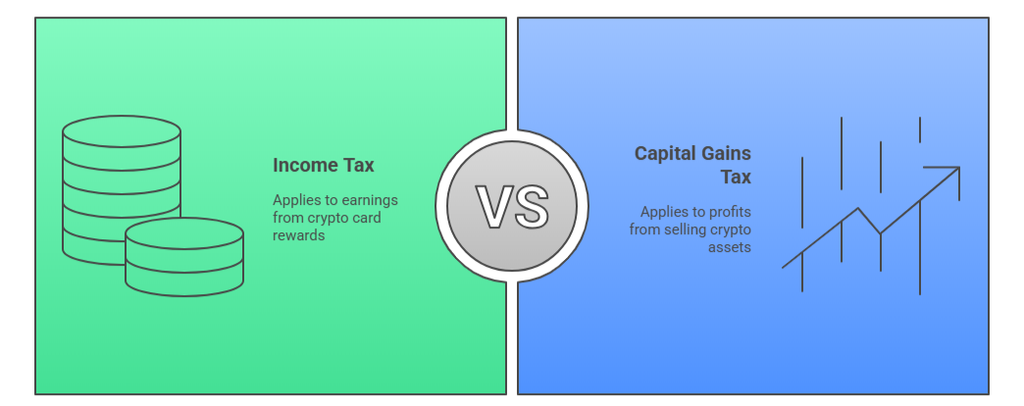
When it comes to crypto card usage, one of the most important distinctions to understand is whether your transaction is subject to income tax or capital gains tax (CGT).
Both taxes apply in different circumstances, and confusing them could result in underreporting or unexpected liabilities.
Situations Where Crypto Spending Is Taxed as Income
Not all crypto disposals are treated as capital gains. If the crypto you spend was earned rather than purchased, tax authorities usually classify it as ordinary income.
For example, if you are paid in crypto for freelance work or employment, spending it later with a crypto card is first taxed as income at the time you receive it, based on its fair market value.
Once classified as income, any later increase in value from holding that crypto may also trigger a capital gains tax when disposed of.
This creates a two-layered tax impact: income tax upon receipt, followed by capital gains tax if the asset appreciates before you spend it.
Airdrops, Staking Rewards, and Card Rewards Impact
Other forms of crypto earnings also fall under income tax rules:
- Airdrops: When tokens are distributed for free, their fair market value at the time of receipt is treated as taxable income. If you later spend these tokens via a crypto card, any price change from the original value will be subject to CGT.
- Staking Rewards: Rewards received from proof-of-stake networks are considered income at the point of receipt. If those tokens are later spent and have risen in value, you may owe capital gains tax on top of the income tax already paid.
- Crypto Card Rewards (Cashback or Rebates): In many jurisdictions, card rewards earned in crypto are treated like traditional credit card cashback, sometimes tax-free. However, some authorities classify them as taxable income at the time you receive them, especially if they are significant or resemble staking-like yields.
In short, income tax applies when crypto is earned (through work, rewards, or distributions), while capital gains tax applies when crypto is sold or spent after holding it.
Tax Regulations Across Key Jurisdictions
Here’s how central tax authorities treat crypto card usage:
United States
The IRS treats cryptocurrency as property, not currency. That means every time you spend crypto with a card, it is generally a taxable disposal: you must recognize a gain or loss equal to the difference between your cost basis and the fiat value at the time of the transaction.
The IRS’s “Digital Assets” guidance and FAQs reiterate that virtual currency used to pay for goods and services is reportable as a disposal, and income rules apply if crypto was received as payment or reward.
For examples, if you bought 0.05 BTC for $1,000 and later spent it when it was worth $1,500, you have a $500 taxable capital gain.
On top of that, the U.S. Treasury has moved to tighten reporting: recent final rules require broader broker/payment-processor reporting to the IRS (new 1099-DA framework and thresholds), which will increase automated reporting of card-linked transactions in coming years. This means fewer crypto card disposals will slip under the radar.
United Kingdom & European Union
In the UK, HMRC treats disposals (including spending crypto via a card) as chargeable events for Capital Gains Tax.
There is no separate short- vs long-term CGT regime, but gains fall into income bands and benefit from an annual allowance (check the current allowance each tax year). HMRC’s crypto pages emphasise record-keeping for each disposal, receipt, and reward.
Across the EU, VAT treatment has settled mainly on the principle that crypto-to-fiat conversions are not a VAT-able supply (following CJEU precedents around exchanges and means of payment), so VAT is typically not charged simply because crypto was converted to pay for goods.
However, VAT can attach to underlying goods/services sold, and member states differ in how they treat ancillary crypto services (custody, mining, NFT services). Businesses using crypto cards must still track VAT on the underlying sale and comply with local invoicing/reporting rules.
Example: a UK resident using a crypto card to buy a £100 taxable item must calculate CGT on any gain from the crypto disposal, while the merchant charges VAT on the £100 as usual, and the VAT treatment doesn’t change because crypto funded the payment.
Canada
Canada’s CRA treats crypto as property for both income and capital gains purposes and expects taxpayers to value crypto at fair market value when transactions occur.
The agency’s guidance lists disposals that must be reported (sell, trade, use for purchase, exchange, gifts) and clarifies when mining, staking or rewards are income rather than capital. Canada also applies its capital gains inclusion rule (only 50% of a capital gain is taxable), which affects the after-tax impact of crypto card spending.
Australia
The Australian Taxation Office has continued to clarify crypto rules and increased compliance activity. The ATO treats crypto disposals (including crypto card payments) as capital gains events for investors; however, crypto received from activities like staking or as income will attract ordinary income tax.
Notably, the ATO published updated guidance on staking rewards and airdrops, clarifying when rewards are assessable income and how cost base adjustments work for later disposals. The ATO has also been active in enforcement and information-gathering from exchanges.
Read Also: How do I Use my Virtual Crypto Card?
Asia
Asia is a patchwork of treatments:
- Singapore generally does not tax private capital gains on crypto, but profits may be taxed as business income if the activity meets the tax authority’s “badges of trade.” This makes frequent card usage, combined with trading, potentially taxable. (National practice emphasises the business vs. investment test.)
- Japan continues to treat many crypto gains as taxable under income or capital rules, and regulators are evolving on how to classify crypto instruments and ETFs. Recent regulatory movements indicate an increasing formalization, but also a conservative tax treatment for some categories.
- Southeast Asia (for example, Indonesia) has signaled tighter tax regimes and new transaction levies, reflecting a broader regional trend of ramping up crypto taxation and exchange reporting.
Jurisdictional detail varies rapidly, so always check local tax authority updates before relying on incentives.
Common Pitfalls and Risks to Avoid
To stay compliant and avoid unnecessary penalties, here are three significant risks to watch out for in 2026.
Ignoring Transaction Records
Every crypto card payment is technically a taxable disposal. Failing to track dates, amounts, and cost bases makes it difficult to calculate accurate gains or losses. Tax authorities increasingly require detailed reporting, and exchanges may share transaction data directly with regulators.
Without your own records, you could face incorrect tax assessments or audits. Using crypto tax software or exporting statements from your card provider helps maintain accurate logs.
Overlooking Card Reward Taxation
Many crypto cards offer perks, such as cash back in Bitcoin or stablecoins. While these rewards feel like “free money,” in many countries, they are classified as taxable income at the time you receive them.
Later, when you spend or sell those rewards, you may also owe capital gains tax if their value has increased. Failing to address this can lead to underreporting and unexpected tax liabilities.
Double Taxation Issues
A common mistake is not distinguishing between income tax and capital gains tax. For example, if you receive staking rewards or card rewards in crypto, they are taxed as income upon receipt. When you later spend them with your crypto card, any appreciation may also trigger CGT.
Without careful planning, this creates a double tax burden. Understanding how different tax layers interact, and tracking cost bases correctly is essential to avoid paying more than necessary.
Smart Strategies to Manage Your Crypto Card Taxes
Managing crypto card taxes doesn’t have to be overwhelming. With the right strategies, you can reduce stress at tax time, lower your liabilities, and stay fully compliant.
Here are some practical approaches to consider:
Using Crypto Tax Software for Tracking
Since every card payment can trigger a disposal, manually tracking gains and losses quickly becomes impractical. Crypto tax software automates the process by pulling data from your wallet, exchange, and card provider.
Tools like CoinTracking, Koinly, or CoinLedger generate reports in line with IRS, HMRC, ATO, and other global requirements. This saves time, reduces errors, and ensures that you capture every taxable event accurately.
Setting Aside a Percentage of Profits for Tax Obligations
One of the simplest yet most effective strategies is to treat taxes like an unavoidable expense. By setting aside a portion of your gains, say 20–30% depending on your jurisdiction, you’ll have funds ready when tax season arrives.
This proactive approach prevents cash-flow shocks and keeps you prepared even if crypto markets dip after you’ve spent or converted assets.
Choosing Stablecoins to Reduce Volatility and Tax Complexity
Spending volatile assets like Bitcoin or Ethereum often creates unpredictable gains or losses. By funding your card with stablecoins (USDC, USDT, DAI), you reduce price fluctuations and simplify tax calculations.
Since stablecoins usually remain close to $1, your disposals are less likely to trigger significant capital gains, making record-keeping and reporting far easier.
Using Tax-Free Jurisdictions or Exemptions Where Applicable
If your circumstances allow, you may benefit from favorable tax regimes. For example, Germany exempts crypto held over 12 months, Portugal provides tax relief for long-term holdings, and the UAE imposes no income or capital gains tax for individuals.
Even without relocating, many countries offer small transaction thresholds or annual allowances that exempt minor gains from tax. Being aware of these rules, and structuring your spending accordingly, can significantly reduce your tax burden.
Final Thoughts
In 2026, using a crypto card is no longer just about convenience, it’s also about understanding tax responsibilities. Each transaction, from buying coffee to booking a flight, can create a taxable event, making accurate records and thoughtful planning essential.
Long-term holding benefits, small exemptions, and crypto-friendly jurisdictions offer opportunities, but overlooking reporting duties can be costly.
In this guide, we’ve covered how crypto card taxation works, common pitfalls, and strategies to stay compliant. By applying these insights, tracking transactions, using stablecoins, and setting aside profits, you can manage crypto card taxes with confidence while making the most of your digital assets.
Frequently Asked Questions
Can I Avoid Paying Taxes on Crypto?
You generally can’t avoid paying taxes on crypto, but you may reduce them legally by holding assets long term, using small transaction exemptions, or taking advantage of crypto-friendly jurisdictions with tax relief policies.
What Are the Tax Implications of Crypto?
The tax implications of crypto generally include capital gains tax when you sell, trade, or spend digital assets, and income tax when you earn crypto through activities like mining, staking, airdrops, or rewards, with rules varying by jurisdiction.
How Much Tax Will I Have To Pay on My Crypto?
The amount of tax you’ll pay on your crypto depends on your country’s rules, how long you held the asset, and how you acquired it. Most users face capital gains tax on disposals and income tax on rewards or airdrops, with rates typically ranging from 0% to over 30% depending on jurisdiction.
What Happens if You Don’t Tax Crypto?
Suppose you don’t report or pay taxes on crypto. In that case, tax authorities may impose penalties, interest on unpaid amounts, and even pursue audits or legal action, since crypto transactions are increasingly traceable in 2026.
Can the IRS Track Crypto?
Yes, the IRS can track crypto through exchanges, blockchain analysis, and mandatory reporting requirements, making accurate record-keeping essential for taxpayers.