Nobody wants their financial life in the open. That is an ordinary wish, and it is why people go looking for an anonymous crypto wallet: not to disappear, but to stop handing their passport to every service that touches their money.
Self-custody genuinely gives you some of that. It also delivers less than the phrase suggests, and the gap is where people get hurt. This guide covers the features, the trade-offs and the wallets, with every claim checked on the vendor’s own site.
Recommended reading: Crypto Wallet Address: What Are They and How to Set Up
Key Takeaways
- A self-custody wallet usually asks you for nothing because it is not an intermediary, not because it makes you invisible.
- Pseudonymous is not anonymous. A public blockchain records every transaction permanently, and one link to your name makes the history behind an address readable.
- Two of the five wallets people list as anonymous are not. Zengo’s own security page says it holds your email and keeps a key share on its servers, and Exodus requires verification for every in-app purchase.
- Wasabi’s coinjoin does not work out of the box: its documentation says “A coordinator must be configured before using coinjoin for the first time.”
- Electrum still does exactly what it says: version 4.8.2, bitcoin only, non-custodial, no account, MIT licence.
What is an Anonymous Crypto Wallet?
It is a wallet you can create and use without giving a company your identity documents. You generate keys on your own device and you hold them, with no registration between you and your funds.
The reason is structural rather than clever. Identity checks attach to regulated intermediaries: exchanges, custodians, card issuers, the places where money changes hands with a business. Most self-custody software is not one of those, so most of it has nobody to ask you for anything.
What such a wallet does not do is hide your transactions. Bitcoin and Ethereum addresses are pseudonyms written to a permanent public ledger. Amounts, timing and counterparties are all visible to anyone, forever.
And pseudonyms leak. The moment one address is tied to a person, by an exchange withdrawal, a merchant refund or a reused address, everything that address ever did becomes readable backwards. You cannot un-link it later.
Key Features of Anonymous Crypto Wallets
Wallets sold on privacy share four properties, and it is worth being precise about what each buys you.
- No account: most ask for no name, address or government identification, because they hold nothing of yours to be accountable for.
- Network privacy: some route traffic through Tor, which hides you from the network, not from the ledger.
- You hold the keys: no intermediary can freeze or move your funds, and none can restore them either.
- Open source: published code can be audited independently, which is a reason for confidence rather than a guarantee.
Should You Use an Anonymous Crypto Wallet?
If you want control of your own assets and fewer copies of your documents in circulation, yes. If you want untraceable transactions, a wallet is the wrong tool, and the sections below explain why.
Advantages of Anonymous Crypto Wallets
The privacy gain is real at the company level. A vendor that never collected your documents cannot lose them in a breach, and much of the harm in this industry has come from leaked customer databases rather than broken cryptography.
Control is the second gain. Your funds are not somebody’s liability, so they cannot be frozen in a dispute, caught in an insolvency or lent out without your knowledge. Both gains are about who holds what, not about what the blockchain records.
Disadvantages of Anonymous Crypto Wallets
Limited recourse comes first. Lose your keys or your recovery phrase and there is no support desk with a reset button. You are the whole of the security and the whole of the backup.
Traceability comes second, and deserves more than its usual footnote: chain analysis is routine, commercial and good. Technical demands come third, and acceptance fourth, because a regulated counterparty may ask where your funds came from.
How to Set Up an Anonymous Crypto Wallet
Step 1: choose your wallet. Decide which assets you hold, which device you want it on, and how much complexity you will tolerate. The table further down gives the current state of five common choices.
Step 2: download it from the vendor’s own site. Type the address yourself rather than following a search advert. Fake wallet downloads are a common way people lose everything.
Step 3: generate the wallet. The software creates a unique pair of cryptographic keys for you. The public one becomes your address, the private one spends your funds.
Step 4: secure your recovery phrase. You will be shown 12 to 24 words. Write them on paper and store them somewhere safe. Never store a recovery phrase digitally, never photograph it, and never share it with anyone, including anyone claiming to be support.
Step 5: start using it. Send a small test amount and confirm it arrives before you move anything that matters. For storing keys safely, see crypto cold storage best practices.
How to Choose the Best Anonymous Crypto Wallet
Four questions settle most of it.
What do you hold? Two of the wallets below take bitcoin and nothing else. If you want privacy coins such as Monero or Zcash, none of the five is the answer, and those assets carry a second problem: exchanges have been delisting them.
Who else holds a piece of it? Some wallets marketed on privacy keep a key share or an email address on their own servers. That is a reasonable design with real recovery benefits, but it is not anonymity.
Is it maintained, and software or hardware? Check the current version and release date before trusting it with a balance. Software is free and convenient, hardware keeps keys offline and costs money, and most people end up with both.
Top 5 Most Popular Anonymous Crypto Wallets in 2026
Here are five of the most widely recommended wallets, with what each vendor’s own site said on 28 September 2026.
| Wallet | What it is | Identity information it requires | Assets | Status on 28 September 2026 |
|---|---|---|---|---|
| Zengo | Self-custodial mobile wallet using multi-party computation instead of a recovery phrase | zengo.com says it “has no access to any private information about you besides your email, and this email can be non-nominative should you choose”. One key share sits on Zengo’s servers | “1,000+ assets”, with Solana and XRP both supported and each given its own page | Live |
| Exodus | Self-custody wallet on desktop, mobile and web, from a publicly listed US company | None to store crypto. For its built-in buying, exodus.com support says “All users must complete verification regardless of purchase amount” | “1,000,000+ assets” across “50+ networks”, including on mobile | Live, with passkey device security and in-app buying by card, bank, PayPal, Apple Pay and Google Pay |
| Wasabi | Open-source, non-custodial bitcoin desktop wallet with Tor and coinjoin | None. No account, no registration | Bitcoin only | Live at version 2.8.3, but docs.wasabiwallet.io says “A coordinator must be configured before using coinjoin for the first time” |
| Electrum | Long-running bitcoin desktop wallet with multi-signature and adjustable security | None. electrum.org states it does not store user account data and is not an intermediary | Bitcoin only | Live at version 4.8.2, MIT licence, private keys encrypted and held on your own machine |
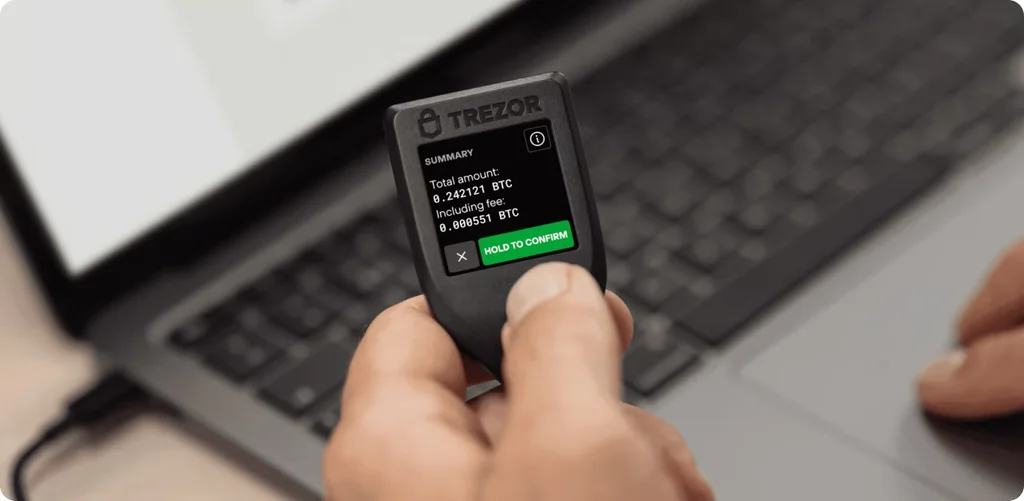
| Trezor Model T | Touchscreen hardware wallet with open-source firmware | None to use the device | “native support for 14 assets”, plus “support for a vast array of 1000s of coins and tokens” | trezor.io labels it “Discontinued” and says “The Trezor Model T is no longer sold, but its spirit lives on in the Trezor Safe 5.” |
Four of those rows need a sentence the round-ups usually skip.
Zengo and Exodus are not anonymous. They are good wallets, and both are self-custodial. But an email address is a persistent identifier, and a buy flow that verifies everyone is a verified buy flow. Use them for what they are.
Wasabi’s coinjoin needs context, not just configuration. zkSNACKs, which ran the coordinator most users relied on, discontinued that service on 1 June 2024, a date docs.wasabiwallet.io still records.
On 27 April 2024 it also said it was blocking US citizens and residents “from visiting its websites, downloading and using Wasabi Wallet and any related products and services”. Its shutdown post noted that other clients using the same coordinator were affected, Trezor Suite among them.
No such notice appears at the addresses read on 28 September 2026, which is not the same as the block having been lifted.
The Trezor Model T can no longer be bought. Trezor’s own page says so and points buyers to the Safe 5. Existing owners are not stranded: Trezor commits to software updates until at least 2031 and critical security fixes until at least 2036.
Where the Identity Checks Actually Happen
The reader’s real question is not whether the wallet asks for identification. It is where, in the journey from cash to coins and back, somebody will.
The answer is the regulated edge. The European Union’s Transfer of Funds Regulation, 2023/1113, has applied since December 2024, and the European Banking Authority sets out what it means in practice.
In its publication “Preventing ML/TF in the EU’s crypto assets sector”, the EBA says crypto-asset service providers “are required to include specific information on the originator and beneficiary” with transfers, so as “to make these transfers traceable”. They must also “apply specific measures in relation to transfers of crypto-assets involving self-hosted addresses”.
Read the scope carefully, because it is the part that gets mangled. Those duties bind the provider, not the wallet and not you. Your own wallet is unaffected. What changes is what a provider must collect and send when you move funds to or from it.
Your obligations are a separate question with a separate answer. Tax on disposals, sanctions law and any reporting your country requires apply to you personally, whether or not anyone ever checked your documents. There is no threshold below which sanctions stop applying.
All of this moves. Every figure here was read on 28 September 2026, and a vendor can change what it asks for without telling anyone. The errors that hurt run one way: a stale line saying less was asked of you than is asked today, which a reader acts on. Note the date on the page you read.
Privacy tooling sits inside that same frame. On 19 November 2025 the US Department of Justice announced that the founders of Samourai Wallet, which it calls a mobile application and a cryptocurrency mixer, were sentenced to five and four years in prison.
The offence, in the release’s own words, was “a conspiracy to operate a money transmitting business in which they knowingly transmitted criminal proceeds”, over more than $237 million. That was a prosecution of the operators of a mixing service, and the release says nothing about users being charged.
Anyone weighing a mixing or coinjoin service should still know the category has produced custodial sentences, and should read what identity checks are actually for before deciding.
Where UPay Sits in This
UPay is one of those regulated edges, and it is straightforward about it. It is registered as a money services business in the United States and Canada, holds a Hong Kong money service operator licence and a Lithuanian VASP approval in principle.
UPay’s own site, read 28 September 2026, lists BTC, ETH, USDT and USDC in its wallet. Its current cards run on Visa and are issued by partner institutions. A virtual Premier or Platinum card costs 10 USDT to issue, with a 2% recharge fee and no annual or monthly charge.
Card eligibility is set by nationality and the list changes, so check the current version in UPay’s Help Center.
That is the trade. A self-custody wallet asks nothing and offers no recourse. A registered provider asks for identification and gives you a spending rail, published fees and somebody to complain to.
Conclusion
Safeguarding financial privacy matters more as breaches become routine, and self-custody is part of the answer. Just buy it for what it is.
Choose the wallet that fits the assets you hold and the device you use, keep your recovery phrase offline and on paper, and treat the public ledger as permanent, because it is. Privacy is a practice, not a product you install once.
FAQs
Are anonymous crypto wallets legal?
Holding your own keys is lawful in most places, and no rule read for this guide prohibits it. The regulation in this area is aimed at providers rather than wallet users. Your tax and sanctions obligations are unaffected by which wallet you choose.
Can transactions from these wallets be traced?
Yes, on transparent chains such as Bitcoin and Ethereum. The ledger is public and permanent, and linking one address to a person exposes the history behind it. “Private” here means fewer parties hold your documents, not that your payments are hidden.
Which wallets here genuinely require nothing?
Wasabi and Electrum, on the reads above, and the Trezor device itself. Zengo requires an email address, and Exodus requires verification for purchases made inside the app.
Can I receive funds with an anonymous crypto wallet?
Yes. Share your public address and anyone can send to it, as with any other wallet. Bear in mind that a sender who is a regulated provider may have to record information about the transfer.
What security measures should I take?
Download only from the vendor’s own address, keep your recovery phrase on paper and offline, use a strong unique password, keep the software updated, and send a test amount first. Anyone asking for your recovery phrase is trying to rob you.
Prefer a spending rail with published fees and a support desk? Open a UPay account at upay.com.