A Contract Account (CA) is an Ethereum address that is controlled by smart contract code rather than by a private key. Unlike an Externally Owned Account (EOA) – the standard wallet controlled by a human with a private key – a contract account is created when a smart contract is deployed to the blockchain and can only execute actions as defined by its code. Contract accounts hold balances, store data (state), and execute logic automatically when triggered by transactions. Every DeFi protocol (Uniswap, Aave, Compound), every NFT collection, every DAO, and every token contract exists as a contract account on Ethereum. Understanding the distinction between EOAs and contract accounts is fundamental to understanding how Ethereum and similar blockchain platforms work.
Definition
A Contract Account is a blockchain address governed by code:
| Aspect | Description |
| Controlled By | Smart contract code (not a private key) |
| Creation | Deployed to the blockchain via a contract creation transaction |
| Capabilities | Hold ETH, store data, execute code, call other contracts |
| Cannot Do | Initiate transactions on its own (must be triggered by an EOA or another contract) |
| Address Format | Same format as EOAs (0x followed by 40 hex characters) |
| Also Known As | Smart contract address, contract, CA |
Origin & History
“An account controlled by code rather than a key – this simple concept enables the entire smart contract ecosystem.”
| Date | Event |
| 2013 | Vitalik Buterin’s Ethereum whitepaper defines two account types: externally owned accounts and contract accounts |
| 2015 | Ethereum launches; first contract accounts deployed on mainnet |
| 2016 | The DAO – a famous contract account that held $150 million in ETH before being exploited |
| 2017 | ERC-20 token standard makes contract accounts the foundation of the token economy |
| 2017 | CryptoKitties – contract accounts for NFTs cause Ethereum congestion |
| 2020 | DeFi protocols deploy contract accounts that manage billions in assets |
| 2020 | DeFi Summer – contract accounts on Uniswap, Aave, and Compound hold tens of billions |
| 2021 | NFT boom creates millions of new contract accounts for collections |
| 2021 | ERC-4337 (Account Abstraction) proposes blurring the line between EOAs and contract accounts |
| 2024 | Smart contract wallets (contract accounts acting as user wallets) gain traction through account abstraction |
How It Works
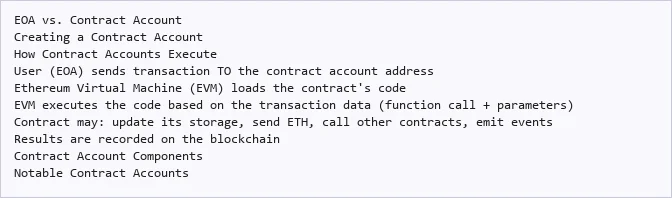
| Feature | Externally Owned Account (EOA) | Contract Account (CA) |
| Controlled by | Private key (human/software) | Smart contract code |
| Can initiate transactions | Yes | No (must be triggered) |
| Has code | No | Yes (stored on-chain) |
| Has storage | No | Yes (persistent state) |
| Creation cost | Free (generate key pair) | Gas fee for deployment |
| Can hold ETH | Yes | Yes |
| Examples | MetaMask wallet, hardware wallet | Uniswap, USDT contract, any dApp |
| Step | Description |
| 1. Write code | Developer writes smart contract in Solidity (or Vyper) |
| 2. Compile | Code is compiled to EVM bytecode |
| 3. Deploy transaction | EOA sends a special transaction with no “to” address containing the bytecode |
| 4. Address generation | Ethereum assigns a deterministic address based on deployer address + nonce |
| 5. Code stored | The bytecode is permanently stored on-chain at the new address |
| 6. Ready | The contract account is live and can receive transactions |
| Component | Description |
| Address | Unique 20-byte identifier (same format as EOAs) |
| Balance | Amount of ETH held by the contract |
| Code | Immutable bytecode that defines the contract’s behavior |
| Storage | Persistent key-value store for the contract’s state data |
| Nonce | Counter for contracts created by this contract |
| Contract | Purpose | TVL/Value |
| Uniswap V3 Router | Decentralized token exchange | Billions in daily volume |
| USDT (Tether) | Stablecoin token contract | $80+ billion in tokens |
| Aave V3 | Lending/borrowing protocol | $10+ billion TVL |
| OpenSea Seaport | NFT marketplace protocol | Billions in NFT trades |
| WETH | Wrapped Ether contract | Billions in wrapped ETH |
In Simple Terms
- A contract account is a robot on the blockchain– it follows programmed rules automatically, like a vending machine that dispenses tokens when you insert the right coins.
- It can hold money and make decisions– a contract account can hold millions of dollars in ETH and tokens, and automatically execute complex financial logic based on its programming.
- It can’t act on its own– unlike your wallet, a contract account can’t initiate actions. It sits and waits until someone (an EOA) or another contract sends it a transaction, then it executes its code.
- Every DeFi protocol is a contract account– when you swap tokens on Uniswap or lend on Aave, you’re interacting with contract accounts that automatically handle the complex logic.
- The code is the law– once deployed, a contract account’s code is (generally) immutable. It does exactly what it’s programmed to do, regardless of the creator’s intentions after deployment.
Important: Contract accounts are the foundation of everything built on Ethereum beyond simple ETH transfers. Every token (ERC-20, ERC-721), every DeFi protocol, every DAO, and every dApp relies on contract accounts. Understanding them is essential for understanding the Ethereum ecosystem.
Real-World Examples
Scenario 1: Uniswap Liquidity Pool
| Aspect | Details |
| Scenario | A user wants to swap ETH for USDC without a centralized exchange |
| Implementation | The Uniswap contract accounts hold liquidity pool reserves. When a user sends a swap transaction, the contract automatically calculates the exchange rate, deducts fees, and sends the correct amount of USDC back to the user |
| Outcome | The entire exchange process is handled by contract account code – no human intermediary, no order book, no counterparty risk from a centralized entity |
Scenario 2: The DAO Hack (2016)
| Aspect | Details |
| Scenario | The DAO was a contract account holding $150 million in ETH, designed as a decentralized investment fund |
| Implementation | An attacker exploited a reentrancy bug in the contract code, allowing them to recursively withdraw ETH before the contract updated its balance |
| Outcome | $60 million was drained. Since contract code is immutable, the bug couldn’t be “patched.” Ethereum performed a hard fork to reverse the theft – a controversial decision that created Ethereum Classic |
Scenario 3: Multisig Wallet (Gnosis Safe)
| Aspect | Details |
| Scenario | A DAO treasury needs to be managed by multiple signers, requiring 3 of 5 members to approve any transaction |
| Implementation | The DAO deploys a Gnosis Safe contract account that holds all treasury funds. The contract code enforces the 3-of-5 signature requirement before executing any transaction |
| Outcome | No single person can steal the funds; the contract account enforces the security policy automatically, and the 3-of-5 requirement is verifiable on-chain |
Advantages
| Advantage | Description |
| Automation | Executes complex logic automatically without human intervention |
| Trustlessness | Users can verify the code and trust the contract instead of a company |
| Composability | Contract accounts can interact with other contracts, creating complex systems |
| Transparency | All code and state are publicly verifiable on-chain |
| Programmable money | Enables DeFi, DAOs, NFTs, and countless other applications |
Disadvantages & Risks
| Risk | Description |
| Code bugs | Bugs in contract code can lead to permanent loss of funds (The DAO, Parity wallet) |
| Immutability | Once deployed, code typically cannot be changed (upgradeable patterns exist but add complexity) |
| Gas costs | Interacting with contract accounts costs gas, which varies with network congestion |
| Complexity | Smart contract development requires specialized skills and rigorous auditing |
| No self-initiation | Contract accounts cannot trigger their own actions (requires external triggers or keepers) |
FAQ
Can a contract account send transactions on its own?
No. Contract accounts can only execute when triggered by an externally owned account (EOA) or when called by another contract that was itself triggered by an EOA. They cannot initiate actions independently. Services like Chainlink Keepers or Gelato Network provide automated triggering for contracts that need periodic execution.
What is the difference between a contract account and a smart contract?
They’re essentially the same thing from different perspectives. A “smart contract” refers to the code and logic. A “contract account” refers to the on-chain entity (with an address, balance, storage, and code). When you deploy a smart contract, it creates a contract account.
Can a contract account’s code be changed after deployment?
Standard contract accounts have immutable code. However, “upgradeable” patterns (like proxy contracts) allow the logic to be changed by pointing to new implementation contracts. This adds flexibility but also introduces centralization risk (whoever controls the upgrade mechanism can change the contract’s behavior).
What is Account Abstraction (ERC-4337)?
Account Abstraction allows contract accounts to function more like user wallets – with features like social recovery, gas sponsorship, and batched transactions. It blurs the line between EOAs and contract accounts, potentially making contract-based wallets the standard for everyday users.