


Most people who earn money from crypto do not spend it. They leave it sitting in a wallet waiting for the price to go up, or they convert it all back to pounds and send it to a bank. Both options miss a third path that is growing rapidly in 2026: earning regular yield from decentralised finance (DeFi) and spending that yield in the real world using a crypto card, without ever needing to sell your original holdings.
This article explains what DeFi yield is, the three main ways to earn it, how you move it into a spendable form, and how a crypto card like UPay completes the loop. The full picture goes from protocol to purchase, and every concept is explained from scratch. By the end, you will have a clear understanding of how people are turning blockchain earnings into everyday spending money in 2026.
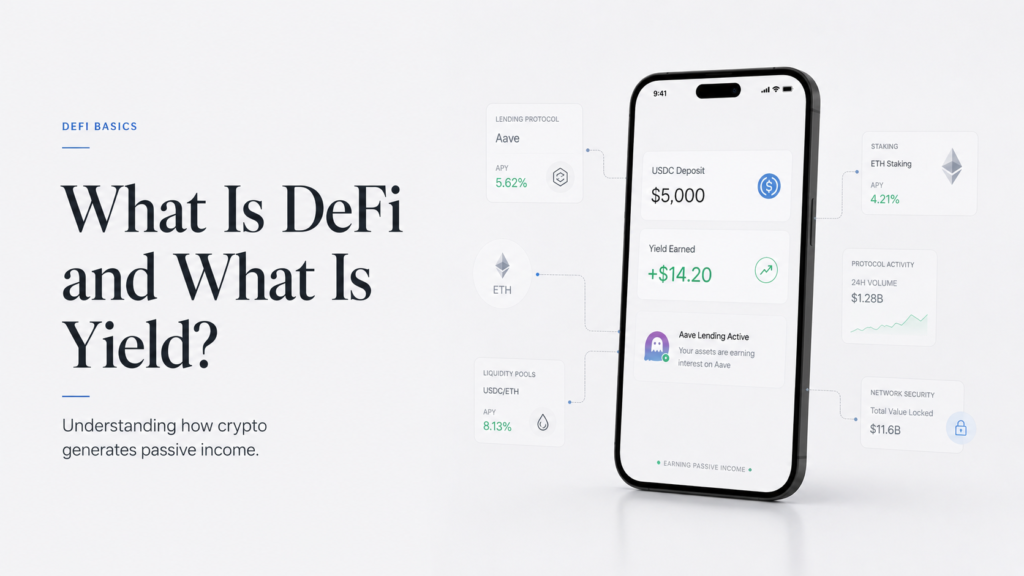
What Is DeFi and What Is Yield?
DeFi stands for decentralised finance. It is a collection of financial tools built on blockchains that operate without banks, brokers, or any central company in the middle. Instead of a bank deciding who can lend and who can borrow, DeFi uses smart contracts: self-executing pieces of code that run automatically on the blockchain and follow a fixed set of rules.
Yield, in this context, is the return you earn for putting your crypto to work inside one of these protocols. Just as a traditional savings account pays you interest for depositing money, a DeFi protocol pays you for depositing crypto. The difference is the scale of what is possible. In 2026, stablecoin yields of 4% to 15% are realistic. Some strategies offer more, but they carry significantly more risk.
The Three Main Ways to Earn DeFi Yield
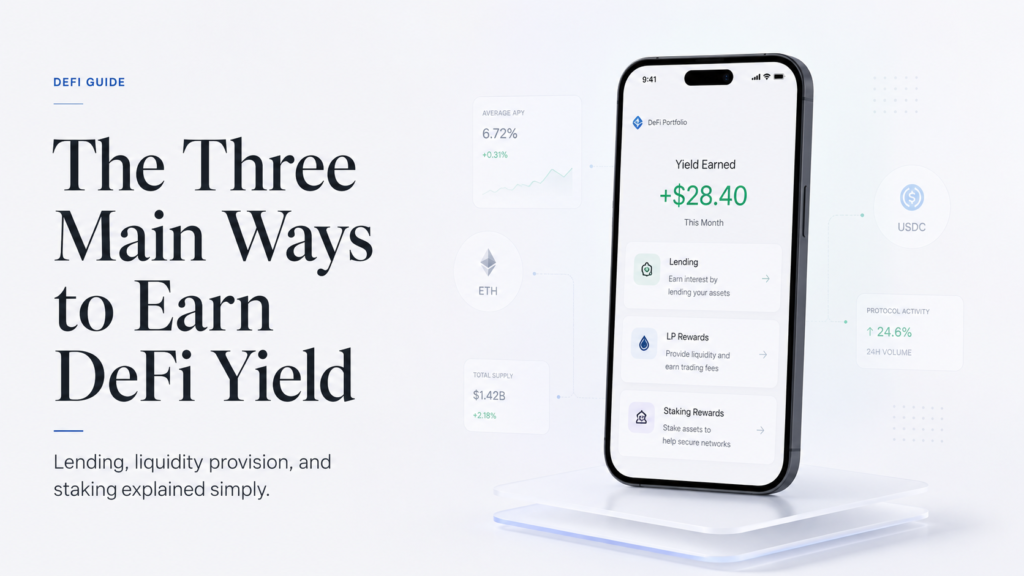
DeFi yield comes from three primary sources. Understanding which source your platform uses is not optional. It determines your risk, your expected return, and what happens if the market moves against you.
1. Lending
Lending is the most straightforward entry point. You deposit tokens into a lending protocol like Aave or Compound, and the protocol lends those tokens to borrowers who pay interest. A portion of that interest flows back to you. The rate adjusts based on how much demand there is from borrowers. For stablecoins like USDT and USDC, lending rates in 2026 typically sit between 4% and 12% APY.
The main risk in lending is smart contract risk, which means there is a small possibility that the code running the protocol contains a vulnerability that could be exploited. This is why choosing established protocols with multiple independent security audits matters. Aave has been operating since 2020 and has been audited repeatedly by firms including OpenZeppelin and Trail of Bits.
2. Liquidity Provision
Decentralised exchanges like Uniswap and Curve Finance do not hold their own funds. Instead, they rely on liquidity providers: people who deposit pairs of tokens into pools so that traders can swap between them. Every time someone makes a trade, a small fee is charged and distributed to everyone who provided liquidity for that pair.
If you deposit USDT and USDC into a Curve pool, you earn a share of every swap that happens within that pool. On popular stablecoin pairs, this can return 6% to 15% APY. On more volatile pairs like ETH and a newer token, returns can be higher but so can a specific risk called impermanent loss, which is covered in the risks section below.
3. Liquid Staking
Liquid staking is a way to earn staking rewards on proof-of-stake blockchains while keeping your assets flexible. If you stake ETH directly on the Ethereum network, your ETH is locked until you choose to unstake. With liquid staking through Lido, you deposit ETH and receive stETH in return. stETH earns staking rewards automatically, and you can still use it in other DeFi protocols to earn additional yield on top.
According to DEXTools, Ethereum staking through Lido provides a 3.5% base return plus the ability to deploy stETH into further DeFi strategies for layered yield. This is one of the most capital-efficient strategies for long-term ETH holders.
What the Numbers Look Like in 2026
DeFi yield rates are not fixed. They move based on how much capital is in a protocol and how much demand there is from borrowers or traders. These figures represent realistic ranges as of May 2026, sourced from DeFi Llama, Aave, and Curve protocol dashboards:
- Stablecoin lending on Aave: 4% to 12% APY. The safest entry point. No exposure to price volatility on your principal.
- Stablecoin LP on Curve Finance: 6% to 15% APY. Minimal impermanent loss because both tokens are pegged to the dollar.
- Liquid staking ETH on Lido: 3% to 8% APY. Predictable base return with full composability in other protocols.
- Volatile pair LP on Uniswap v3: 10% to 30% APY. Higher returns, but impermanent loss risk increases significantly.
- Yield vaults on Yearn or Beefy Finance: Strategy aggregators that automatically deploy capital into the three primary sources (Lending, Liquidity Provision, and Liquid Staking) to chase the best rate.
The Spending Problem: How Do You Actually Use Your Yield?
Earning DeFi yield is one thing. Spending it is another. Most DeFi protocols pay your yield in one of three forms: the same token you deposited, a governance token specific to that protocol, or a reward token that may or may not have stable value. If you want to buy groceries or pay a bill with that yield, you need to bridge the gap between on-chain earnings and real-world spending.
The traditional way to do this involved several steps. Collect your yield. Transfer it to a centralised exchange. Convert it to fiat. Withdraw from your bank. Wait for the bank to process the transfer. Then spend. That process can take two to five business days and costs fees at multiple points.
In 2026, a crypto card cuts that entire process down to a single tap.
How a Crypto Card Completes the Loop
A crypto card is a Visa or Mastercard linked directly to your crypto balance. When you tap the card to pay, the platform converts the required amount of crypto to local currency at the point of sale and processes the transaction normally. The merchant sees a standard card payment. You spend your crypto balance in real time without selling in advance or involving a bank.
According to Finviz reporting on Globe Newswire data, crypto card spending has reached an annualised rate of $18 billion in 2026, growing more than 15 times since 2023. That figure reflects a genuine shift: people are not just holding crypto. They are spending it.
UPay sits directly in this space. According to the UPay blog, UPay supports BTC, ETH, USDT, and USDC at over 55 million Visa merchants worldwide, with no bank account required and transparent cross-border fees of 1% to 2% depending on card tier.
An Example: How Emeka Can Earn Yield and Spend It
Emeka holds £5,000 worth of USDC. He does not want to sell it. He also does not want it sitting idle. Here is what he does.
- He deposits £4,000 USDC into Aave and earns 7% APY. That works out to approximately £280 per year, or about £23 per month, credited directly to his Aave balance in USDC.
- He keeps £1,000 USDC on his UPay card for day-to-day spending. That balance is ready to spend at any shop, restaurant, or website that accepts Visa.
- Each month, he withdraws his yield (approximately £23 in USDC) from Aave and moves it to his UPay card balance.
- He spends from his card balance normally. The UPay card converts USDC to pounds at the point of sale. Emeka never touches a bank.
Over 12 months, Emeka has spent roughly £276, funded entirely by DeFi yield. His original £4,000 USDC principal is untouched in Aave. His £1,000 card balance handles the rest. The yield, not the principal, is what pays for his spending.
The Risks You Must Understand Before Starting
DeFi is not a savings account. The word “decentralised” means there is no company to call, no compensation scheme, and no customer service team if something goes wrong. These are the real risks, explained plainly.
Smart Contract Risk
Every DeFi protocol runs on code. If that code contains a bug or vulnerability, it can be exploited. The Wormhole bridge hack in 2022 resulted in a loss of $325 million. The Ronin bridge exploit drained over $600 million from users. These are not edge cases. They are a real feature of this market. To reduce this risk, only use protocols that have been audited multiple times by reputable firms and have been operating for several years.
Impermanent Loss
Impermanent loss affects anyone who provides liquidity to a pool containing two tokens of different volatility. If you deposit ETH and USDC into a pool and ETH doubles in price, the pool automatically rebalances. You end up with less ETH than you started with and more USDC, because the pool sold some of your ETH as the price rose. The total value may be lower than if you had simply held. This is called impermanent loss. It reverses if prices return to the original ratio, but if you withdraw while prices are diverged, it becomes a permanent loss. Stablecoin pairs have minimal impermanent loss. Volatile pairs carry it as a real cost.
Protocol Risk and Changing Rates
Yield rates in DeFi are variable. A lending rate of 10% today can drop to 3% next week if borrowing demand falls. Always check DeFi Llama for live rates before deploying capital. It shows real-time TVL, rates, and protocol health across every major DeFi network.
Centralized Counterparty Risk (Crypto Card)
While the core DeFi strategies are decentralized, using a crypto card like UPay reintroduces a central counterparty. This means your spending funds are held by a company, not directly in a protocol. The risk here is reliance on that company’s continued operation, their ability to process conversions, and the possibility of changes to their terms or fees, which is a different type of risk than a smart contract exploit.
Tax on Yield
In the UK, HMRC treats DeFi yield as income at the time it is received. In the US, the IRS applies similar rules. Every time yield lands in your wallet, it is a taxable event at the current pound or dollar value. Keep records. Use crypto tax software like Koinly or Cointracker. Spending USDC or a stablecoin via a card may also trigger a taxable disposal event if the stablecoin was acquired at a different value. If you are unsure, speak to a tax professional who works with digital assets.
How to Get Started: The Right Order
The biggest mistake beginners make in DeFi is starting too complex. The right approach is to begin at the lowest rung of the risk ladder and only move up once you fully understand what you are doing.
- Get a Web3 wallet. MetaMask or Rabby Wallet are the standard choices. This is the wallet that connects to DeFi protocols. Write your seed phrase on paper and store it somewhere safe. Anyone who has your seed phrase controls your funds.
- Start with stablecoin lending on Aave. Go to aave.com, connect your wallet, and deposit USDT or USDC. You will earn 4% to 8% APY with no exposure to price volatility on your principal. Check DeFi Llama for current rates before depositing.
- Collect your yield regularly. Aave shows your accrued interest in real time. Withdraw it to your wallet whenever you choose. Most people collect monthly.
- Move yield to your UPay card. Transfer your collected USDC to your UPay account. From there it sits on your card balance and is ready to spend at any Visa merchant worldwide.
- Spend normally. Use the UPay card for everyday purchases. The platform converts USDC to your local currency at the point of sale. No bank transfer required. No delay.
- Only graduate to more complex strategies when comfortable. Liquidity provision and liquid staking carry additional risks that require a solid understanding of impermanent loss and protocol mechanics before you commit capital.
Bringing It Together
DeFi yield to spending is not a complicated concept once you see the full picture. You deposit crypto. A protocol pays you for it. You collect that yield. A card turns it into spending money. Your original holdings stay intact.
The part that trips most people up is the gap between earning and spending. That is the gap UPay is designed to close. With a UPay card linked to your USDC balance, the yield you earn on Aave can be spent at a coffee shop in London, a petrol station in Lagos, or an online store in Singapore, anywhere Visa is accepted, with no bank account involved.
To get started, visit upay.best and create an account. For further reading on how crypto cards work and how the fees compare across providers, see the UPay blog on crypto card fees. For live DeFi yield rates across all protocols, bookmark DeFi Llama and check it before deploying any capital.