Définition
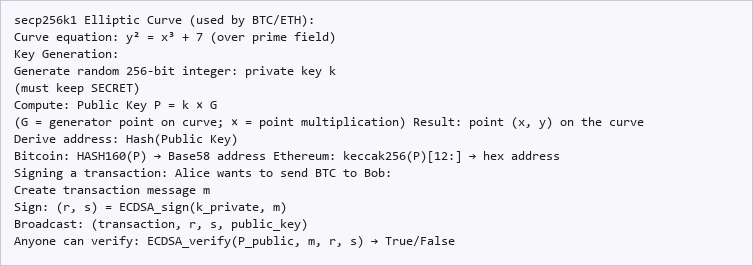
Cryptographie à courbe elliptique (ECC)est asymétrique cryptographique approach based on the algebraic structure of elliptic curves over finite fields, providing equivalent security to RSA with significantly smaller key sizes – a 256-bit ECC key offers the same security as a 3072-bit RSA key. In blockchain and cryptocurrency, ECC is fundamental: Bitcoin and Ethereum use the secp256k1 elliptic curve to generate public-private key pairs, create digital signatures (ECDSA – Elliptic Curve Digital Signature Algorithm), and verify transaction authorization. Every wallet address in Bitcoin and Ethereum is derived from an ECC public key, and every transaction signature proves ownership of the corresponding private key without revealing it. ECC’s hardness relies on the Problème de logarithme discret sur courbe elliptique (ECDLP)– given a point on the curve and the result of repeated point addition, it is computationally infeasible to determine how many times the operation was performed. ECC’s efficiency (small keys, fast operations, low storage) makes it ideal for blockchain’s high-transaction-volume requirements.
Origine & Histoire
| Date | Espaces |
| 1985 | Neal Koblitz and Victor Miller independently propose ECC in separate papers |
| 2000 | SEC (Standards for Efficient Cryptography) Group publishes secp256k1 curve specification |
| 2009 | Bitcoin launches using secp256k1 ECC for private/public key generation and ECDSA signatures |
| 2015 | Ethereum adopts secp256k1 – same curve as Bitcoin for wallet keys and signatures |
| 2010 | Sony PlayStation 3 ECC hack: nonce reuse in ECDSA exposes private key – critical security lesson |
| 2020 | Schnorr signatures (more efficient ECC variant) proposed for Bitcoin via BIP-340 |
| 2021 | Bitcoin Taproot upgrade activates Schnorr signatures – improved privacy and batch verification |
| 2022 | Post-quantum cryptography concerns emerge: ECC vulnerable to future quantum computers (Shor’s algorithm) |
“The security of all Bitcoin wallets rests on a 256-bit elliptic curve. It’s the lock protecting trillions of dollars of value.”
Fonctionnement
| ECC Curve | Utilisé par | Taille de clé | Security Equivalent |
| secp256k1 | Bitcoin, Ethereum | 256-bits | 128-bit symmetric |
| secp256r1 | TLS, U2F, some wallets | 256-bits | 128-bit symmetric |
| Ed25519 | Solana, Cardano, SSH | 256-bits | 128-bit symmetric |
| BLS12-381 | Ethereum validators (BLS sigs) | 381-bits | ~120-bit symmetric |
En termes simples
- Asymmetric magic: You can publish your public key to everyone; only someone with the matching private key can create valid signatures. Anyone can verify signatures using your public key alone.
- Clé privée = total control: Your Bitcoin private key is a 256-bit random number. The public key (and address) is mathematically derived from it – but no computer can reverse the process to recover your private key from your address.
- The lock and key: Your public address is the lock – anyone can send you Bitcoin to it. Your private key is the only key that opens it to spend. There are 2^256 possible keys – more than atoms in the observable universe.
- Point multiplication security: The hardness of ECC comes from computing k given P = k×G – multiplying a point on a curve by itself k times is easy, but reversing it (finding k from P and G) is computationally infeasible.
- Quantum threat: Future quantum computers running Shor’s algorithm could theoretically solve ECDLP – the main reason blockchain researchers are developing post-quantum alternatives for long-term security.
Lire aussi: Frax Finance : Le stablecoin qui s'est reconstruit de A à Z
Exemples du monde réel
| Scénario | Mise en œuvre | Résultat |
| Bitcoin wallet creation | Random 256-bit number → secp256k1 → public key → SHA256+RIPEMD160 → Bitcoin address | Single entropy event creates address controlling potentially unlimited BTC |
| Signature des transactions | MetaMask uses ECDSA secp256k1 to sign every Ethereum transaction | Cryptographically proves you authorized the transaction without sharing your private key |
| Taproot batch verification | Bitcoin Taproot (Schnorr ECC variant) enables batch signature verification | Multiple signatures verified in one operation – 50%+ efficiency gain for multi-sig |
| PS3 hack (ECC cautionary tale) | Sony’s PS3 used same random nonce for all ECDSA signatures – private key extractable | Console DRM broken; demonstrated that ECC security requires proper randomness |
Avantages
| Avantage | Description |
| Small key sizes | 256-bit ECC = 3072-bit RSA security – less storage and bandwidth |
| Calcul rapide | Point multiplication faster than RSA modular exponentiation at equivalent security |
| Blockchain native | secp256k1 optimized for blockchain use cases; hardware wallet support universal |
| Compact signatures | ECDSA signatures are 64-72 bytes – efficient for blockchain space |
| Testé au combat | 15+ years in Bitcoin/Ethereum with zero known successful breaks |
Inconvénients et risques
| Désavantage | Description |
| Vulnérabilité quantique | Shor’s algorithm on quantum computers could break ECDLP |
| Nonce criticality | Reusing or guessing the signing nonce exposes private key (PS3 hack, Bitcoin early bugs) |
| Key management burden | Private key loss = permanent asset loss; no recovery mechanism |
| Complexité de mise en œuvre | Correct ECC implementation is subtle; bugs can be catastrophic |
Conseils de gestion des risques :
- Never reuse ECDSA signing nonces – use RFC 6979 deterministic nonce generation
- Store private keys offline (hardware wallets) to protect from software vulnerabilities
- Monitor post-quantum cryptography developments – plan for eventual migration when standards mature
- Use well-audited ECC libraries (libsecp256k1, OpenSSL) – never implement ECC from scratch
QFP
What is secp256k1 and why did Satoshi choose it?
secp256k1 is a specific elliptic curve defined by y² = x³ + 7 over a 256-bit prime field, published in the SEC standard. Satoshi’s choice was somewhat unusual (secp256r1/P-256 is more common in standards) – secp256k1’s structure has advantages for efficient signature computation and was considered less likely to contain NSA-inserted backdoors than the NIST-recommended P-256 curve.
Can Bitcoin addresses be cracked by guessing private keys?
Practically impossible. The secp256k1 key space is 2^256 – a number so large that checking all possibilities would take longer than the age of the universe even with all computing power on Earth.
How does the PS3 hack relate to ECC?
Sony’s PS3 used ECDSA signatures to verify game code. Their implementation used the same random nonce (k value) for every signature – a fatal flaw. When two signatures share a nonce, the private key can be algebraically recovered. This same vulnerability existed in some early Bitcoin implementations.
What are Schnorr signatures and how do they differ from ECDSA?
Both are ECC-based signature schemes using secp256k1. Schnorr signatures (activated in Bitcoin’s Taproot upgrade) are simpler, enable native multi-signature aggregation (multiple signatures appear as one), batch verification, and better privacy. ECDSA was chosen for Bitcoin initially because Schnorr patents hadn’t expired in 2009.
Will quantum computers break Bitcoin?
Current quantum computers cannot – they lack sufficient qubits and error correction. A future quantum computer with millions of error-corrected qubits could theoretically break secp256k1. The Bitcoin community is monitoring NIST’s post-quantum cryptography standardization and can hard fork to quantum-resistant algorithms before the threat materializes.