




Marcus made money in crypto the hard way — glued to three monitors, phone alert, skipping dinners because the market looked interesting.
He was profitable. He was also exhausted. One evening, his daughter asked why he was always busy. He didn’t have a good answer.
That question is what led him to learn how to earn crypto passively. The best decision he never planned to make.
“Passive crypto income is not about chasing quick profits. It is about earning steady rewards while avoiding the stress of constant trading.”
What Does Passive Crypto Income Really Mean?
Passive income in crypto is money you earn automatically by holding or locking your cryptocurrency in specific platforms or networks.
Instead of trading every day, you deposit your coins into services that reward you over time.
Common ways to earn passive crypto income include:
- Staking: Locking coins to support a blockchain and earning rewards
- Lending: Lending your crypto to others and earning interest
- Yield farming: Providing liquidity to DeFi platforms for rewards
- Savings accounts: Earning interest through crypto platforms
For example, if you stake Ethereum or lend stablecoins like USDT, you may receive weekly or monthly rewards without doing extra work.
“Passive crypto income means letting your crypto work for you, instead of watching charts or trading every day.”
Why Crypto Passive Income Matters
In 2026, crypto passive income is more important than ever for several reasons. First, traditional savings accounts still offer very low interest in many countries.
Meanwhile, crypto platforms often provide higher returns when used wisely. Second, blockchain technology has matured.
Many platforms are now more secure, regulated, and user-friendly. This makes it easier for beginners to earn safely.
Third, inflation continues to reduce the value of money worldwide. Earning passive income through crypto helps protect purchasing power over time.
Crypto passive income also matters because it:
- Creates an extra income stream
- Helps grow long-term wealth
- Reduces dependence on a single salary
- Supports financial independence
For many people in 2026, crypto is no longer just for trading. It has become a serious tool for building steady income.
Read Also: How to integrate crypto payments into a website?
How to Earn Crypto Passively-Different Methods
| Method | Typical APY Range | Risk Level | Skill Level | Best For |
| Staking | 3%-15% | Low-Medium | Beginner | Long-term holders |
| Crypto Lending | 4%-12% | Low-Medium | Beginner | Stable income seekers |
| Yield Farming | 5%-50% | High | Advanced | High return seekers |
| Dividend Tokens | 2%-13% | Medium | Intermediate | Long-term investors |
| Liquid Staking | 4%-18% | Medium | Intermediate | Flexible earners |
| Real-Yield Protocols | 6%-20% | Medium | Intermediate | Sustainable income seekers |
1. Staking
Staking is one of the simplest ways to earn passive income in crypto. Instead of letting your coins sit idle in a wallet, you lock them into a blockchain network to help keep it running smoothly.
In return, the network rewards you with more coins. Some blockchains allow you to stake directly by running a validator, which usually requires technical skills and a large amount of capital.
Others use delegated staking, where you simply choose a validator and assign your coins to them. They handle the technical work, while you earn a share of the rewards.
Over time, staking has also evolved. Today, many platforms offer flexible options, including liquid staking, which lets you earn rewards while still keeping your funds usable.
Popular staking coins in 2026 include Ethereum (ETH), Solana (SOL), Cardano (ADA), Polkadot (DOT), and Cosmos (ATOM). These networks are trusted, widely used, and supported by many platforms.
Pros of Staking:
- Easy way to earn regular rewards
- Suitable for beginners
- Supports long-term investing
- Often available on major platforms
Cons of Staking:
- Funds may be locked for some time
- Rewards depend on network performance
- Token prices can still fall
- Validator failures may affect earnings
See Also: Crypto-to-fiat conversion methods.
2. Crypto Lending & Interest Accounts
Crypto lending works like a digital savings account. You deposit your crypto, and other users borrow it. In return, you earn interest.
On centralized platforms, everything is handled for you. You simply deposit your assets, and the platform manages the lending process.
This is convenient but requires trusting the company with your funds.
On decentralized platforms like Aave or Compound, smart contracts handle lending automatically.
You stay in control of your wallet, and everything is transparent on the blockchain.
Many investors prefer lending stablecoins such as USDT, USDC, or DAI because their prices do not fluctuate much.
This makes income more predictable and reduces stress during market swings.
However, lending is not risk-free. If markets crash suddenly or platforms face liquidity problems, withdrawals may be delayed, or funds may be lost.
Pros of Crypto Lending:
- Steady and predictable income
- Works well with stablecoins
- Easy on centralized platforms
- No need to trade daily
Cons of Crypto Lending:
- Risk of platform failure
- Smart contract vulnerabilities
- Possible withdrawal delays
- Interest rates can change quickly
3. Yield Farming & Liquidity Provision
Yield farming is a more active way of earning passive income. It involves providing liquidity to decentralized exchanges and earning rewards in return.
When you add two tokens to a liquidity pool, you receive LP tokens that represent your share.
These LP tokens can then be staked in farming platforms to earn extra rewards.
Some platforms automatically reinvest your earnings through vaults. This means your profits compound over time without you doing anything manually.
However, yield farming comes with a major risk called impermanent loss. If token prices change sharply, you may end up with less value than if you had simply held your coins.
In recent years, new models like Pendle and dual-reward farms have emerged, offering more ways to earn. These systems can be profitable, but they require more knowledge and attention.
Yield farming is best for users who are comfortable with DeFi and willing to monitor their investments.
Pros of Yield Farming:
- High earning potential
- Multiple reward streams
- Works well with auto-compounding tools
- Great for advanced users
Cons of Yield Farming:
- Risk of impermanent loss
- Complex for beginners
- Smart contract risks
- Requires regular monitoring
4. Dividend & Revenue Sharing Tokens
Some crypto projects reward holders by sharing part of their profits, similar to dividends in traditional stocks.
These tokens give you a claim on platform revenue. As the project grows and earns more, your income increases.
Payments may come in stablecoins, native tokens, or fee discounts. This makes them attractive for investors who want regular payouts.
NFTs have also joined this model. Some NFTs earn royalties when resold, while others represent ownership in games, platforms, or digital businesses.
In Web3 gaming and metaverse projects, NFTs can generate rent, rewards, or staking income.
This method works best for people who believe strongly in a project and want to benefit from its long-term success.
Pros of Revenue Sharing Tokens:
- Regular income from platform profits
- Works like digital dividends
- Encourages long-term holding
- Growing use in NFTs and Web3
Cons of Revenue Sharing Tokens:
- Depends on project success
- Income may fluctuate
- Some projects lack transparency
- Regulatory uncertainty
How Passive Crypto Income Differs From Active Trading
Passive crypto income and active trading are two very different approaches to making money. Active trading involves:
- Buying and selling frequently
- Watching price charts daily
- Timing the market
- Managing high emotional stress
Traders aim to profit from short-term price changes. While it can be profitable, it is risky and requires constant attention. Passive crypto income, on the other hand, focuses on:
- Holding assets long-term
- Earning steady rewards
- Minimal daily involvement
- Lower emotional pressure
Instead of worrying about daily price movements, passive investors focus on earning consistent returns over time.
See Also: How to build a crypto payment app?
Top Passive Income Protocols
| Category | Name | Best For | APYs | Pros | Cons |
| CEX | Binance | Users who want many earning options in one place and are comfortable with advanced features | 3%–10%+ | Huge selection of earning products; Competitive APYs; Supports many cryptocurrencies; Easy switching between strategies | Complex interface for beginners; Regulatory issues in some regions; Account restrictions possible; Fully custodial |
| CEX | Kraken | Investors who prioritize security, transparency, and long-term stability | 3%–7% | Strong security reputation; Simple staking setup; Clear fee structure; Good regulatory standing | Fewer earning products; Lower yields than Binance; Limited advanced strategies; Smaller asset selection |
| CEX | Coinbase | Beginners and long-term investors who value trust and simplicity over high returns | 2.5%–5% | Extremely beginner-friendly; Strong regulatory compliance; Trusted brand reputation; Easy fiat integration | Lower APYs; Higher fees; Limited earning products; Less flexibility |
| DEX | Lido | Ethereum investors looking for staking rewards while keeping capital flexible | 3%–4% | Flexible staking with liquid derivatives; Well-established and trusted; Compatible with DeFi platforms | Moderate APY; Smart contract risks; Dependence on Ethereum performance |
| DEX | Aave | Investors seeking stable, reliable interest on stablecoins and crypto lending | 4%–7% | Simple non-custodial lending; Transparent audited smart contracts; Flexible withdrawals; Wide asset selection | Rates fluctuate; Smart contract risks; Moderate returns |
| DEX | Pendle | Advanced DeFi users looking to trade or maximize future yield exposure | Variable / High Yield | Enables sophisticated yield strategies; High flexibility; Access to unique DeFi yield markets | Complex for beginners; Higher risk exposure; Requires understanding of yield token mechanics |
| DEX | Rocket Pool | Users who want decentralized staking with smaller amounts of ETH | 3%–5% | Decentralized and community-driven; Low minimum staking; Compatible with restaking opportunities | APY lower than Lido sometimes; Less adoption; Ethereum dependency |
| DEX | Curve Finance | Users looking to provide stablecoin liquidity with minimal impermanent loss | 2%–10% | Stable returns; Low impermanent loss risk; Fee-sharing rewards | Returns lower than volatile farming; Requires LP understanding; Smart contract risk |
| DEX | Convex Finance | Curve LPs seeking higher yield without manual staking management | 5%–15%+ | Higher APY for Curve LPs; Easy-to-use platform; Yield optimization | Dependent on CRV value; Platform centralization risk; Limited to Curve ecosystem |
| DEX | Yearn Finance | Investors wanting automated yield strategies without active management | 4%–12% | Fully automated compounding; Saves time and gas fees; Access to multiple strategies | Smart contract risks; Limited customization; Returns depend on market conditions |
| DEX | EigenLayer | Advanced Ethereum stakers looking to maximize yield through multi-layer staking | 5%–15%+ | Amplifies staking rewards; Integrates with multiple protocols; New earning opportunities | Complex and high-risk; Exposure to multiple smart contracts; Requires deep DeFi knowledge |
| DEX | Compound | Users who want steady decentralized interest on major cryptocurrencies and stablecoins | 3%–6% | Non-custodial and transparent; Strong security track record; No lock-up period; Simple interface | Moderate returns; Variable interest rates; Smart contract risks; Limited high-yield opportunities |
How to Choose the Right Crypto for Passive Income
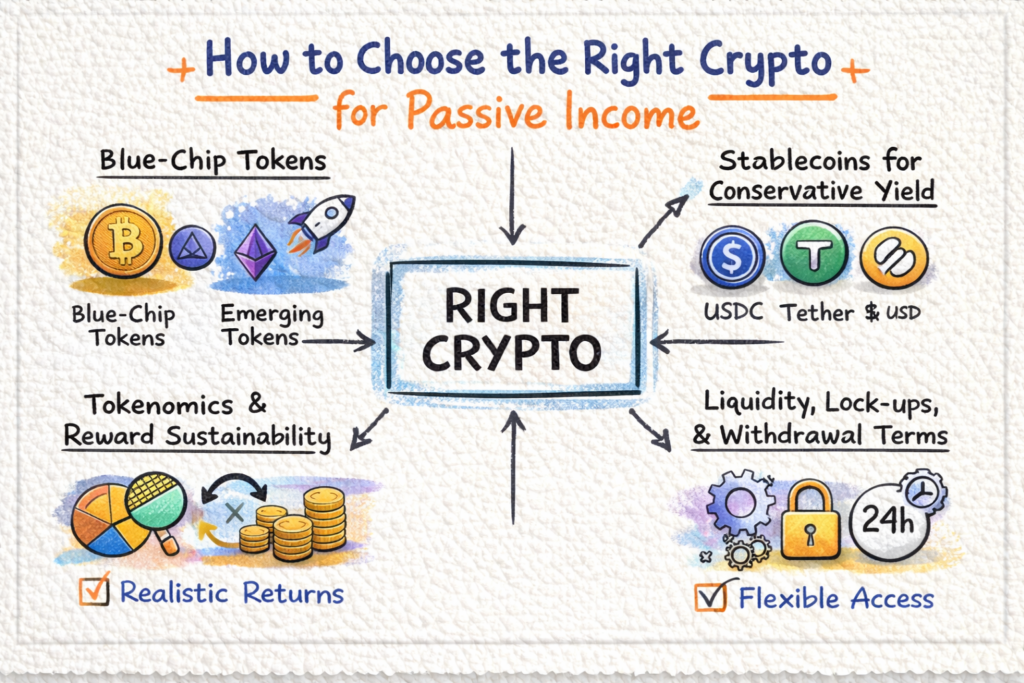
1. Blue Chip vs Emerging Tokens
Blue-chip cryptocurrencies like Bitcoin, Ethereum, and Solana are generally safer bets for earning passive income.
They have proven track records, strong networks, and deep liquidity. Staking or lending these coins offers more predictable returns, and they’re less likely to lose significant value overnight.
Emerging tokens, on the other hand, can offer sky-high yields. Many DeFi projects and altcoins advertise APYs that seem too good to pass up.
But with higher reward comes higher risk; these tokens are prone to price swings, rug pulls, or protocol failures.
2. Stablecoins for Conservative Yield
If you want to earn passive income without worrying about market volatility, stablecoins like USDC, USDT, or DAI are your safest option.
These coins are pegged to fiat currencies and usually generate yields from lending or liquidity provision.
Stablecoins typically earn 3–12% APY depending on the platform.
They’re ideal if your goal is steady income, short-term funding, or capital preservation.
3. Tokenomics & Reward Sustainability
Not all APYs are created equal. Understanding a token’s tokenomics, how it’s minted, distributed, and burned, is essential.
Some projects reward users with new token emissions, which can inflate supply and reduce real value over time.
Others distribute revenue generated from fees or protocol activity, which tends to be more sustainable.
Look for platforms where rewards come from real yield (fees, interest, or revenue-sharing) rather than pure token inflation.
This ensures your earnings aren’t wiped out by devaluation.
4. Liquidity, Lock-ups, & Withdrawal Terms
Before staking or depositing, always check liquidity and lock-up conditions.
Some platforms require you to lock funds for weeks or months, which can limit flexibility and make it hard to react if prices drop.
Others allow instant withdrawals but may offer lower APYs.
High liquidity ensures you can exit or move your assets without losing value.
Lock-ups can boost APY but add risk. Withdrawal terms vary; some platforms charge fees or require advanced notice.
Tools & Tracking for Passive Crypto Income
Keeping tabs on your crypto income and security isn’t just smart; it’s essential. Fortunately, there are tools that make life far easier.
1. Portfolio Trackers
Tools like CoinTracker, Koinly, or Delta help you monitor all your crypto across exchanges and wallets in one place.
They sync transactions automatically and show your overall portfolio value, performance, and changes in real time. Many also generate tax reports you can use during tax season.
2. DeFi Analytics Dashboards
DeFi can be messy with multiple chains, yield strategies, and token types. Analytics dashboards like Zerion, Debank, or Dune offer deep insights into positions, earnings history, and trends.
These dashboards visualize your passive income streams and can help you spot inefficiencies or opportunities to optimize your yield.
They also make tracking DeFi interactions much simpler than chasing history through block explorers.
3. Automation Tools & Bots
Automation tools like Autonoly and others are emerging that automate parts of tax reporting or portfolio management.
They can pull your transactions from wallets and exchanges, reconcile them, classify events like staking rewards or swaps, and even prepare audit-ready reports.
Frequently Asked Questions
Is crypto passive income really passive, or does it require work?
Crypto passive income can be mostly hands-off, but it isn’t completely automatic.
You still need to choose good platforms, monitor performance, and adjust when markets or rules change.
Think of it as low-effort income, not set it and forget it.
Can I lose money while earning passive income?
Yes. Risks include price crashes, platform hacks, smart contract failures, and scams. Higher yields usually mean higher risk.
Diversifying and using secure platforms helps reduce potential losses.
Should I use centralized platforms or DeFi for passive income?
It depends on your experience and goals. Centralized platforms are easier and safer for beginners.
DeFi offers higher potential returns and more control but requires technical knowledge and careful risk management. Many investors use both for balance.
Do I need a lot of money to start?
No. Many platforms allow you to start with a small amount of crypto. Some learn-and-earn programmes even let you earn without investing any money.
Conclusion
Crypto passive income is no longer just about chasing the highest APY or jumping on the newest trend.
It is about building a system that works for you, one that balances growth, safety, flexibility, and peace of mind. The most successful earners aren’t the ones who gamble everything on risky platforms.
They are the ones who understand how to earn crypto passively, spread their capital wisely, and adapt as the market changes.