Crypto arbitrage is a trading strategy that exploits price differences for the same cryptocurrency across different exchanges, markets, or trading pairs. Because crypto-markten are fragmented across hundreds of exchanges worldwide – each with its own supply, demand, and liquidity dynamics – the same asset can momentarily trade at different prices on different platforms. Arbitrageurs buy the asset where it’s cheaper and simultaneously sell where it’s more expensive, capturing the spread as profit. In traditional finance, arbitrage opportunities are rare and fleeting due to highly efficient markets. In crypto, however, the market’s decentralized and fragmented nature creates more frequent (though increasingly competitive) arbitrage opportunities. Arbitrage plays a crucial role in market efficiency – by exploiting price discrepancies, arbitrageurs actually help align prices across exchanges and reduce inefficiency in the global crypto market.
Definitie
Crypto arbitrage involves profiting from price differences across markets:
| Aspect | Beschrijving |
| Kernbegrip | Buy low on one exchange, sell high on another – capture the price spread |
| Waarom het bestaat | Crypto markets are fragmented; prices differ across 500+ exchanges |
| Vereiste snelheid | Seconds to minutes – opportunities are fleeting and competitive |
| Risicoprofiel | Lower risk than directional trading, but not risk-free (transfer delays, fees, slippen) |
| Marktrol | Improves price efficiency by aligning prices across exchanges |
| Tools | Bots, APIs, cross-exchange algorithms, DeFi flash loans |
Oorsprong en geschiedenis
“Arbitrage is the invisible hand of markets – it doesn’t predict prices, it corrects them.”
| Datum | Evenementen |
| Oude tijden | Merchants practice arbitrage by buying goods cheaply in one market and selling in another |
| 1800s | Rothschild family famously arbitraged government bond prices across European markets |
| 2010-2013 | Early Bitcoin arbitrage – massive price differences between Mt. Gox and other exchanges (sometimes 10%+) |
| 2017 | “Kimchi Premium” – Bitcoin trades 5-30% higher on Korean exchanges due to capital controls |
| 2017 | ICO boom creates massive arbitrage opportunities between exchange listings |
| 2020 | DeFi summer introduces flitslening arbitrage – borrow, arbitrage, repay in a single atomic transaction |
| 2021 | MEV (Maximale Extraheerbare Waarde) becomes a major topic – validators/miners extract arbitrage profits from transaction ordering |
| 2022-2024 | Sophisticated MEV bots and Flashbots dominate on-chain arbitrage; cross-chain arbitrage grows with bridge proliferation |
Hoe het werkt
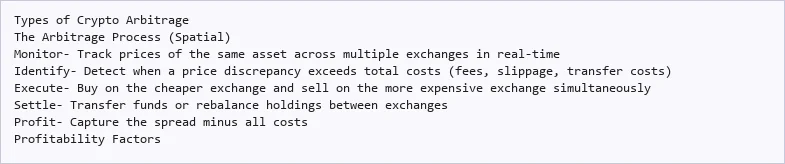
| Type | Beschrijving | Voorbeeld |
| Spatial (Exchange) | Same asset, different price on two exchanges | BTC at $65,000 on Exchange A, $65,150 on Exchange B |
| Driehoekig | Exploit mispricing between three trading pairs on the same exchange | BTC/ETH → ETH/USDT → USDT/BTC loop yields profit |
| Statistisch | Use historical correlations to identify temporary pricing anomalies | ETH/BTC ratio deviates from historical mean; trade the reversion |
| DeFi-arbitrage | Exploit price differences across DEXs or between DEX and CEX | Uniswap vs. SushiSwap price differences on the same token |
| Flash-lening arbitrage | Borrow large sums (no collateral), execute arbitrage, repay – all in one transaction | Borrow $10M on Aave → arb across DEXs → repay + keep profit |
| Cross-Chain | Arbitrage between the same token on different blockchains | USDC on Ethereum vs. USDC on Arbitrum |
| Factor | Impact |
| Prijsspreiding | Must be larger than total costs to be profitable |
| Handelskosten | Typically 0.1%-0.3% per trade on each exchange |
| Overdrachtsvergoedingen | Network fees to move crypto between exchanges |
| Overdrachtstijd | Slow transfers mean the opportunity may disappear |
| Slippage | Large orders can move the price against you |
| Competitie | Other arbitrageurs and bots compete for the same opportunities |
In eenvoudige bewoordingen
- Imagine Bitcoin is selling for $65,000 on Exchange A and $65,200 on Exchange B at the same moment – that $200 difference is an arbitrage opportunity.
- You buy 1 BTC on Exchange A(cheaper) and simultaneously sell 1 BTC on Exchange B (more expensive), pocketing the $200 difference minus fees.
- This works because crypto markets are fragmented– there are hundreds of exchanges around the world, each with its own buyers and sellers, and prices don’t always stay perfectly aligned.
- In practice, it’s not as simple as it sounds– you need money pre-deposited on multiple exchanges, you’re competing with automated bots that execute in milliseconds, and fees/slippage can eat into profits.
- DeFi has created a new type of arbitrage using “flash loans” – you can borrow millions of dollars with no collateral, execute an arbitrage trade, and repay the loan all within a single blockchain transaction. If the trade isn’t profitable, the entire transaction reverts as if it never happened.
Belangrijk: While arbitrage is lower risk than directional trading, it’s not risk-free. Exchange insolvency, transfer delays, sudden price movements, and technical failures can all lead to losses.
Voorbeelden uit de echte wereld
The Kimchi Premium – Geographic Arbitrage
- Scenario: Bitcoin consistently traded at a 5-30% premium on South Korean exchanges compared to global markets, due to capital controls limiting money flow in/out of Korea
- Implementatie: Traders attempted to buy BTC on global exchanges and sell on Korean exchanges (Bithumb, Upbit) – but strict regulations on moving Korean won abroad made this difficult
- Resultaat: The Kimchi Premium persisted for years, demonstrating that arbitrage only works when capital can flow freely; regulatory barriers can create persistent price differences
Flash Loan Arbitrage – DeFi Innovation
- Scenario: A trader identified that DAI was priced at $1.00 on Uniswap but $1.02 on another DEX due to a temporary liquidity imbalance
- Implementatie: Using a flash loan from Aave, the trader borrowed $5 million, bought DAI on Uniswap (cheaper), sold on the other DEX (more expensive), repaid the flash loan + fee – all in a single atomic transaction
- Resultaat: Profit of approximately $100,000 in a single transaction with zero capital at risk (if the trade fails, the flash loan automatically reverts)
MEV Bots – The Arbitrage Arms Race
- Scenario: Automated bots on Ethereum monitor the mempool for pending trades that will create arbitrage opportunities
- Implementatie: When a large swap is detected on Uniswap, MEV bots submit their own transactions with higher gas fees to execute arbitrage before the original trade settles (known as “backrunning”)
- Resultaat: MEV extraction has generated billions in cumulative profit; led to the creation of Flashbots and PBS (Proposer-Builder Separation) to manage its impact on network fairness
Voordelen
| Voordeel | Beschrijving |
| Lower Directional Risk | Profits from price differences, not from predicting market direction |
| Marktredement | Arbitrage activity aligns prices across exchanges, benefiting all traders |
| Consistent Small Profits | Can generate steady, incremental returns when executed at scale |
| DeFi-innovatie | Flash loans enable capital-free arbitrage with zero collateral risk |
| Schaalbaarheid | Automated bots can monitor thousands of pairs across dozens of exchanges simultaneously |
| Leerzaam | Understanding arbitrage provides deep insights into market microstructure |
Nadelen en risico's
| Risico | Beschrijving |
| Uitvoeringsrisico | Prices can change during the time it takes to execute both sides of the trade |
| Overdrachtsvertragingen | Moving crypto between exchanges takes time – opportunity may vanish |
| Fee Erosion | Trading fees, withdrawal fees, and network fees can eliminate narrow spreads |
| Valutarisico | Funds on exchanges are at risk of hacks, insolvency, or frozen withdrawals |
| Competitie | Professional bots and HFT firms have millisecond advantages over manual traders |
| Regelgevingsrisico | Some jurisdictions restrict capital flows that enable arbitrage (e.g., Korea’s Kimchi Premium) |
FAQ
Is crypto arbitrage legal?
Yes – arbitrage is a legitimate trading strategy in virtually all jurisdictions. It actually benefits markets by improving price efficiency. However, certain methods (like front-running other users’ transactions) raise ethical and potentially legal concerns.
Can I do crypto arbitrage manually?
Technically yes, but it’s increasingly difficult. Most arbitrage opportunities are captured by automated bots within seconds. Manual arbitrage is more feasible with geographic premiums (like the Kimchi Premium) where opportunities persist for longer.
How much money do I need for crypto arbitrage?
For centralized exchange arbitrage, you typically need significant capital ($10,000+) pre-deposited on multiple exchanges to make meaningful profits from small percentage differences. For DeFi flash loan arbitrage, you technically need zero capital (but need technical skills to build and deploy smart contracts).
What is the Kimchi Premium?
The “Kimchi Premium” refers to the phenomenon where Bitcoin and other cryptocurrencies trade at significantly higher prices on South Korean exchanges compared to global markets – sometimes 5-30% higher. It’s caused by capital controls that prevent easy arbitrage.