Peer-to-peer trading puts you opposite another person instead of an order book. You agree a price, the platform locks the seller’s crypto in escrow, the buyer pays by bank transfer or mobile money, and the escrow releases.
That is why P2P reaches markets a card-funded exchange does not, and why the small print decides everything. Fees move, venues close, and a dead marketplace can leave its marketing pages up for years.
Every figure below was read on the operator’s own page on 28 September 2026.
Key Takeaways
- Five names on almost every list need a second look: LocalBitcoins, LocalCryptos and Paxful stopped trading, WazirX trades again under a court-sanctioned scheme, and Huobi is just the old name for HTX.
- Escrow protects the crypto leg of a trade and not the money leg, which is why a seller who releases against a reversible payment method can lose both.
- Published fees vary more than most lists say: 0.75% to each side at Hodl Hodl, 1.3% combined on the old Bisq protocol, and 1% to the offer creator at LocalCoinSwap.
- Region gating is the first constraint you meet. Hodl Hodl and Bybit both bar United States residents outright, and LocalCoinSwap and OKX both bar India.
- Neither side of a Binance P2P trade is reliably free, because a flat taker fee applies to USDT pairs in selected fiat markets and Binance publishes maker fees separately.
- Identity checks are mandatory at Binance, OKX, Bybit, MEXC and WazirX, discretionary at LocalCoinSwap, and absent at Hodl Hodl and Bisq. No venue here operates a small-trade exemption.
What a P2P Exchange Is, and What Escrow Actually Covers
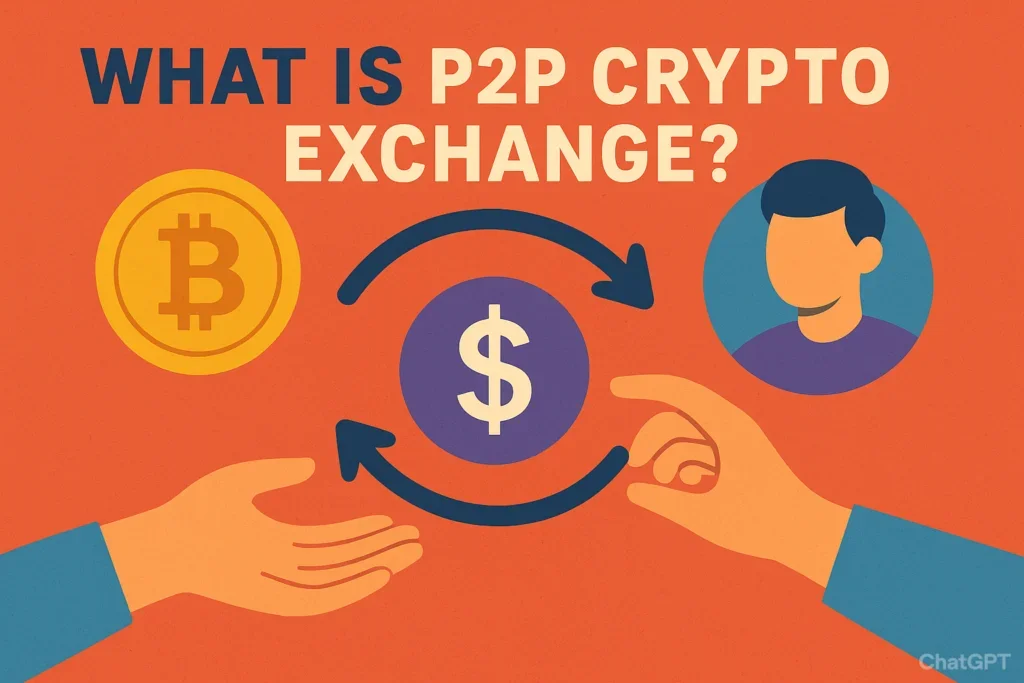
On a P2P marketplace you trade against a named counterparty, and the venue’s only job is to hold the crypto while the money moves on a rail it does not control.
MEXC describes it plainly at mexc.com: “When an order is created, MEXC locks the crypto amount being traded within the P2P order until both parties complete the transaction.” Non-custodial venues do the same with multi-signature wallets rather than a company account.
That sentence contains the most important fact about peer-to-peer trading. Escrow holds crypto. It does not hold the buyer’s money, and cannot claw it back once it has been sent and reversed.
Binance says so in its own guide to chargebacks: a chargeback happens “when your trade partner requests to have their funds back after you’ve completed the transaction and received your money”.
The seller can “end up losing both the crypto you sold and the money you received”, and Binance’s advice is to “select payment methods that do not allow chargebacks as much as possible”.
In practice that means card payments, PayPal and some mobile wallets, all of which can be pulled back weeks later. A cleared bank transfer, or cash, cannot.
Reversibility is a property of the payment rail, not of the person. A counterparty with five hundred completed trades and a perfect rating can still file a card dispute, so reputation does not protect a seller here. Crypto itself moves the other way: once sent, it is not reversible.
The Nine Venues, and What Each One Publishes
Where a venue’s own page could not be read, the cell says so rather than sitting empty.
| Venue | Identity check | Fee, from its own page | Country restrictions in its own terms |
|---|---|---|---|
| Binance P2P | Mandatory for all new users | Flat taker fee of 0.06 to 0.08 USDT per trade order on USDT pairs in selected fiat markets, plus maker fees of 0% to 0.35% by market | Its terms serve through an embedded PDF viewer, so the current list could not be read |
| OKX P2P | Required, and the paying account name must match the verified name | “No service fee for trading P2P”, with payment providers charging their own | Its Risk and Compliance Disclosure, updated 8 July 2026, restricts Afghanistan, Canada, Cuba, Hong Kong, India, Iran, Japan, Malaysia, Nepal, North Korea, Syria and parts of Ukraine |
| Bybit P2P | Standard level mandatory for all products | Its P2P fee article, updated 28 July 2026: takers 0% in most listed markets, makers 0.05% to 0.3% | Its help centre, updated 1 September 2026, excludes the United States, Chinese Mainland, Hong Kong, Singapore, Canada, North Korea, Cuba, Iran, Uzbekistan, Sudan and Syria |
| MEXC P2P | Primary verification mandatory | Zero platform fee, with the payment provider’s own charges on top | Its published app-availability table names no restricted region |
| WazirX | Required, with Travel Rule verification on crypto deposits | Not published at any address read for this table | Not published at any address read for this table |
| HTX P2P | Not readable; its support pages return empty bodies to a fetch | Not readable, same reason | Not readable, same reason |
| Hodl Hodl | None today, but its terms reserve the right to introduce it | 0.75% per registered user, paid by each side separately | United States residents barred outright, with Russia, Belarus, Cuba, Iran, Iraq, North Korea, Somalia, Sudan and Syria |
| Bisq | No registration and no KYC | Bisq Easy, the only protocol Bisq 2 launched with, charges no trade fee; the older multisig protocol is 1.3% combined | Its introduction page names none |
| LocalCoinSwap | Discretionary, and can be demanded on any trade | 1% to whoever created the offer | India barred, with Belarus, Cuba, Iran, Iraq, Lebanon, Libya, Mongolia, Russia, Syria and others |
Hodl Hodl’s fee is not shared. Its FAQ at hodlhodl.com sets a “Trading fee of 0.75% for every registered user” and says “each party will pay their respective fee”, so a trade costs up to 1.5% between you, less where one side is a referral at 0.5%.
Bisq publishes two different answers because it runs two protocols. The wiki at bisq.wiki puts the older “Combined BTC trading fee rate” at “1.3% (0.15% by maker and 1.15% by taker)”, while Bisq Easy, the only protocol Bisq 2 launched with, says “There are no trade fees for buyers or sellers”, capped at 600 USD a trade.
LocalCoinSwap’s identity policy has no threshold. Its terms reserve the right “at our sole discretion, to require Know Your Customer (KYC) and Anti-Money Laundering (AML) documentation” on a dispute, on suspicion, or on a regulator’s request. That can arrive on a ten dollar trade or a ten thousand dollar one.
MEXC has the cheapest published fee and the most regulator attention. The Financial Conduct Authority added MEXC Global Ltd to its warning list on 22 March 2024: “This firm may be promoting financial services or products without our permission.”
BaFin published an unauthorised-business notice on mexc.com on 19 October 2023, and France’s AMF blacklisted the site on 4 June 2024.
Five Names You Will Still Find on Other Lists
A P2P venue can stop trading while its marketing site keeps running, and a venue that stopped can start again, so the only reliable check is the operator’s own announcement page on the day you act.
Paxful is the clearest case. Its main site still reads “Buy bitcoins instantly” and still lists gift cards among its payment methods.
Its own withdrawal property at withdraw.paxful.com carries the headline “Paxful Has Shut Down Operations: What You Need to Know”, and offers only “a limited service for users to access existing accounts and withdraw any remaining digital assets”.
The Department of Justice announced at justice.gov on 8 July 2024 that co-founder and former chief technology officer Artur Schaback pleaded guilty to an anti-money-laundering conspiracy, having “marketed Paxful as a platform that did not require KYC”.
LocalBitcoins states it on its own front page: “LocalBitcoins Oy has closed its Bitcoin trading service. You may still have funds available for withdrawal.”
LocalCryptos runs the same trap and runs it harder, because localcryptos.com carries no closure notice at all. Only the operator’s farewell post, its “5th and final birthday” for a platform “launched on this day in 2017”, says that after 18 November 2022 “new trade creation will be disabled”.
WazirX is the one that came back, which is why a closure notice is not the end of the check. Its blog records a scheme of arrangement that “takes effect from 15 October 2025”, sanctioned by the Singapore High Court after a July 2024 cyberattack.
Its own announcements centre is posting again, most recently on 25 September 2026.
Huobi never closed at all. HTX’s own post from TOKEN2049 on 13 September 2023 explains the rebrand, with the H standing for Huobi and the T for TRON, and the P2P service continues under the HTX name.
How Sellers Actually Lose Money
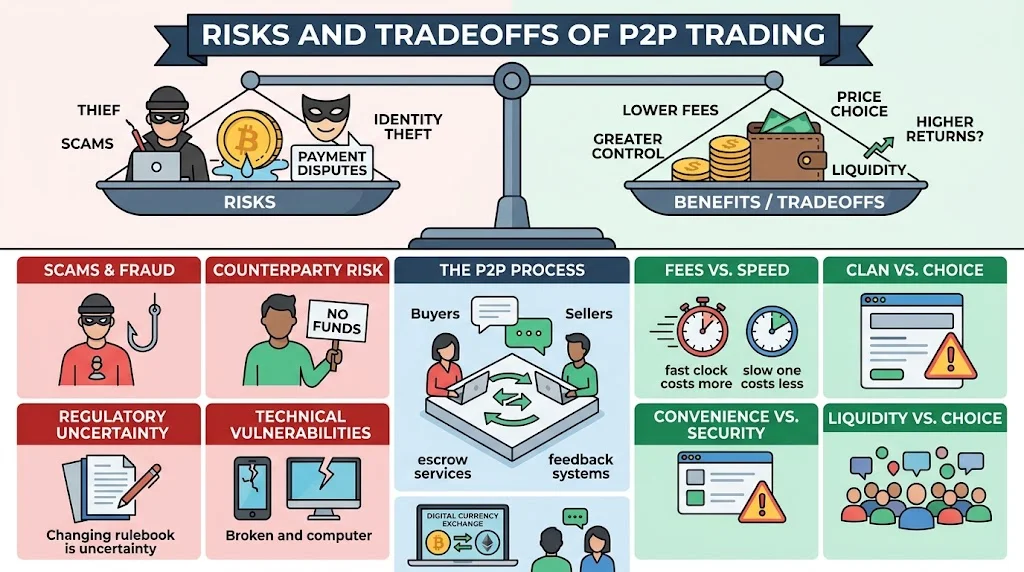
The payment options are the reason to use P2P and the reason it goes wrong, because they settle outside the platform. The rail choice is yours to get right.
A second seller-side attack sits outside the rail rule. A buyer who opens a trade and never pays locks the seller’s crypto in escrow until the order times out, costing them the use of the coins and any price movement.
OKX closes part of the first gap by rule rather than advice. Its P2P transaction rules say: “Please use the payment method with the account owner name that is consistent with your registered name on OKX.”
The same rules state that “The Platform does not support non-real-name-verified payment methods”, and set a minimum fifteen day suspension of the P2P function for using one.
Account freezing is the outcome nobody mentions. Binance’s P2P statement on anti-money-laundering rules says that where suspected illegal transactions are found the platform “will take actions against the user, including but not limited to freezing accounts, notifying relevant authorities”.
Binance pleaded guilty on 21 November 2023 to Bank Secrecy Act, unlicensed money transmitting and IEEPA charges, paying $4,316,126,163 in forfeiture and fines.
OKX pleaded guilty on 24 February 2025 to one count of operating an unlicensed money transmitting business and agreed to pay more than $504 million. The Department of Justice said OKX employees “advised customers how to provide false information to circumvent the company’s KYC process and official policy prohibiting U.S. customers”.
What the Law Asks of You, Wherever You Trade
What a service asks for and what the law requires of you are two different questions. Your tax, sanctions and reporting duties follow you into a trade whether or not anyone checked a passport, and sanctions carry no minimum amount, so a small trade with the wrong counterparty is still a breach.
Pseudonymous is not anonymous either. A public ledger is permanent, and an address that is later tied to a person makes its whole history readable backwards, including trades made years earlier on a venue that has since closed.
Treat a permissive threshold you read somewhere as the most dangerous kind of stale fact, because it is the kind a reader acts on. Take the wording from the provider’s own current page, note the date you read it, and keep the address.
The position for an individual also differs from the position for a platform, which our guide to whether peer-to-peer crypto trading is legal sets out by jurisdiction.
Making Your First Trade Without Losing It
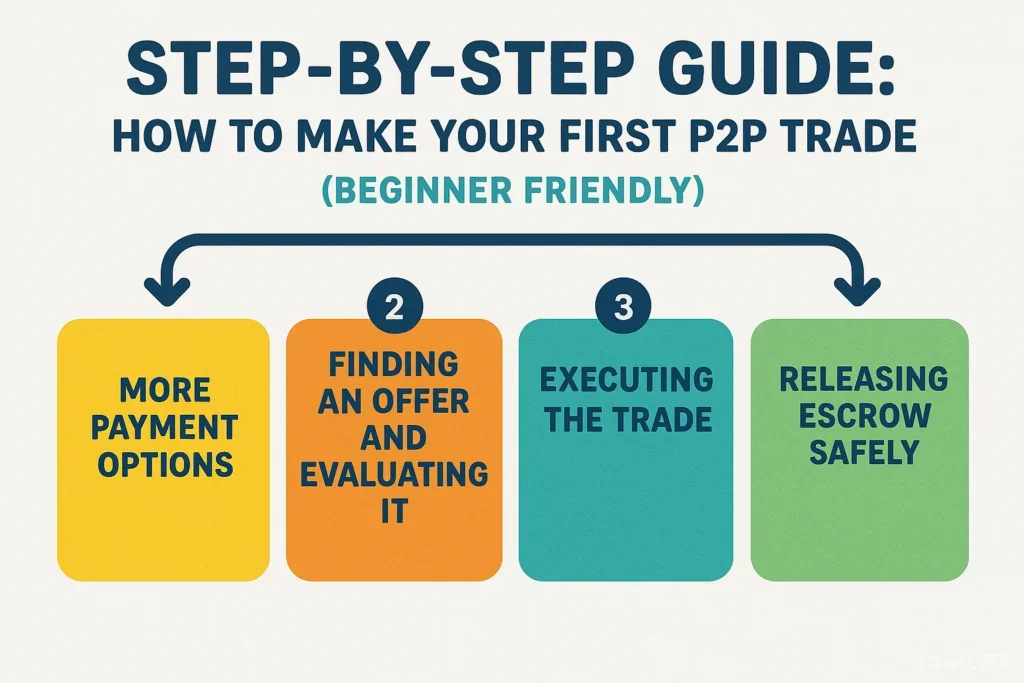
- Find the venue’s restricted-country list before you register, because an account you cannot lawfully hold is worse than no account.
- Complete verification where it is required. Venues that check identity apply the same identity rules banks apply, and avoiding them is what the OKX prosecution was about.
- As a seller, refuse reversible rails, and never release escrow on a screenshot or a pending notification.
- As a buyer, pay only from an account in your own name, through the platform’s own payment flow.
- Check the offer’s payment window and the fee you will actually be charged.
- If something goes wrong, open a dispute inside the platform before the escrow timer expires, and keep your payment receipt.
Spending the crypto afterwards is a separate problem, and UPay, whose blog this is, sells a card of its own, so read the next sentence as the publisher describing its own product.
UPay’s current consumer cards run on Visa, are issued by partner institutions, cost 10 USDT to issue in virtual form with no annual or monthly fee, and are topped up from the UPay wallet at a 2% recharge fee.
FAQs
Do I need identity verification to trade peer-to-peer? At Binance, OKX, Bybit, MEXC and WazirX, yes, and their own help pages say so without qualification. Hodl Hodl and Bisq require none. None offers a size-based exemption, so the idea that a smaller trade escapes checks is not a feature any of them publishes.
Which P2P exchange has the lowest fees? Three publish zero: Bisq Easy, OKX (“No service fee for trading P2P”) and MEXC, though your payment provider’s charges apply in every case. The cheapest published fee is not the same as the safest venue, as MEXC’s three regulator notices show.
Is escrow enough to keep me safe? It protects a buyer well and a seller only partly. It guarantees the crypto exists and is locked, and does nothing about a payment reversed after release, or a buyer who never pays.
Can I use these platforms from anywhere? No. Hodl Hodl and Bybit both bar United States residents, and LocalCoinSwap and OKX both restrict India. Check the operator’s own terms for your country before you deposit anything, and never try to route around a restriction.
What happened to LocalBitcoins, Paxful and LocalCryptos? All three stopped trading and now exist mainly to let former users withdraw. Two of the three still look open, which is why you check an operator’s announcement page rather than its homepage.
Do I still owe tax on a peer-to-peer trade? Yes. A disposal is a disposal wherever it happens, and the duty is yours rather than the platform’s. Our guide to reporting cryptocurrency income covers what that involves in practice.