




Every couple of months, a headline claims stablecoins have “crossed” some new milestone, maybe $300 billion, $320 billion, and soon maybe $1 trillion.
It’s easy to scroll past these numbers without really registering what they mean. But look closer and the story gets genuinely interesting: as of May 2026, the combined value of all stablecoins in circulation has hit roughly $321–322 billion, a figure that now exceeds the foreign exchange reserves of 95 countries, including the United Kingdom and Canada.
That’s not a crypto-native statistic anymore. It’s a real signal about how fast dollars are moving onto blockchain rails.
Two issuers, Tether and Circle, still control more than 80% of the market between them, even as new regulation, bank charters, and payment integrations are reshaping who gets to compete.
At the same time, analysts can’t agree on where this goes next, forecasts for 2030 range from a modest $500 billion to a bullish $4 trillion, depending on who you ask.
This guide breaks down exactly where the stablecoin market cap stands today, what’s fueling its growth, which risks could slow it down, and how to track it yourself going forward.
Key Takeaway
- Stablecoin market cap hit a record of ~$321–322 billion in May 2026, now bigger than the FX reserves of 95 countries.
- USDT and USDC together control over 80% of the market, though USDT is losing ground in the EU under MiCA.
- Regulation is the biggest growth driver in 2026, the GENIUS Act and MiCA have pushed banks, exchanges, and payment giants like Visa and Mastercard deeper into stablecoins.
- Real risks remain, including depegging events, tightening regulation, and rising competition from tokenized bank deposits and CBDCs
What Is Stablecoin Market Cap?
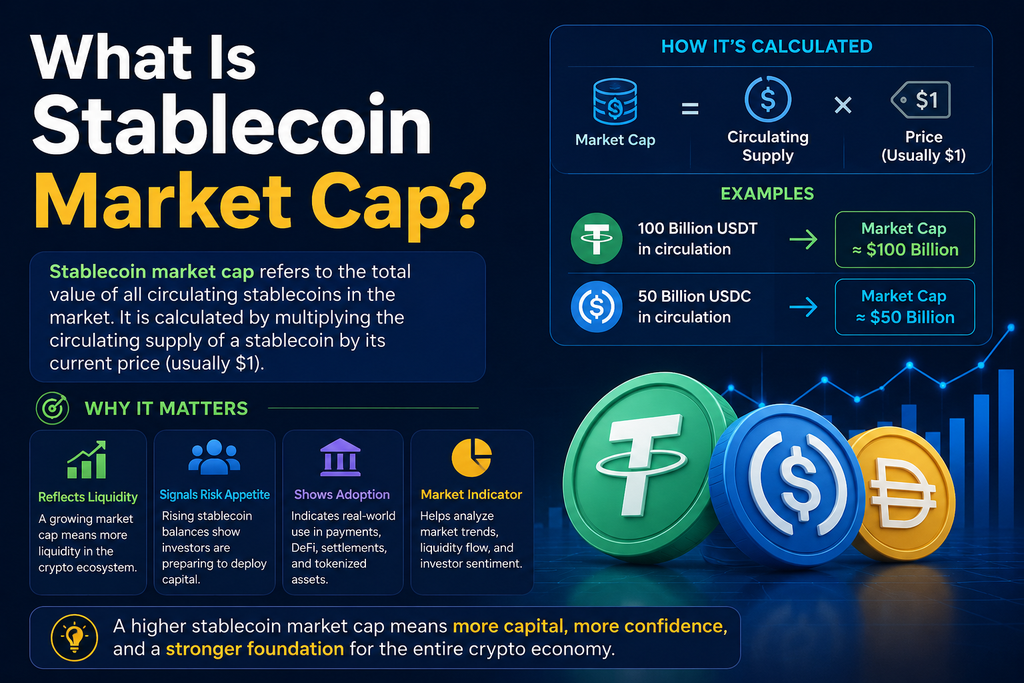
Stablecoin market cap is the total dollar value of all stablecoins currently in circulation. It’s the number people point to when they say the stablecoin market crossed a certain amount, but it’s easy to misread if you don’t know what’s actually being measured.
Why Stablecoin Market Cap Differs From Volatile Crypto Market Cap
With Bitcoin or Ethereum, market cap swings because price swings. A coin’s supply might barely change in a week, but its market cap can jump or drop 20% just from trading activity.
Stablecoins work the other way. Price is designed to stay flat, so market cap growth reflects real demand, issuers minting new tokens because people are depositing dollars to get stablecoins in return, or burning tokens when users redeem them for cash.
That makes stablecoin market cap a more direct read on capital flowing into (or out of) the crypto ecosystem, rather than a reflection of speculation or sentiment.
Also Read: Best Open Source Crypto Trading Bots
How Market Cap Is Calculated
The formula itself is simple:
Market cap = price × circulating supply
But there’s more going on underneath it than that one-line formula suggests. Here’s the full picture:
The two inputs, explained
- Price: what one unit of the stablecoin is currently trading for on exchanges. For a healthy dollar-pegged stablecoin, this should hover close to $1.00, usually within a fraction of a cent either way.
- Circulating supply: the total number of tokens that currently exist and are in the hands of holders (wallets, exchanges, protocols). This isn’t a fixed number; it goes up when new tokens are minted and down when tokens are redeemed and burned.
A worked example
Take USDT. If there are 180 billion USDT tokens in circulation and each one is trading at $1.00, the market cap is:
180,000,000,000 × $1.00 = $180 billion
If USDT temporarily drifts to $0.998 during a period of market stress, that same supply would technically value the market cap at about $179.6 billion, a small but real dip that reflects momentary peg pressure rather than any change in actual token count.
Also Read: How to Use ChatGPT for Crypto Strategy Signals
Total Stablecoin Market Cap in 2026 (Current Numbers)
The stablecoin market has now settled at a new all-time high. As of May 24, 2026, total stablecoin market cap stood at $321.21 billion according to MacroMicro’s tracker.
CoinDesk reported a similar figure two days later, putting the combined market value at a record $322 billion, surpassing the foreign exchange reserves of 95 countries, including developed economies like the United Kingdom and Canada
As of the most recent DeFiLlama-sourced data, Tether (USDT) continues to dominate the market with roughly $188 billion in market cap, while Circle’s USD Coin (USDC) holds the second position with around $78 billion.
Together, Tether and Circle control a bit more than four-fifths of the whole stablecoin market.
Growth Since January 2026 ($308B → $322B)
The rise to $322 billion didn’t happen overnight, it’s been a steady grind through the first five months of 2026:
- January 2026: Stablecoin market cap reached $308.55 billion, per eMarketer’s citation of DeFiLlama data.
- Reuters reporting cited around the same period put the market closer to $300 billion in early March 2026
- April 21, 2026: The market cap surpassed the $321 billion mark, marking a new all-time high for the sector, with USDT alone accounting for 58.29% of total supply (Bitcoin Foundation) .
Top Stablecoins by Market Cap in 2026
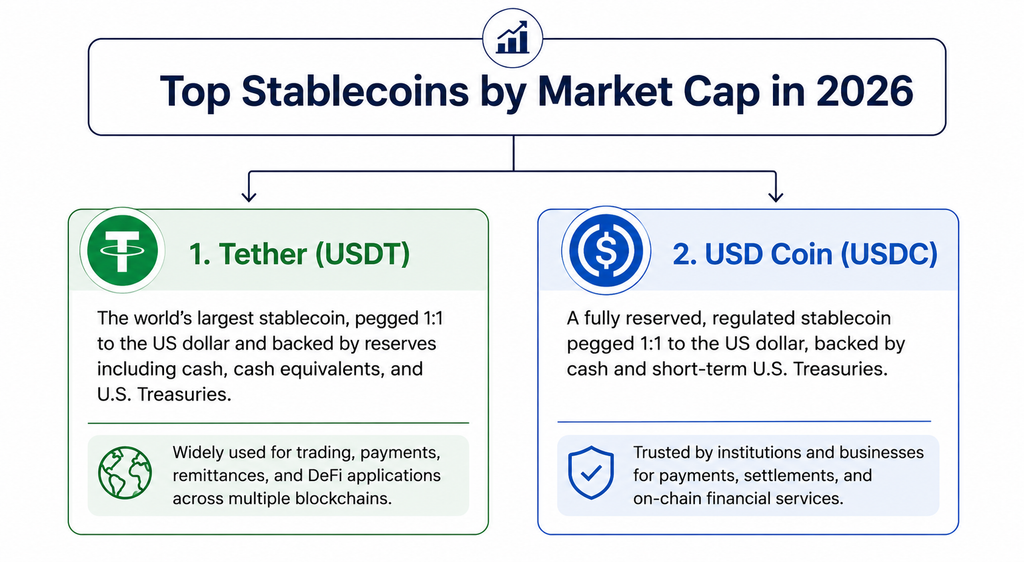
USDT and USDC still hold the top two spots, but the size gap between them says a lot about how this market actually works.
Tether (USDT)
Tether remains the largest stablecoin by a wide margin. As of mid-May 2026, USDT’s net circulation reached $189.77 billion, giving it roughly 58–59% dominance of the entire stablecoin market.
Tether reported approximately $1.04 billion in net profit for Q1 2026 alone, generated primarily from interest income on its Treasury holdings, a scale of profitability that puts Tether’s revenue per employee ahead of nearly any other financial company.
Because Tether is incorporated outside the US (originally the British Virgin Islands, now operating principally out of El Salvador) and holds Bitcoin as a reserve asset, it doesn’t currently qualify under the GENIUS Act’s framework for licensed US payment stablecoins.
It’s also not authorized under the EU’s MiCA regime, which requires a minimum share of reserves held in EU-licensed bank deposits, a structural mismatch with Tether’s Treasury-heavy model.
That’s led to USDT being delisted or restricted for EU users on several major exchanges, even as USDT volumes have continued growing outside the EU, especially across Tron based payment corridors in Southeast Asia and Latin America
Pros
- Highest liquidity of any stablecoin
- Widely used across 15+ blockchains
- Strong peg history since 2014
Cons
- No full audit, only quarterly attestations
- Holds Bitcoin and gold, not just cash
- Not GENIUS Act compliant
- Losing access to EU exchanges under MiCA
USD Coin (USDC)
USDC holds the clear number two position, with circulation around $76.5–78 billion as of May 2026, roughly a quarter of total stablecoin market cap, and less than half of USDT’s size.
How USDC is backed
Circle runs a notably simpler and more conservative reserve model than Tether.
USDC reserves are held in cash and short-dated Treasuries, specifically across Other Bank Deposits, Deposits at Systemically Important Institutions, Overnight Reverse Treasury Repo, and Treasury securities under three months, largely routed through a regulated 2a-7 money market fund structure.
Pros
- Backed only by cash and short-term Treasuries
- Monthly Big Four audits (Deloitte)
- Fully compliant with GENIUS Act and MiCA
- Fast-growing on Solana and PayPal
Cons
- Smaller market cap than USDT
- Less liquidity on exchanges
- Weaker presence in emerging markets
How to Track Stablecoin Market Cap in Real Time

If you want current numbers, these are the tools worth bookmarking.
DefiLlama
DefiLlama’s stablecoin dashboard is the go-to source for most of the data cited throughout this post, and for good reason. It tracks total stablecoin market cap, circulating supply, prices, inflows, and peg stability across every major stablecoin, with breakdowns by issuer, blockchain, and collateral type.
CoinMarketCap / CoinGecko
These are the more consumer familiar trackers, and they’re a good fit if you just want a quick market cap ranking without digging into on-chain detail.
CoinMarketCap lists stablecoins by market capitalization, largest to smallest, and includes basic classification (fiat-collateralized, crypto-collateralized, non-collateralized) alongside price and volume data.
CoinGecko offers a similar ranking view, with the addition of historical charts and a stablecoin-specific category page that’s useful for tracking how smaller entrants like USDe or USD1 are trending over time.
MacroMicro
MacroMicro takes a more macro-economic lens on stablecoin data, plotting total market cap as a time series alongside broader financial indicators, useful if you’re trying to contextualize stablecoin growth against things like Treasury yields or global liquidity trends rather than just crypto-native metrics.
Also Read: AI Crypto Trading: How It Works, Best Bots & Strategies (2026 Guide)
Risks to Stablecoin Market Cap Growth

Stablecoin market cap has grown almost every month through 2026, but the growth story isn’t risk-free. Four pressure points stand out.
Depegging Events and Reserve Mismanagement
A stablecoin’s entire value proposition rests on holding $1. When that breaks, confidence and market cap can vanish fast.
The clearest recent example is USDC’s brush in March 2023, when Silicon Valley Bank’s collapse temporarily froze a portion of Circle’s reserves, causing USDC’s market cap to fall 26% in a single month before recovering.
Regulatory Restrictions in Key Markets
Regulation has been a growth driver in 2026, but it cuts both ways, it can also lock issuers out of entire markets. USDT is the live example: because Tether isn’t MiCA-authorized, it’s been delisted or restricted across major EU exchanges, effectively shutting Tether out of EU retail markets even as it keeps growing elsewhere.
Competition from Tokenized Bank Deposits
Banks aren’t sitting still. Tokenized deposits, essentially bank account balances represented on a blockchain, offer many of the same benefits as stablecoins (instant settlement, programmability) while staying inside the traditional banking and deposit-insurance system.
Also Read: Using The Crypto Tracking Spreadsheet in 2026
FAQs
What is the total stablecoin market cap right now?
As of late May 2026, total stablecoin market cap sits at roughly $321–322 billion, according to DefiLlama and MacroMicro data.
Which stablecoin has the largest market cap in 2026?
Tether (USDT) remains the largest, with roughly $188–190 billion in circulation well ahead of USDC’s $76–78 billion.
Will the stablecoin market hit $1 trillion?
Estimates vary widely. Citi projects $1.9 trillion by 2030 in its base case, Standard Chartered projects $2 trillion by 2028, while JPMorgan expects a more modest $500–600 billion by 2028. No major forecaster expects $1 trillion within 2026 itself.
Why is USDT still bigger than USDC?
USDT has a decade-plus head start, deeper exchange liquidity, and dominant use in emerging-market payment corridors via Tron. USDC leads on regulatory compliance and reserve transparency but trails significantly in overall scale.
Are stablecoins safe to hold at this scale?
Major stablecoins are generally well-collaterated, but they’re not risk-free. Both USDT and USDC have had brief depegging events tied to reserve stress (SVB’s collapse for USDC in 2023, market volatility for USDT in 2022), and reserve quality varies by issuer.
What’s driving stablecoin market cap growth in 2026?
Regulatory clarity from the GENIUS Act and MiCA, growing institutional and bank adoption, payment integrations with Visa and Mastercard, cross-border remittance demand, and the rise of yield-bearing stablecoins are the main drivers.