International business payments currently suffer from a cross-border tax where traditional gateways capture up to 5% of transaction value through currency spreads and interchange fees.
According to 2026 industry benchmarks, businesses operating in high-volume international markets can reduce payment processing costs by up to 40% by shifting to crypto-native infrastructure.
This transition is critical for companies seeking to optimize margins and eliminate the settlement delays inherent in legacy banking systems.
This article compares UPay Business vs traditional payment gateways on the things that actually affect your bottom line: fees, settlement speed, global reach, chargeback exposure, card issuance, and what you can build on top of each. No fluff. Real numbers from publicly available pricing pages.
| KEY FACTS: UPay Business at a Glance |
| Cost Reduction: Up to 40% savings on cross-border fees versus traditional international gateway rates. |
| Settlement Speed: 1 to 3 minutes on-chain confirmation versus T+2 standard fiat banking settlement. |
| Chargeback Risk: Zero. Crypto transactions are irreversible once confirmed on the blockchain. |
Read Also: Coin Ticker: The Three Letters That Speak for a Whole Crypto Project.
What Traditional Payment Gateways Actually Cost
The standard fee that Stripe advertises is 2.9% plus $0.30 per domestic card transaction. That is the number on the pricing page, and it is accurate for domestic US transactions.
It is not the number you pay when your business is international, which for most serious ecommerce and SaaS businesses, it is.
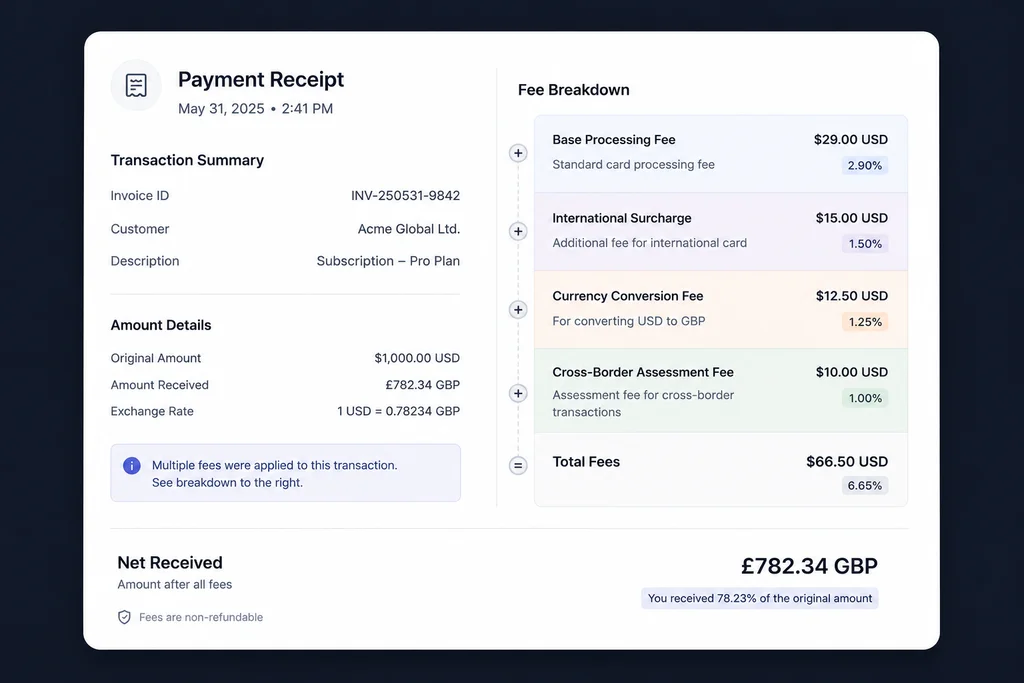
Here is what the fee stack actually looks like when you go cross-border:
- Base rate: 2.9% + $0.30 per transaction for domestic US cards on Stripe. PayPal charges 3.49% + $0.49 for the same transaction, which, according to Merchant Insiders, is 63% higher per-transaction fee than Stripe on a flat-fee basis.
- International card surcharge: Stripe adds 1.5% for cards issued outside the US. According to Midrocket’s 2026 gateway comparison, Stripe charges 3.25% + €0.25 for non-European cards processed in Europe. PayPal adds up to 4.99% on international transfers.
- Currency conversion: If a customer pays in euros and you settle in pounds, there is a conversion spread on top of the international card fee. According to 0xProcessing’s 2026 fee analysis, the 2Checkout (Verifone) FX markup runs 2% to 5% on top of bank rates. Stripe’s conversion fee is an additional 1% on top of its standard rate.
- Chargeback fees: According to Midrocket, chargeback fees with traditional gateways typically run €15 to €25 per dispute. Beyond the flat fee, chargebacks consume staff time in evidence gathering and dispute management.
- Payout delays: Stripe’s standard payout is T+2, meaning funds arrive two business days after the transaction. Instant payouts are available but cost an additional 1% fee. PayPal holds funds in its own balance immediately, but bank withdrawal takes additional time, and newer accounts face more frequent holds.
Add all of that together for a business sending invoices to clients in Nigeria, South Africa, and the UAE, settling in pounds, and dealing with occasional disputes, and the effective rate per transaction sits well above 4%. At scale, that is a high cost that compounds month after month.
For domestic online sales, Stripe and PayPal are comparable at around 2.9%. But for international operations, the cost diverges sharply. PayPal international transfers can cost up to 4.99% plus a fixed fee plus a currency conversion spread. Cross-border transactions carry additional costs that can push total effective rates above 5% per transaction for businesses with significant international revenue. Crypto gateways, by comparison, save up to 40% on fees and reduce settlement times from days to minutes.
The Hidden Costs Nobody Puts on the Pricing Pag
Fund Holds
Both Stripe and PayPal reserve the right to hold merchant funds if their risk systems flag unusual activity. According to WPForms’s Stripe vs PayPal comparison, PayPal tends to place holds more often and more systematically, especially on newer accounts.
A hold means your revenue is frozen in a platform you have no contractual guarantee will release it on a specific timeline.
For a small or medium business with tight cash flow, a single unexpected hold can cause real operational problems.
This is not a hypothetical risk. It has happened to enough merchants that there are entire communities dedicated to appealing PayPal holds and account restrictions.
Traditional gateways make their own risk decisions, and their risk decisions take priority over your cash flow needs.
Rolling Reserves
Many traditional gateways apply rolling reserves to higher-risk merchant categories: a percentage of your revenue held back for a set period as a buffer against chargebacks.
If your business is in crypto, travel, digital goods, or anything the gateway classifies as elevated risk, you may find 5% to 10% of your revenue sitting in reserve rather than in your account.
This does not appear on the headline pricing page. It appears in the merchant services agreement.
The Chargeback Asymmetry
With card payments, the customer has the right to dispute a transaction and the card network sides with the customer by default.
The merchant bears the burden of proving the payment was legitimate. Beyond the flat chargeback fee of €15 to €25, a high chargeback rate puts your merchant account at risk.
Exceed the threshold set by Visa or Mastercard (typically around 1% of transactions) and the gateway will restrict or terminate your account.
Crypto payments have no chargeback mechanism. A transaction confirmed on the blockchain is final. The customer has no route to dispute it through a card network.
Account Termination Risk
Stripe, PayPal, and Square all maintain lists of restricted business categories. Businesses operating in crypto, financial services, certain subscription models, or markets those companies have decided carry too much regulatory risk can have their accounts closed without warning.
If your primary payment infrastructure is a single traditional gateway and that account is terminated, you have no revenue until you establish a new merchant relationship. This concentration risk is often invisible until it is not.
Read Also: Best Crypto Cards With Apple Pay and Google Pay Support
Where Traditional Gateways Fall Short for International Business
The clearest limitation of traditional gateways becomes visible when you look at their actual geographic coverage versus where business actually happens in 2026.

Stripe supports 46 countries for merchant accounts. PayPal is available in more countries for receiving payments, but charges significant premiums for cross-border flows. Authorise.Net is largely US-centric.
Square, despite being a major player, is only fully available in the US, Canada, Australia, Japan, and Ireland. For a business with customers in Nigeria, Ghana, Kenya, the UAE, or Southeast Asia, the practical coverage of traditional gateways is narrower than their marketing suggests.
The currency conversion model makes this worse. A customer paying in naira or cedi through a traditional gateway is paying a fee to convert to a major currency, and the merchant is paying another fee to receive in their settlement currency. Every conversion takes a margin.
According to Spark’s 2026 fee comparison tool, cross-border fees can add 2% to 3% on top of base rates, pushing total costs above 5% per transaction for businesses with significant international revenue.
The payment gateway space has diversified significantly. Stripe leads in developer experience. PayPal offers the largest active user base. But for international B2B settlements, crypto gateways are becoming indispensable. They save up to 40% on fees and reduce settlement times from days to minutes. Merchant demand for stablecoin settlement options is growing steadily, driven by the practical advantages of faster clearing and lower cross-border costs.
What UPay Business Offers Differently
UPay Business is not a direct swap for Stripe. It is a different category of product built for a different set of problems. Understanding what it is actually designed to do makes the comparison clearer.
How to Integrate UPay Business
The integration process follows a clear sequence:
- Access developer credentials: Register at business.upay.best to obtain your API key and Request ID.
- Configure authentication: Every request requires four mandatory headers: X-UPA-APIKEY, X-UPA-REQUESTID, X-UPA-TIMESTAMP, and X-UPA-SIGN (a cryptographic signature preventing tampering in transit).
- Initialise payments: Call POST /api/v1/acquirer/pay to generate unique payment addresses for customers at checkout.
- Configure webhooks: Set up a secure endpoint to receive real-time payment confirmations and automatically update order statuses.
- Sandbox testing: The test environment at https://openapi.upay-test.best mirrors production behaviour. Test all flows, edge cases, and signature verification before going live.
A Note on MEV and Sandwich Attack Risk
Merchants evaluating crypto payment infrastructure sometimes raise concerns about MEV (Maximal Extractable Value) attacks and sandwich attacks, which are transaction manipulation risks associated with public decentralised exchanges and automated market makers.
Because UPay Business operates as a managed API gateway rather than a public DEX or AMM, merchants are effectively shielded from these risks. Payments are routed through UPay’s managed infrastructure, not through public liquidity pools where front-running bots operate.
The merchant never interacts directly with open blockchain mempools in a way that exposes individual orders to sandwich attack vectors.
The Acquirer API: Accepting Crypto Payments
For merchants wanting to accept crypto payments, the UPay Acquirer API handles the full payment lifecycle. A customer chooses crypto at checkout.
Your backend calls POST /api/v1/acquirer/pay. The API returns a unique payment address. The customer sends crypto. The API monitors the blockchain for confirmation.
Once confirmed, a webhook notifies your system and you update the order status. The process is equivalent to a card payment flow but without chargebacks, without network interchange fees, and without currency conversion spreads on crypto-to-crypto transactions.
Transaction fees sit between 1% and 1.5% for most merchant categories, significantly below the effective rate for international card processing. There is no chargeback mechanism because crypto transactions are irreversible on-chain.
The Card Issuance Programme
This is where UPay Business separates from every traditional gateway entirely. Through the UPay Business white-label card programme, businesses can issue their own branded Visa cards to customers or staff.
You control the brand and customer experience. UPay manages card issuing, production, fulfilment, settlement, and compliance in the background.
A fintech company can launch a branded prepaid card product without building card issuing infrastructure from scratch.
A business paying remote workers in USDT can issue branded cards those workers use to spend anywhere Visa is accepted. A loyalty programme can issue cards with programmatic spending controls.
None of this is possible with Stripe, PayPal, or any traditional payment gateway.
Settlement and the Wallet API
UPay Business includes a Wallet API for managing crypto balances, deposits, and withdrawals. Merchants can apply AML controls to incoming transactions, manage withdrawal flows, and maintain a stablecoin treasury without depending on a single bank relationship.
According to the UPay API documentation, the platform supports BTC, ETH, USDT, USDC, and other major assets across multiple chains. This matters for international businesses that want to hold stablecoin balances as an FX hedge rather than converting every incoming payment to fiat immediately.
A strong cryptocurrency payment API allows merchants to accept digital assets without deep technical knowledge. These APIs simplify integration and improve user experience. They offer payment generation, invoice creation, and direct integration with existing checkout systems. Many also handle automatic conversion, which reduces volatility risk for merchants who prefer to settle in stablecoins rather than local currency.
| Feature | Traditional Gateways(Stripe/PayPal) | UPay Business |
| Settlement Time | T+2 Business Days(Standard) | 1 to 3 Minutes(On-chain) |
| Chargeback Risk | High(Network-mediated disputes) | Zero(Irreversible on-chain) |
| International Fees | High(FX spreads + Cross-border surcharges) | Competitive(1% to 1.5% fixed) |
| Geographic Coverage | Limited(Merchant-restricted) | Global(Borderless) |
| Card Issuance | Not supported | Full White-label Visa Programme |
| Treasury Management | Fiat-only(Platform-controlled) | Multi-asset Crypto and Stablecoin |
The choice between these infrastructures depends on the specific operational need. Traditional gateways suit domestic fiat-first retail.
UPay Business provides the alternative for international settlements, crypto-native operations, and branded card programmes.
Compliance and Regulation: How They Compare
Traditional gateways like Stripe, PayPal, and Adyen are regulated financial institutions in their respective jurisdictions.
They hold money transmitter licences, comply with PCI DSS for card data security, and have established AML programmes.
For merchants, this means the gateway handles a significant portion of the compliance burden, particularly around card data handling and fraud screening.

UPay Business operates with a different compliance model. The platform works with Sumsub for KYC verification, SlowMist for security auditing, and StraitsX for settlement rails.
SlowMist is one of the most reputable blockchain security firms globally. Sumsub powers identity verification for regulated financial institutions worldwide.
These are not consumer-grade partnerships. The key difference is in what each model requires of the merchant. Traditional gateways handle card network compliance because they must.
UPay Business requires merchants to maintain their own KYC processes for end users and ensure the platform is appropriate for their jurisdiction.
Compliance is built into the infrastructure through mandatory IP whitelisting, signature verification, and AML controls. It is not delegated away. It is enforced at the technical layer.
Regulatory clarity, when well executed, reduces uncertainty and creates predictable environments for innovation. The shift across payment infrastructure globally is from permission-based systems where a bank or card network decides what is allowed, to programmable infrastructure where the business sets its own rules within a compliant framework. The merchants who build on the latter will have structural advantages in cost, speed, and product capability over those who remain entirely dependent on traditional gateways.
Who Should Use UPay Business
The right choice depends on two variables: the geographic scope of your customer base and how crypto-native your customers already are.
The matrix below maps those two dimensions to an infrastructure recommendation.
| Low International Exposure | High International Exposure | |
| Crypto-Native Customer Base | UPay Business + Traditional Use UPay for crypto checkout. Keep a traditional gateway for card-paying customers. | UPay Business (Primary) High-volume, global crypto payments with card issuance. Maximum fee savings. |
| Card-First Customer Base | Traditional Gateway, Only Stripe or Square is the right choice. No crypto complexity is justified. | Traditional + UPay Supplement, keep the card gateway for domestic. Add UPay Acquirer API for cross-border settlements. |
The Case for Using Both
The most practical answer for most businesses is not to replace traditional gateways with UPay Business but to use both for different transaction types.
According to 0xProcessing’s 2026 fee analysis, the best strategy is to combine solutions: Stripe or PayPal for accepting payments from customers who pay by card, and a crypto gateway for B2B settlements and cross-border payments.
A practical split for an international business: domestic card payments go through Stripe because the rate is competitive, and the customer expects a card checkout. International payments from markets where crypto is widely held go through the UPay Acquirer API because the effective rate is lower and settlement is faster.
Card issuance for staff or customers sits on UPay Business because no traditional gateway offers that product.
This approach also removes concentration risk.
A single PayPal hold or Stripe account termination does not shut down your entire payment processing capability if you have parallel infrastructure for crypto payments. Each system handles what it does best.
Read Also: How Many Crypto Wallets Do You Actually Need?
Wrap Up
Traditional gateways are well-built products with strong brand recognition, good documentation, and large ecosystems.
For domestic card payments in markets where they are fully supported, they are a reasonable choice. The problem is that the world most businesses actually operate in is not domestic-only, and the fee structure of traditional gateways reflects an older era of financial infrastructure where every cross-border transaction passes through multiple intermediaries, each taking a margin.
UPay Business solves a different set of problems. It is lower cost for international transactions, zero chargeback exposure on crypto payments, fast settlement, and it adds card issuance capability that no traditional gateway provides.
The API is reliable, the compliance partners are credible, and the product is built for businesses that take global payments seriously.
The two are not mutually exclusive. The businesses that will pay the least in fees and retain the most revenue in 2026 are the ones that put each type of payment through the infrastructure built for it, rather than routing everything through a single traditional gateway, because it is the default.
To explore UPay Business, visit business.upay.best and book a demo. The full API documentation is at upay-api-en.readme.io.