


Two months. That’s how long a team spent trying to build blockchain payment infrastructure from scratch.
Two months of wallet errors, failed transactions, and gas fee miscalculations while the product launch date sat on the calendar like a threat. The client didn’t care about the complexity.
They just wanted payments to work. A stablecoin payment SDK was the answer nobody thought to search for until month three.
What Is a Stablecoin Payment SDK?
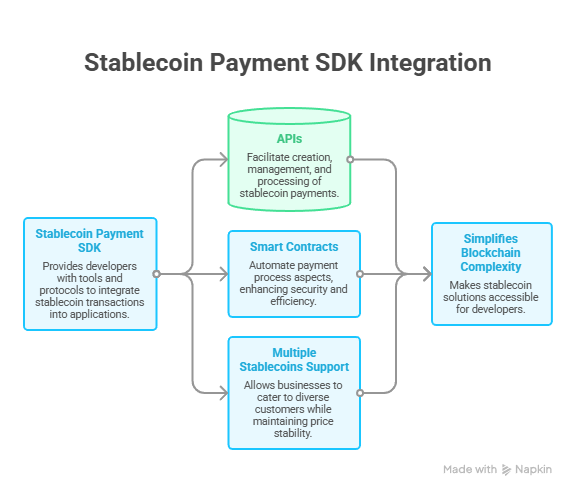
A stablecoin payment SDK is simply a toolkit developers use to accept and send stablecoin payments inside their apps or websites.
Think of it like a shortcut. Instead of building blockchain payment systems from scratch, the SDK gives you ready-made tools you can plug into your product.
These tools let your app handle stablecoins like USDT or USDC without needing deep blockchain knowledge.
So instead of worrying about smart contracts or network complexity, you just integrate the SDK and focus on your product.
Essentially, it connects your app to stablecoin networks and lets users pay or receive money in stablecoins. It also handles the technical blockchain work in the background.
You’ll usually find stablecoin payment SDKs used in fintech apps, global marketplaces, SaaS platforms, and any product that wants to move money across borders quickly.
Read Also: How to earn crypto passively
How a Stablecoin Payment SDK Works
Below is a brief breakdown of how this toolkit works:
1. Payment initiation inside the application
The process begins when a user decides to make a payment within your application. This could happen during checkout, subscription renewal, or any form of digital transaction.
At this point, your backend interacts with the stablecoin payment SDK to create a payment request.
This request defines the key details of the transaction, including the amount, the type of stablecoin to be used, and the destination wallet or merchant account.
Once created, the SDK converts this into a blockchain-ready payment instruction that can be processed by the network.
2. Wallet connection and user authorization
After the payment request is created, the SDK connects the user to their crypto wallet. The user is then prompted to review and approve the transaction before any funds are moved.
This step is essential because it ensures that the user remains in full control of their assets.
The SDK manages the communication between your application and the wallet securely, without exposing private keys or requiring you to build wallet infrastructure yourself.
3. Transaction creation and blockchain execution
Once the user approves the payment, the SDK constructs the actual blockchain transaction and submits it to the relevant network.
This includes preparing the transaction data, handling gas fee requirements where applicable, and broadcasting it to blockchain nodes.
From the developer’s perspective, this entire process is abstracted away. You don’t need to interact with low-level blockchain protocols or manage node infrastructure.
4. Network confirmation and transaction finality
After submission, the transaction enters the blockchain network for validation. Depending on the blockchain being used, confirmation can take anywhere from a few seconds to a few minutes.
During this period, the SDK continuously monitors the transaction status until it is fully confirmed.
This ensures that your application always receives an accurate and reliable indication of whether the payment has succeeded.
5. Real-time updates and webhook notifications
Once the transaction is confirmed, the SDK sends a notification back to your application through a webhook or API callback.
This allows your system to immediately update its records. An order can be marked as paid, a subscription can be activated, or a user account can be credited without delay.
This real-time communication is what makes stablecoin payments usable in production-grade applications.
6. Settlement and post-payment handling
After confirmation, the final handling of funds depends on the capabilities of the SDK provider. In some cases, stablecoins are simply delivered to the merchant’s wallet.
In more advanced setups, the SDK may offer automatic conversion to fiat currency, treasury management features, or payout distribution tools.
This flexibility allows businesses to choose whether they want to operate entirely in crypto or integrate stablecoin payments into a more traditional financial system.
Read Also: How USDT payment works
Key Features of a Good Stablecoin Payment SDK
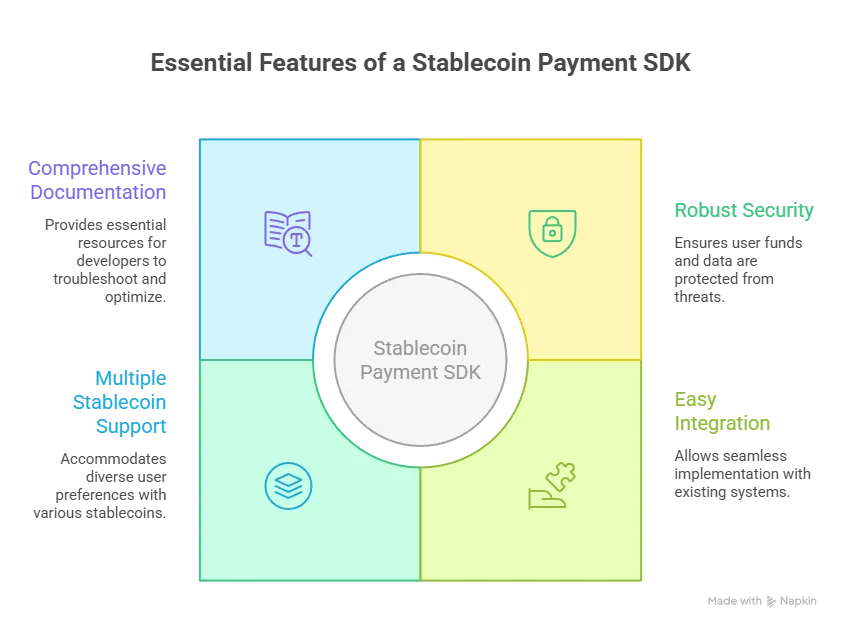
The quality of the SDK often defines how smooth or frustrating the entire payment experience will be for both developers and end users. Here are some key features to look out for:
1. Multi-chain compatibility
A strong SDK should support multiple blockchain networks. Since stablecoins exist across different chains such as Ethereum, Tron, and Solana, developers need flexibility in choosing the network that best fits their use case.
Multi-chain compatibility ensures that applications are not locked into a single ecosystem and can serve users globally.
2. Simple API and developer-friendly integration
One of the most important features of a good SDK is ease of integration. Developers should be able to connect the SDK to their application without dealing with unnecessary complexity.
A clean API structure, clear documentation, and predictable responses make it easier to implement payment flows quickly and reduce development time significantly.
3. Wallet integration support
A reliable stablecoin payment SDK must support smooth integration with popular crypto wallets such as MetaMask and WalletConnect.
This allows users to approve transactions securely while keeping full control of their assets.
The SDK should handle wallet communication in a way that is smooth and consistent across different platforms and devices.
4. Real-time transaction tracking
Because blockchain transactions are not instant in the traditional sense, real-time tracking becomes essential.
A good SDK continuously monitors the status of transactions and provides updates as they move from pending to confirmed. This ensures that applications can respond immediately when payments are completed.
5. Webhooks and event-driven architecture
Webhooks a critical feature in any production-ready payment SDK. They allow the system to notify your backend the moment a transaction is confirmed.
This makes it possible to automate actions such as order fulfillment, subscription activation, and user account updates without manual intervention.
6. Security and compliance support
Security is non-negotiable when dealing with financial transactions. A good SDK ensures that private keys are never exposed and that all sensitive operations are handled securely.
In more advanced systems, compliance features such as transaction monitoring and audit logs are also included to support regulatory requirements.
Read Also: Crypto exchanges with low fees.
How to Integrate a Stablecoin Payment SDK
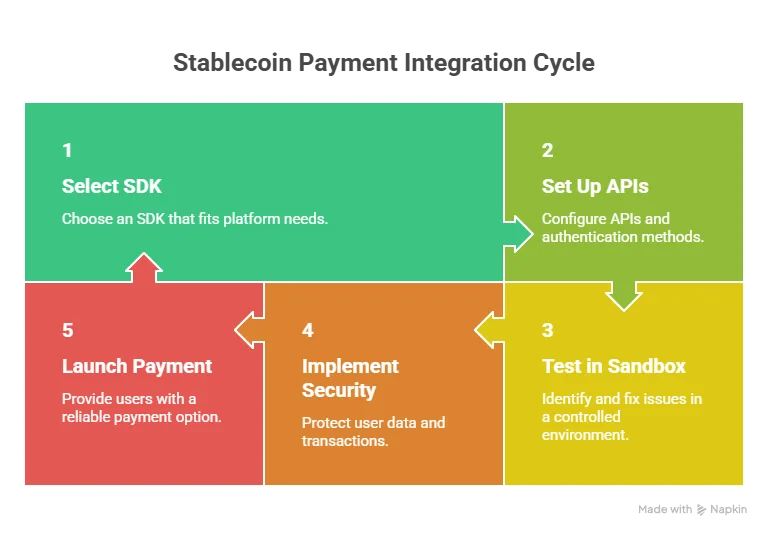
Integrating this SDK into an application is designed to be straightforward, especially when compared to building blockchain payment infrastructure from scratch.
Most SDKs are built to fit into existing backend systems, allowing developers to add crypto payment capabilities without rewriting their entire architecture.
1. Choose and install the SDK
The process begins by selecting a stablecoin payment SDK that fits your use case.
This could depend on factors like supported blockchains, stablecoins, pricing structure, or developer tooling.
Once selected, the SDK is typically installed through a package manager like npm for web applications or added as a REST API dependency, depending on the provider.
2. Configure API keys and environment settings
After installation, the next step is configuring your project with the required credentials.
This usually includes API keys, webhook URLs, and network settings such as mainnet or testnet environments.
At this stage, developers also define how payments should be routed, including wallet addresses and supported stablecoins.
3. Create a payment request flow
Once the configuration is complete, the SDK is used to generate payment requests whenever a user initiates a transaction.
This is usually integrated into checkout pages, subscription systems, or wallet funding flows.
The SDK structures the payment details and prepares them for blockchain execution behind the scenes.
4. Handle wallet connection and user approval
The SDK then connects the user to a supported crypto wallet. The user is prompted to approve the transaction before any funds are moved.
This step is handled through the SDK’s wallet integration layer, ensuring secure communication without exposing private keys to the application.
5. Listen for confirmations via webhooks
After the transaction is submitted and processed on-chain, the SDK sends a webhook or callback to your backend.
This allows your system to immediately update the payment status.
At this point, developers typically trigger business logic such as order confirmation, service activation, or balance updates.
6. Test before going live
Most SDKs provide a test environment or sandbox mode. Developers use this to simulate transactions, validate webhook responses, and ensure the payment flow works correctly before deploying to production.
Challenges Developers Should Expect While Integrating a Stablecoin Payment SDK
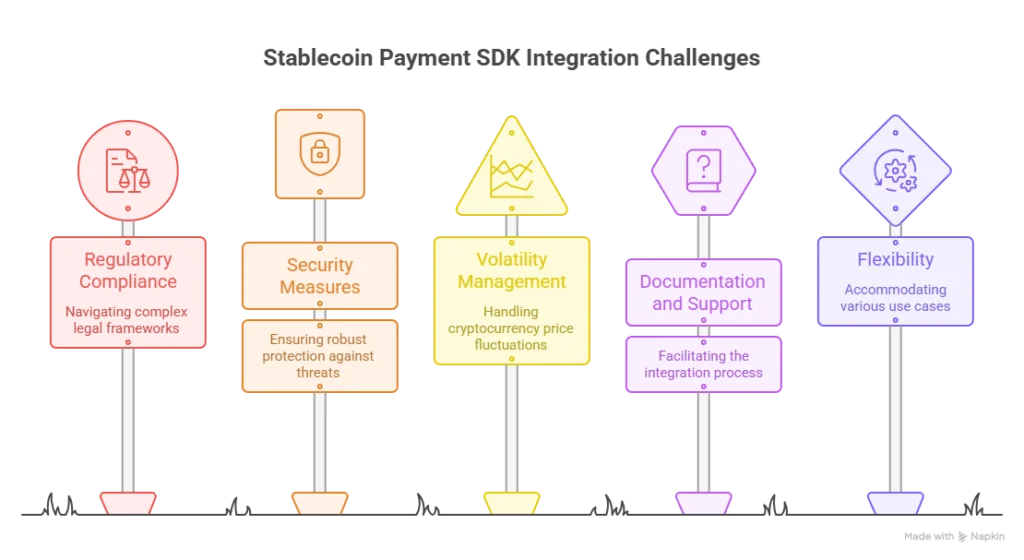
While stablecoin payment SDKs simplify blockchain integration, developers may still encounter a few challenges during implementation.
These challenges are usually less about basic setup and more about edge cases, infrastructure, and blockchain behavior.
1. Network variability and confirmation delays
Different blockchain networks have different confirmation speeds and congestion levels. Developers need to account for delays in transaction finality, especially during periods of high network activity.
2. Gas fees and network costs
Although stablecoins are stable in value, transaction fees on networks like Ethereum can fluctuate significantly.
Developers must decide how to handle gas fees, whether they are user-paid or absorbed by the platform.
3. Handling failed or pending transactions
Not all transactions are successful on the first attempt. Network congestion, insufficient gas, or wallet issues can result in failed or stuck transactions.
Proper retry logic and status tracking are essential to avoid inconsistencies in the application.
4. Webhook reliability and event synchronization
Since SDKs often rely on webhooks for updates, ensuring reliable delivery and handling of missed events is critical.
Developers may need to implement fallback polling mechanisms to confirm transaction status in edge cases.
5. Multi-chain complexity
Supporting multiple blockchains adds flexibility but also increases complexity. Each network has its own standards, confirmation rules, and fee structures, which developers must account for in their integration logic.
6. Regulatory and compliance considerations
Depending on the region and use case, stablecoin payments may fall under financial regulations.
Developers may need to consider KYC, AML, and reporting requirements, especially for platforms handling large transaction volumes.
Frequently Asked Questions
Do I need blockchain experience to use a stablecoin payment SDK?
No, that is one of the main advantages. Stablecoin payment SDKs are designed so that traditional developers can integrate crypto payments without deep blockchain knowledge.
Which stablecoins are usually supported?
Most stablecoin payment SDKs support widely used assets such as USDT, USDC, and DAI, depending on the blockchain networks they operate on.
Conclusion
Stablecoin payment SDKs are quickly becoming a core building block for modern financial applications.
They allow developers to focus on building user-facing products rather than managing infrastructure like smart contracts, wallets, and transaction monitoring.
As more businesses look for faster, cheaper, and borderless payment solutions, these SDKs offer a practical way to bridge traditional applications with blockchain-powered settlement systems.
While integration still requires careful handling of security and compliance, the overall development experience is more streamlined than building directly on-chain systems.