



A bank once took 18 months to launch a digital payment feature. A fintech startup launched the same functionality in six weeks using a white label digital wallet and a team of four.
No blockchain engineers, no compliance team, no infrastructure built from scratch. Just a customized, market-ready product.
That gap — 18 months versus six weeks is exactly what this guide is about.
First things first
What Is a White Label Digital Wallet?
A white label digital wallet provides businesses with a ready-made crypto wallet solution that they can rebrand and customize to fit their specific requirements.
Developers have already built, tested, and prepared the core wallet functionality for deployment. Therefore, rather than building a wallet from scratch, companies can customize an existing framework.
This significantly reduces development time, cost, and risk while retaining full control over branding and the user experience.
This approach enables businesses to enter the digital wallet market quickly and efficiently. At the same time, it allows them to maintain complete ownership of their brand identity and customer experience.
Read Also: The Best Crypto Card for Online Shopping.
How White Label Digital Wallets Work
| Aspect | How It Works |
|---|---|
| Wallet Architecture | Built on pre-tested blockchain infrastructure for secure storage and smooth transactions — cuts development time vs. building from scratch |
| Customization | Businesses brand it with their own logo, colors, interface, and features to build trust and consistency |
| Blockchain Integration | Connects directly to blockchain networks for send/receive/manage functions; often built with blockchain dev partners; multi-chain support adds flexibility |
Why Businesses Are Choosing White Label Digital Wallets
| Benefit | Details | Source |
|---|---|---|
| Faster Launch | 5-week launch for a European fintech client; 4.5B wallet users in 2025, 6B by 2030 | Evercode Lab · BoA |
| Lower Cost | No need to hire engineers, security, compliance, UI/UX in-house | — |
| Built-In Compliance | KYC, AML, fraud detection included by default | AML terms |
| Full Branding | Customers only see your brand, not the provider’s | — |
| New Revenue | Fees, interest, premium tiers, loyalty programs; market to hit $32T by 2033 | Yahoo Finance |
Key Features to Look for in a White Label Digital Wallet
Not every platform offers the same capabilities. Before choosing a provider, you should know what the essentials are.
- User-friendly interface: An intuitive interface helps both beginners and experienced users navigate the wallet with ease, improving adoption and encouraging long-term engagement.
- Multi-currency support: Enables users to manage fiat currencies, stablecoins, and cryptocurrencies smoothly within a single wallet.
- KYC and AML compliance: Automates identity verification and continuously monitors transactions to ensure regulatory compliance across the platform.
- Card issuance: Provides virtual and physical branded debit cards, typically powered by Visa or Mastercard, and directly linked to the wallet.
- Crypto-to-fiat conversion: Allows businesses to instantly convert received cryptocurrency into fiat to support everyday operational needs.
- API integration: Offers a reliable, well-documented API that enables smooth integration with existing business systems and infrastructure.
- Reporting dashboard: Delivers real-time insights into transactions, user behavior, and compliance metrics for full operational visibility.
- P2P transfers and cross-border payments: Facilitates fast, secure money transfers between users locally and across international borders.
Read Aksi: Quick tips on how to convert crypto to cash.
Top 11 White Label Digital Wallet Providers for Business
Here’s a straight look at the platforms worth evaluating, including what each does well and who it’s best for.
Turnkey Apps & Exchanges
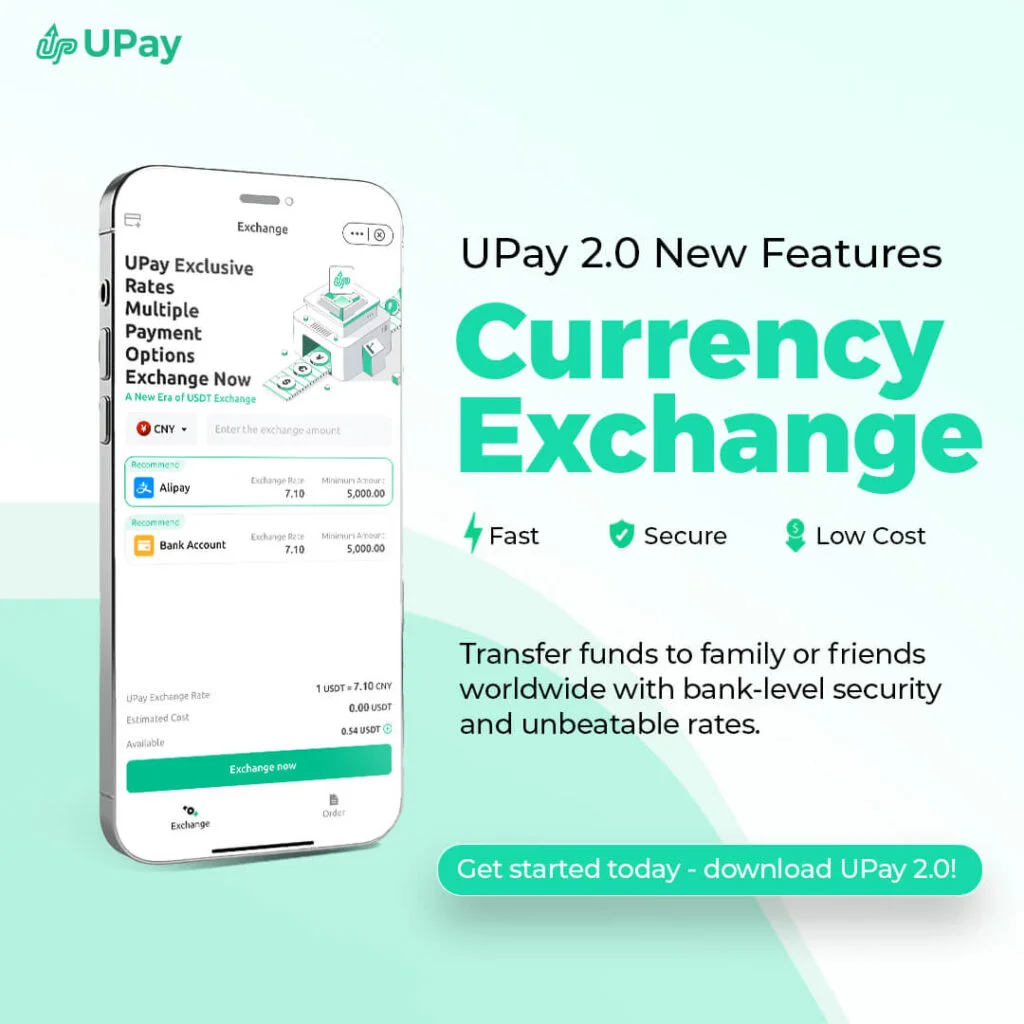
1. UPay: Best For Fintechs, Neobanks, and Crypto Exchanges
Source: Upay.best
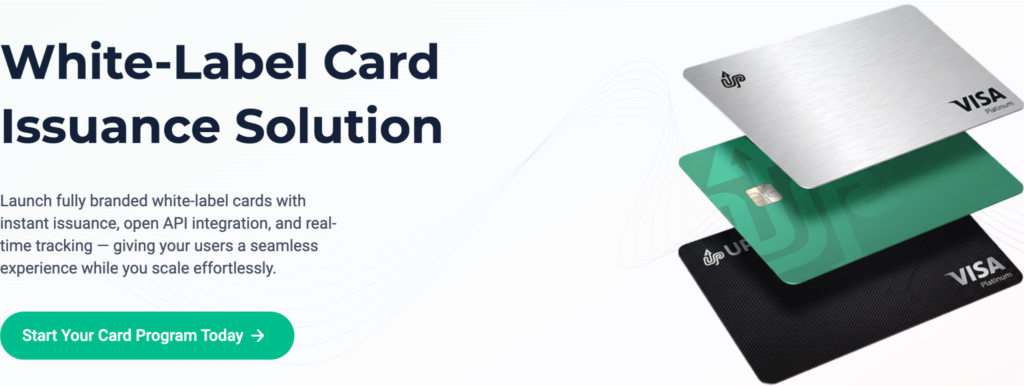
UPay White Label is a card issuance solution that lets businesses launch fully branded virtual and physical payment cards without building the infrastructure from scratch.
It’s designed for crypto-native and fintech companies that want to offer their users a smooth spending experience under their brand.
The platform integrates in under three weeks via a developer-friendly API, handling everything from card production to compliance, so your team can focus on growth instead of backend complexity.
Key features:
- Full branding control: Custom card design, colors, and app experience
- Virtual & physical cards: For digital and real-world payments
- Crypto-to-fiat support: Instant USDT and USDC to fiat conversion across multiple chains
- Global acceptance: Works in 180+ countries, with Apple Pay, Google Pay, and Alipay
- Built-in compliance: KYC, KYB, KYT, and AML support
- Real-time tracking: Balance and transaction visibility for users
- Scalable API: Built for exchanges, wallets, neobanks, DeFi platforms, and more.
Institutional Web3 Infrastructure
3. Fireblocks: Best For Fintechs And PSPs
Source: fireblocks.com
Fireblocks White Label lets businesses launch their own branded digital asset wallet experience without having to build the underlying infrastructure.
At its core, it’s a modular, white-label solution that enables businesses to create fully customizable experiences for their end users, built on top of Fireblocks’ proven, battle-tested infrastructure and designed to scale to millions of users.
Key Features:
- Custom-branded wallets: Build white-labeled wallets for consumer and retail apps, with full control over the customer experience.
- Self-custody by design: Developers can integrate white-labeled, self-custody wallets directly into any app or service.
- Crypto custody for institutions: Financial institutions can implement direct custody under their brand without relying on third parties.
- Stablecoin payments: Businesses can create stablecoin payment accounts using the white-labeled Wallets-as-a-Service solution.
- Investor portals: Users get an all-in-one dashboard to discover offers, subscribe to tokens, and manage their portfolios.
In short, Fireblocks’ white-label is the invisible engine powering digital asset products for fintechs, banks, and exchanges worldwide.
Read Also: Best Crypto Cards With Apple Pay and Google Pay Support.
4. BTCPay Server: Ideal For Fintechs & Freelancers
Source: btcpayserver.org
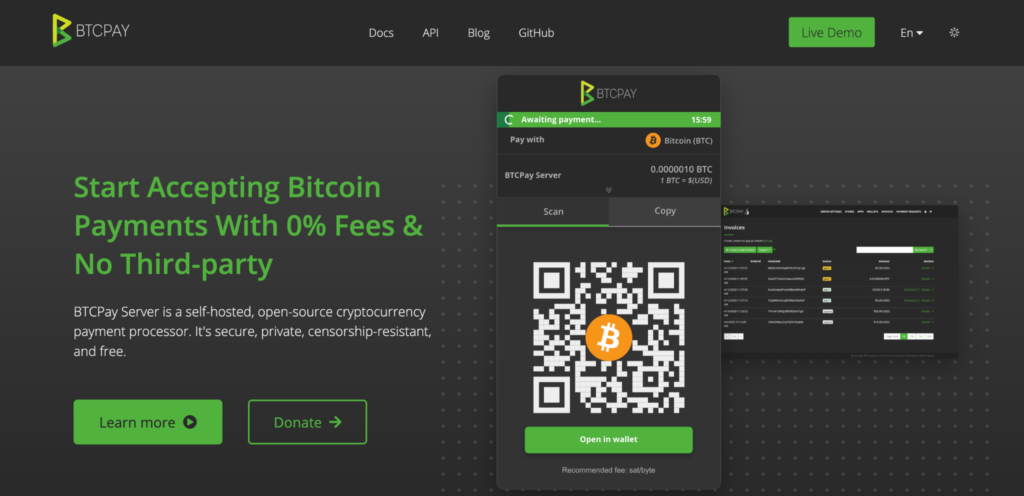
BTCPay Server is an open-source, self-hosted Bitcoin payment processor that enables merchants to accept crypto payments directly without intermediaries.
Its white-label functionality allows businesses to fully brand checkout pages, dashboards, and user interfaces, making it ideal for fintech and payment gateway solutions.
It supports Bitcoin payments via on-chain and Lightning Network, with plugin extensions for multiple cryptocurrencies.
This flexibility enables multi-asset payment systems while maintaining a secure backend. White-label deployments are commonly used by service providers to offer branded crypto payment infrastructure powered by BTCPay Server’s reliable and secure architecture.
Key features:
- Fully white-labeled checkout and payment pages with custom branding
- Self-hosted, non-custodial crypto payment infrastructure
- Bitcoin and Lightning Network support with optional altcoin integrations
- Plugin ecosystem for additional token/crypto support
- Built-in compliance-friendly invoicing and audit-ready transaction tracking
- Open-source architecture for customization and enterprise scaling
Overall, it acts as a foundation for building branded crypto payment or wallet platforms on top of a proven, secure stack.
5. SDK.Finance: Best For Tech-Savvy Teams
Source: sdk.finance
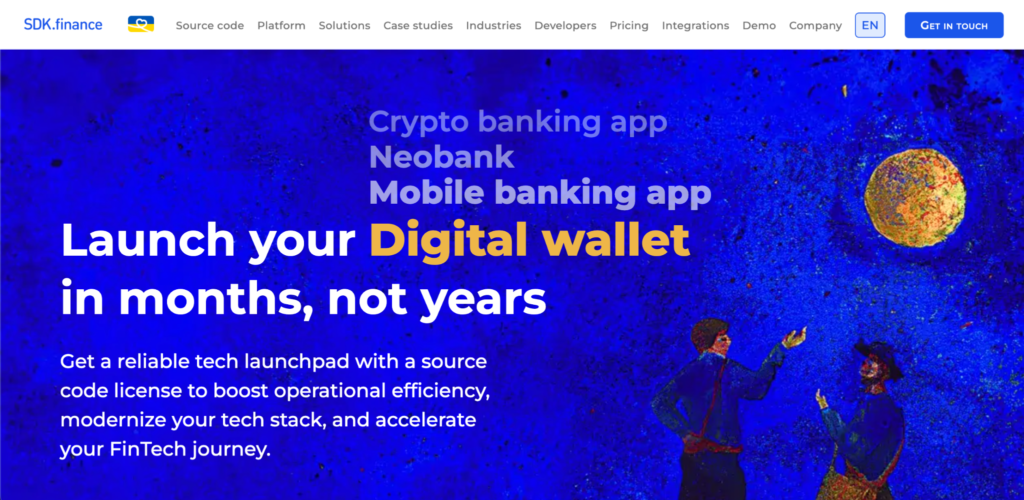
SDK.Finance is a white-label, modular FinTech platform that gives businesses full source code access to build digital banks, e-wallets, and payment systems faster and without vendor lock-in.
The platform is designed to cater to the distinct needs of businesses across a wide range of use cases.
This includes banks, fintechs, PSPs, and enterprises that want to move fast without the risk of building from scratch.
Key Features:
- Full source code ownership: Modify and customize everything at your own pace, with no dependency on the vendor.
- Out-of-the-box functionality: Covers onboarding, KYC/KYB, multi-currency accounts, card issuing, real-time currency exchange, and payment links.
- Back-office management: Built-in CRM, AML/anti-fraud tools, transaction monitoring, and role-based permissions.
- iOS & Android mobile app: Ready for white-label deployment as a neobank or e-wallet.
- Security certified: PCI-DSS Level 1 and ISO 27001:2022 compliant
The trade-off is complexity. It’s a better fit for businesses with development resources than for teams looking for a plug-and-play option.
Read Also: Crypto Scalping vs Swing Trading: Which One Actually Fits Your Life?
Hybrid Fiat-Crypto Core Engines & Plugins
6. BitGo: Best For Neobanks & Fintechs
Source: bitgo.com
BitGo’s white-label solution lets banks, fintechs, neobanks, and other platforms offer crypto services under their brand without building the infrastructure from scratch.
Businesses can embed secure wallets, crypto trading, and on/off ramps into their platform in a matter of weeks, using BitGo’s plug-and-play APIs and regulated licensing framework.
Key Features:
- Regulatory coverage: Skip the costly licensing process by using BitGo’s federally regulated OCC charter, MiCAR license in the EU, and major payment institution license in Singapore.
- Fast user onboarding: Turnkey KYC/KYB flows and smooth on/off ramps via wire/ACH (US) and SEPA (EU).
- Full crypto functionality: Offer trading, staking, and transfers via your own front end, with access to 1,400+ crypto assets across 40+ blockchains.
- Institutional-grade security: A customizable policy engine for user permissions and spending limits, with client funds insured up to $250M.
7. Crassula: Best For Neobanks And Financial Services in Europe
Source: crassula.io
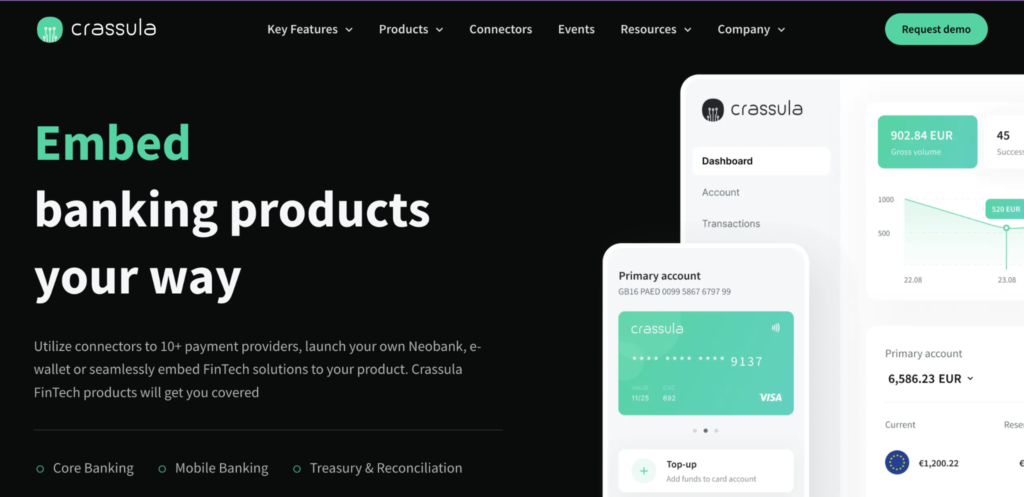
Crassula is a white label fintech platform based in Europe that lets businesses launch fully branded banking and payment products without building anything from scratch.
The platform has two core offerings: The core banking solution supports multi-currency accounts, virtual IBAN generation, international and SEPA transfers, currency exchange, card issuing, and AML/KYC management, all manageable from a single admin panel.
The Merchant Payments product lets PSPs, banks, and acquirers build a global payments gateway within days, complete with merchant interfaces, checkout APIs, anti-fraud rules, and chargeback management.
Key features:
- White-label crypto wallet offerings allow clients to create crypto accounts with unique wallet addresses, exchange fiat-to-crypto, make transfers, and invest in digital assets.
- Crypto compliance is built to meet international regulatory standards, including OFAC, FATF, and MLD5.
- Native multi-chain coverage, including BTC, ETH, Solana, Layer-2 networks, all ERC-20 tokens, and major stablecoins.
- 60+ service integrations across 15+ languages.
- Fully branded iOS, Android, and web apps.
- Launch-ready in as little as 10 business days.
- Support for PSPs, banks, acquirers, and e-commerce businesses.
It’s a strong choice for businesses that want a broad financial product, not just a wallet built under their brand.
Read Also: What Does 5x Mean in Crypto?
8. Purpleplum: Best for Banks, Fintechs, And Credit Unions
Source: purpleplumfi.com
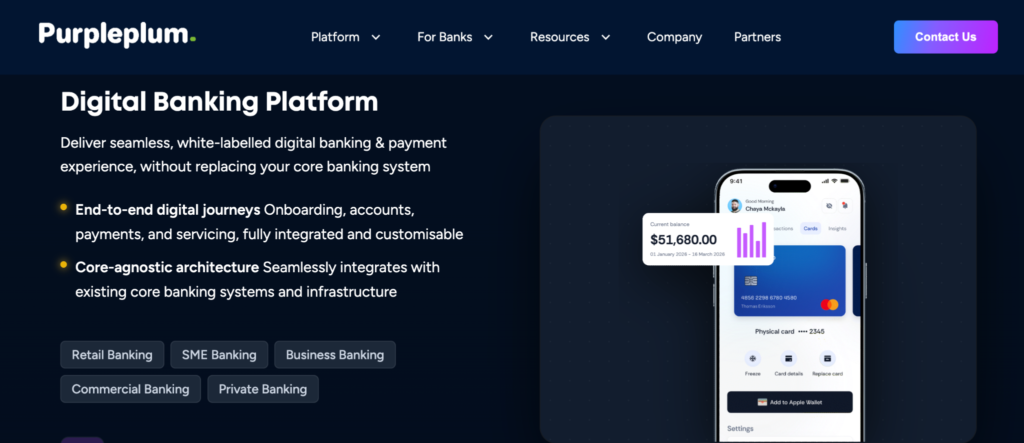
Purpleplum is a Fintech-as-a-Service platform built to help you launch world-class financial products fast and scale them over the long term.
Their white label solution targets banks, credit unions, and fintechs that want to go digital without the headache of building from scratch.
The core promise is helping institutions go live in under 90 days, fully compliant and scalable, through a microservices-based, API-first architecture that integrates smoothly with existing core banking systems, card platforms, and payment rails.
Key Features:
- Core-agnostic design: It doesn’t replace your existing core banking system but makes it work in the modern world
- Fast deployment with end-to-end digital customer journeys
- Global reach, with 20+ banks, credit unions, fintechs, and enterprises across India, the US, the Middle East, Europe, and Southeast Asia
- Fully branded experience under your own identity
It’s essentially a plug-and-play infrastructure layer for financial institutions ready to modernize without starting over.
9. Velmie: Best For Fintechs & Banks

Source: velmie.com
Velmie White Label is a ready-to-launch fintech platform that lets banks, fintechs, and digital asset companies go to market in weeks, without building everything from scratch.
It combines accounts, cards, FX, crypto, payments, and back-office tools into one composable, modular system, all wrapped in a fully brandable mobile and web experience.
Key Features:
- White-label crypto wallet: A full suite of crypto services, including a turnkey crypto banking platform, crypto payment solutions, and white-label exchange
- Broad token & currency support: Supports most global currencies, enabling international remittance, FX, investments, and digital asset use cases.
- Crypto compliance built in: KYC flows, consent steps, disclosures, and limit controls are baked into the customer journey, keeping regulated onboarding smooth.
- Card issuance: debit, credit, or prepaid cards via integrated issuers with white-label app options.
- Source code ownership: Clients own the code, not just a license.
- Cloud & on-premises delivery with 24/7 tech support.
Read Also: How to earn crypto passively.
10. AnankAI: Best for Fintechs, PSPs & Banks
Source: anankai.com
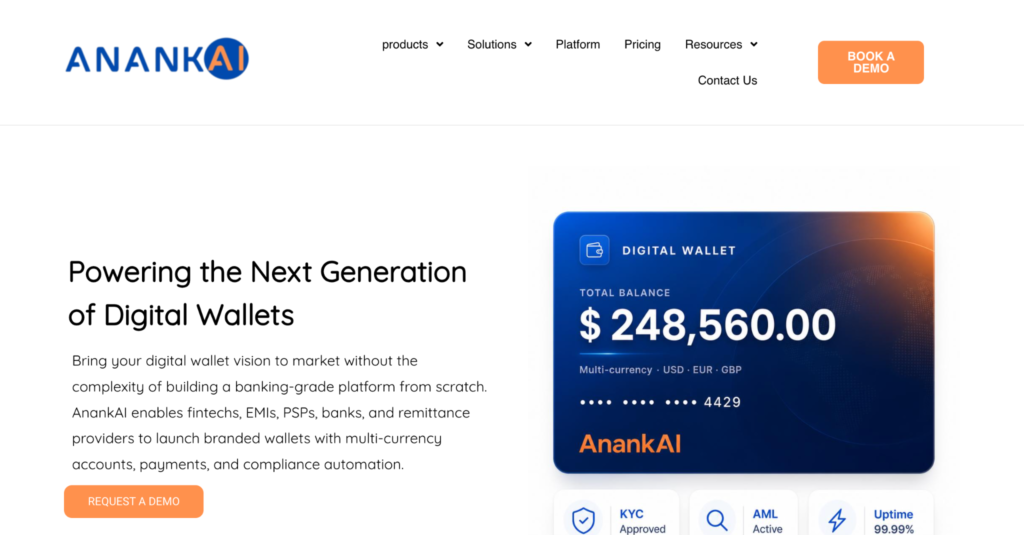
AnankAI helps fintechs, EMIs, PSPs, banks, and remittance providers launch fully branded digital wallets without the years it takes to build banking-grade infrastructure from scratch.
The platform handles the heavy lifting, like compliance, payments, and operations, all from one unified hub so you can focus on growth.
Key Features:
- White-Label Ready: Launch entirely under your own brand; AnankAI manages the tech and compliance behind the scenes.
- Multi-Currency Wallets: Support multiple currencies within a single platform for both consumer and business accounts.
- KYC/KYB Automation: Streamlined onboarding and identity verification built in.
- AML & Compliance: Automated transaction monitoring with region-specific regulatory alignment across the UK, Europe, UAE, USA, and beyond.
- Cross-Border Payments: Domestic and international payment capabilities, including remittance flows
- API-First Architecture: Smooth integration with existing or third-party systems.
- Crypto & Digital Assets: Secure customer account management and wallet services for digital asset use cases.
11. DigiPay.Guru: Best for Fintechs & Banks
Source: www.digipay.guru
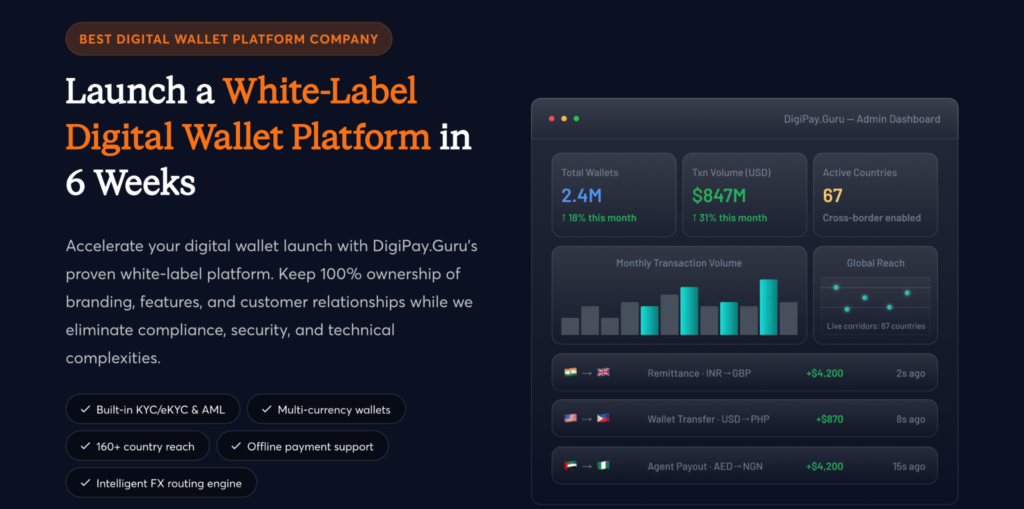
DigiPay.Guru helps fintechs, banks, and remittance providers launch a fully branded digital wallet in just 6 weeks, without the cost and complexity of building from scratch.
You keep complete ownership of your brand, data, and customer relationships, while DigiPay.Guru handles the heavy lifting on compliance, security, and infrastructure.
Key Features:
- White-Label Control: Fully branded wallet experience across iOS, Android, and web using a React Native SDK; you own 100% of the product identity.
- Multi-Currency Wallets: Support for 100+ currencies with real-time balance tracking, sub-wallets, and an intelligent FX routing engine.
- Built-In Compliance: KYC/eKYC, AML monitoring, sanctions screening, and PCI SSF compliance-ready from day one across 160+ payment corridors.
- P2P Transfers & Cards: Instant transfers via mobile, QR, or NFC, plus the ability to issue Visa/Mastercard virtual and physical cards.
- Modular Architecture: Plug-and-play modules for remittance, bill pay, merchant acquiring, loyalty, and you can turn features on or off as needed.
- Enterprise Scalability: Cloud-native infrastructure proven to handle millions of wallets with 99.9% uptime SLA.
How to Choose the Right White Label Digital Wallet for Your Business
Ask yourself these questions before signing with any provider:
Assets Support: If you are a fiat-first or hybrid business, platforms like SDK.finance or Purpleplum are best.
If crypto is central to your model, look at Wallet Factory, Fireblocks, or BitGo.
Card Issuance: Not all platforms issue physical or virtual cards. If your customers need a card they can use at Visa or Mastercard terminals, confirm this feature before moving forward.
Upay shines in this category as a platform that offers both virtual and physical card options for its users.
Compliance Requirements: Regulations vary significantly by region. If you operate in the EU, look for MiCA-licensed (Markets in Crypto-Assets Regulation) providers.
If you’re in the US or UAE, verify the provider holds the relevant financial licenses in those jurisdictions.
Team Technical Knowledge: API-first platforms like SDK.finance are powerful but require developer resources to integrate.
If you want a faster setup with less technical overhead, managed solutions from UPay or Wallet Factory are more practical.
Fee Structure: Some providers charge a flat monthly fee. Others charge a percentage of each transaction. Know the full cost model before you commit.
Read Also: Ways to short bitcoin
Conclusion
The fintech startup from week six didn’t have more engineers than the bank. They had a better starting point.
A white label digital wallet doesn’t just save time; it changes what’s possible with the resources you already have. The right provider on this list is your starting point. The question is how fast you want to move.