


A payment that should take seconds but sits in a bank queue for four days, losing 3% to fees somewhere in the middle.
That gap between when money is sent and when a business actually has it is exactly what USDT closes. How to accept USDT payments for business isn’t a crypto trend. It’s a settlement upgrade. Here’s how to make it work.
First things first:
What Does It Mean to Accept USDT Payments for Business?
At its core, accepting USDT is similar to accepting any other form of payment. When a customer chooses USDT at checkout, they transfer the required amount from their crypto wallet to the business’s designated wallet address or payment gateway.
Once the blockchain confirms the transaction, the funds become available to the business. Depending on the payment setup, the merchant can keep the funds in USDT, convert them into fiat currency, or use them for other business-related transactions.
Instead of relying solely on traditional payment methods such as bank transfers, debit cards, or credit cards, businesses can receive payments through blockchain networks.
This enables faster transactions and broader access to customers worldwide.
Stablecoins are relatively stable in value, easy to transfer, and widely used as settlement assets within crypto markets. Axel Schimmelpfennig and Bo Zhao
One of the main reasons businesses are increasingly turning to USDT is its stability. Unlike cryptocurrencies such as Bitcoin or Ethereum, which can experience significant price fluctuations, USDT is pegged to the US dollar.
This makes it easier for businesses to price products, manage revenue, and forecast cash flow without worrying about sudden changes in asset value.
For growing businesses, manually managing crypto payments can quickly become inefficient.
This is where crypto payment providers come in. Solutions such as UPay Business simplify the process by allowing businesses to receive USDT payments through a secure, non-custodial infrastructure.
Read Also: Beyond the Hype: Why Is Bitcoin So Expensive?
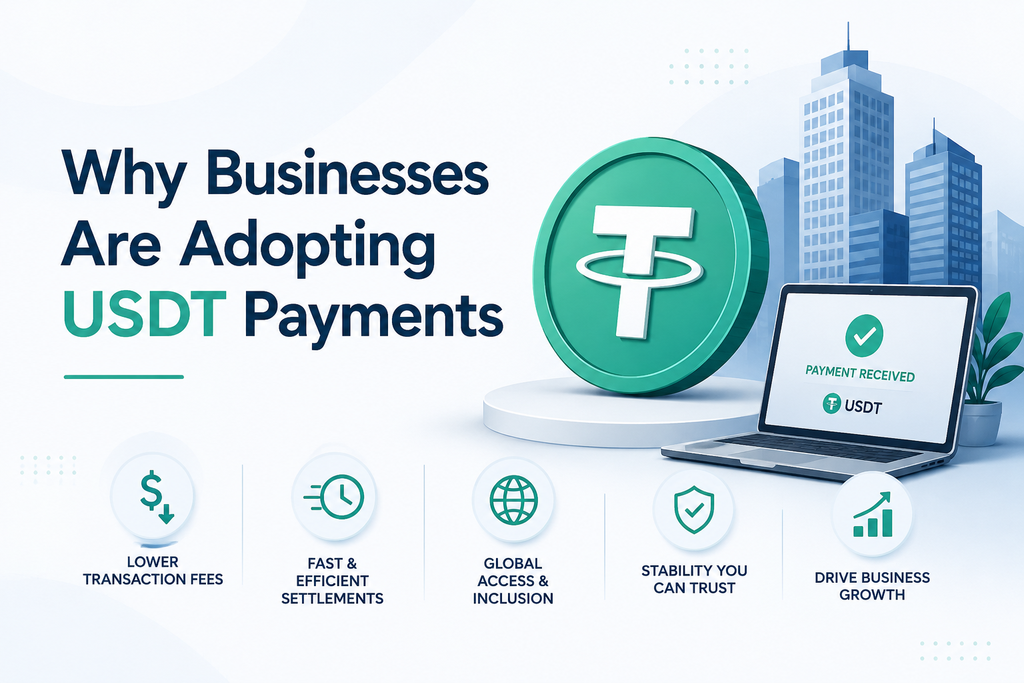
Why Businesses Are Adopting USDT Payments
| Benefit | How It Helps Your Business |
| Faster Transfers | Settles in minutes instead of 1–5 bank days, improving cash flow and order delivery. |
| Lower Fees | Avoids expensive credit card processor fees, especially on low-cost networks like TRON. |
| Global Reach | Accepts payments from anywhere in the world without local banking friction. |
| Price Stability | Pegged 1:1 to the US Dollar, eliminating crypto volatility and simplifying accounting. |
| Customer Flexibility | Gives crypto-native users a direct, hassle-free way to pay. |
| Simple Integration | Connects easily via gateways like UPay using payment links, APIs, or QR codes. |
Is It Legal to Accept USDT Payments for Business?
The legality of accepting USDT payments depends on the regulatory framework of each country, as different jurisdictions treat cryptocurrency differently.
In most regions, USDT itself is not prohibited, but its use in business transactions is regulated under existing financial, tax, and anti-money laundering laws.
This means businesses can generally accept USDT payments, provided they comply with local reporting and compliance requirements.
In the United States, for example, cryptocurrency transactions, including USDT payments, are generally permitted.
However, businesses are required to treat crypto income as taxable and report transactions to the Internal Revenue Service (IRS).
The regulatory environment is overseen by agencies such as the Financial Crimes Enforcement Network (FinCEN), which applies anti-money laundering rules to certain crypto-related activities.
For example, the European Union’s Markets in Crypto-Assets (MiCA) regulation has introduced stricter rules for stablecoins. Under these rules, several major exchanges have adjusted their services for European users.
Under MiCA, crypto companies have to apply for licences from regulators in individual EU countries, which they can use as a “passport” to operate throughout the 27-nation bloc.
Platforms such as Binance have reduced or removed USDT trading pairs in parts of the European Economic Area due to compliance requirements linked to MiCA.
This does not mean USDT is illegal in the region. However, it means access through regulated exchanges may be limited or redirected toward alternative stablecoins that meet EU standards.
In the United Kingdom, crypto assets are legal, but businesses must comply with rules set by the Financial Conduct Authority (FCA), particularly around anti-money laundering registration and financial promotions.
The FCA requires crypto businesses and related service providers to meet strict compliance standards before offering services to the public.
In Nigeria, cryptocurrency is not banned, and individuals and businesses can hold and trade digital assets.
Since December 2023, the Central Bank of Nigeria has allowed banks to service crypto firms licensed by the Securities and Exchange Commission, lifting the restriction it placed on the sector in 2021.
The Investments and Securities Act signed in 2025 now treats digital assets as securities under the SEC, and from January 2026 profits from crypto are taxable under the Nigeria Tax Administration Act.
Read also: Top DeFi Protocols by Category: Banking Without the Bank.
How to Accept USDT Payments for Business
Choose a Reliable USDT Payment Solution
The first step is selecting how you want to receive USDT payments. While some businesses choose to use personal crypto wallets, most prefer a structured payment solution that simplifies transaction handling and improves operational efficiency.
A provider such as UPay allows businesses to accept USDT payments through a secure, non-custodial infrastructure.
This means you retain control of your funds while benefiting from tools such as payment links, API integration, QR code payments, and real-time transaction tracking.
These features reduce manual work and help ensure a smoother payment experience for customers. When choosing a provider, it is important to consider how well it aligns with your business needs, including ease of integration and security standards.
Set Up Your Wallet or Merchant Account
Once you have selected a payment solution, the next step is setting up your wallet or merchant account. This is where you will receive incoming USDT payments.
During setup, a wallet address is generated for your business, or you are given access to a merchant dashboard if you are using a payment gateway.
This dashboard typically helps you track payments, monitor balances, and manage transactions in one place.
At this stage, security becomes essential. Enabling two-factor authentication and safeguarding your recovery credentials ensures that your funds remain protected from unauthorized access.
Select the Appropriate Blockchain Network
USDT operates on several blockchain networks, including TRON, Ethereum, Solana, BNB Smart Chain, and Polygon. Each network has its own transaction speed and fee structure.
It is important that both your business and your customers use the same network when sending and receiving payments. If a mismatch occurs, funds may be delayed or permanently lost.
For this reason, businesses often clearly communicate supported networks at checkout to avoid confusion and errors.
Integrate USDT Into Your Payment Flow
After setting up your wallet, you need to integrate USDT into your existing payment system. This can be done through website checkout pages, payment links, invoices, QR codes, or API integrations, depending on your business model.
With platforms like UPay, this process becomes significantly easier because the infrastructure is already built. You simply plug the solution into your website or application.
After that, customers can begin paying with USDT without requiring additional manual confirmation from your team.
Test the Entire Payment Process
Before launching USDT payments for real customers, it is important to test the system thoroughly. Testing ensures that payments are received correctly, transaction confirmations work as expected, and funds are routed to the correct wallet.
It also helps you identify potential issues such as incorrect network configuration, delayed confirmations, or integration errors.
Running test transactions provides confidence that your system is functioning properly before going live.
Monitor and Manage Incoming Payments
Once your system is active, monitoring becomes an ongoing responsibility. Most crypto payment platforms provide dashboards that allow you to track incoming transactions, view payment history, and manage wallet balances in real time
At this stage, you also decide how to manage the USDT you receive. Some businesses choose to convert it into fiat currency immediately, while others retain it as part of their digital asset holdings or use it for operational expenses where possible.
Read Also: Best Crypto Cards With Apple Pay and Google Pay Support
Best Practices for Safe USDT Transactions
Alt text:
1. Use Secure and Trusted Payment Infrastructure
Your payment infrastructure plays a central role in securing your funds. It is important to use reputable wallets or payment providers that offer strong encryption, authentication mechanisms, and secure transaction handling.
Solutions like UPay Business also provide non-custodial processing, which ensures that businesses maintain control of their funds while still benefiting from secure payment orchestration.
2. Verify Wallet Details Before Every Transaction
Every USDT transaction must be handled with precision. Before sharing or using a wallet address, always verify that it is correct and matches the intended blockchain network.
Even a small error in a wallet address can result in irreversible loss. Many businesses reduce this risk by using QR codes or automatically generated payment links instead of manually entering addresses.
3. Clearly Define Supported Blockchain Networks
Because USDT exists on multiple networks, clarity is essential. Businesses should clearly communicate which networks they support, such as TRC20 or ERC20, so that customers do not accidentally send funds through an unsupported chain.
This simple step prevents failed transactions and improves customer confidence in the payment process.
4. Strengthen Account Security Measures
All accounts associated with your payment system should be secured with strong authentication methods.
Enabling two-factor authentication, using strong passwords, restricting staff access, and securing recovery phrases are essential steps in protecting your funds.
For businesses handling large transaction volumes, additional safeguards such as hardware wallets or enterprise-level custody solutions may also be appropriate.
5. Maintain Proper Financial Records
Even though blockchain transactions are recorded on the network, businesses still need internal financial records for reconciliation, taxation, and reporting purposes.
Keeping accurate documentation of transaction IDs, invoice details, payment amounts, and conversion records ensures transparency and simplifies financial management.
6. Monitor Transactions for Risk and Compliance
Businesses must also remain mindful of regulatory requirements in their operating regions. Many crypto payment providers now include built-in monitoring tools that help detect suspicious activity and support compliance with AML and KYC standards.
Platforms such as UPay incorporate transaction screening features that help businesses reduce exposure to high-risk transactions while maintaining smooth payment operations.
7. Train Your Team on Crypto Payment Handling
If multiple team members are involved in managing payments, proper training is important. Staff should understand how blockchain transactions work, how to verify payments, and how to respond to common issues such as network delays or incorrect transfers.
Well-trained teams reduce operational errors and improve the overall reliability of your payment system.
8. Regularly Review and Improve Your Payment System
As your business grows, your payment infrastructure should evolve with it. Regularly reviewing your setup helps ensure that it remains secure, efficient, and cost-effective.
This includes evaluating transaction fees, supported networks, integration tools, and reporting capabilities. Continuous improvement helps your business stay competitive while maintaining a smooth payment experience for customers.
Read Also: How Many Crypto Wallets Do You Actually Need?
Frequently Asked Questions
Do I need a special account to accept USDT payments?
You do not necessarily need a traditional bank account to accept USDT payments because you can use a crypto wallet or a merchant payment processor instead.
Why should I accept USDT instead of only traditional payments?
Accepting USDT allows businesses to receive international payments faster, reduce transaction fees, and reach customers who prefer digital assets.
Conclusion
USDT payments have introduced a more efficient way for businesses to handle transactions across borders while maintaining stability in value and speed in settlement.
When you accept USDT payments for business, you give your customers a faster and more flexible payment option.
The appeal of USDT lies in its consistency. Because it is pegged to the US dollar, it removes the uncertainty that often comes with other digital assets.
This allows businesses to plan pricing, revenue, and cash flow with greater confidence.