


DeFi, as you already know, comprises decentralized applications and protocols that remove intermediaries, enabling open access to lending, borrowing, trading, and yield opportunities.
It has become a driving force for innovation in digital finance, bringing transparency, efficiency, and more control back to users. With smart contracts running the show, trust is built directly into the code, rather than relying on institutions.
Now, on the outside, what make up the most noteworthy projects are features such as liquidity provision, lending pools, stablecoin support, staking options, and interoperability across multiple blockchains. Each protocol aims to address specific financial needs, while also enhancing accessibility for global users seeking more than traditional banking offers.
We’ve carefully put together a curated list of the top 10 DeFi projects of 2026, on other blockchains aside from Ethereum, ensuring this guide highlights platforms that truly define decentralized finance.
Key Takeaways
- Uniswap, Aave, Curve Finance, and Compound Finance highlight how decentralized exchanges and lending protocols anchor the growth of DeFi.
- Liquid staking platforms such as Lido Finance and Jito provide users with staking rewards while keeping their assets flexible for DeFi use.
- Raydium and PancakeSwap showcase efficient trading experiences on Solana and BNB Chain, with fast transactions and low fees.
- MakerDAO (Sky) and Just Lend demonstrate how decentralized stablecoins and lending on Tron continue to drive adoption in DeFi ecosystems.
- Key risks such as smart contract vulnerabilities, liquidity shortages, market volatility, and regulatory uncertainty remain central considerations for DeFi users and investors.
Also Read: How to Earn Crypto Passive Income in 2026: Staking, Lending, and DeFi
Top 10 DeFi Projects of 2026
| Platform | Category | Blockchain(s) | Launched | Founder(s)/Team | Native Token | TVL | Key Features |
| Uniswap | Decentralized Exchange | Ethereum, Arbitrum, Optimism, Polygon | 2018 | Hayden Adams | UNI | $5.5 Billion | AMM model, deep liquidity, concentrated liquidity pools, multi-chain swaps |
| Aave | Lending & Borrowing | Ethereum, Polygon, Arbitrum, Avalanche | 2017 | Stani Kulechov | AAVE | $8.5 Billion | Overcollateralized loans, flash loans, GHO stablecoin |
| Sky (MakerDAO) | Collateralized Stablecoin | Ethereum | 2015 | Rune Christensen & Maker Foundation | MKR, DAI (now SKY branding) | $7 Billion | Decentralized stablecoin issuance, DAO governance, multi-collateral vaults |
| Lido Finance | Liquid Staking | Ethereum, Solana (limited), Polygon | 2020 | P2P Validator, Chorus One, Stakefish | LDO | $14 Billion | stETH liquid staking, DAO-driven governance, and ETH staking dominance |
| Raydium | Decentralized Exchange | Solana | 2021 | Anonymous core team | RAY | $200 Million | AMM + orderbook model, integrates with Serum DEX, liquidity for Solana DeFi |
| Curve Finance | Stablecoin DEX | Ethereum + multiple L2s | 2020 | Michael Egorov | CRV | $4.2 Billion | Stablecoin-focused AMM, low slippage trades, Curve DAO governance |
| PancakeSwap | Decentralized Exchange | BNB Chain, Ethereum | 2020 | Anonymous developers | CAKE | $3.3 Billion | Very low fees (~0.01%), large liquidity pools, cross-chain swaps |
| Jito | Liquid Staking / MEV | Solana | 2021 | Jito Labs (Lucas Bruder, Zano Shermani) | JTO | 15.3M SOL | MEV-powered staking, JitoSOL LST, optimized validator infrastructure |
| JustLend DAO | Lending & Borrowing | Tron | 2020 | Justin Sun | JST | $8.42 Billion | Supply & Borrow Markets, TRX staking, energy rental, stablecoin USDJ |
| Compound Finance | Lending & Borrowing | Ethereum, Polygon, Arbitrum, Base | 2018 | Robert Leshner & Geoffrey Hayes | COMP | $2.92 Billion | Algorithmic interest rates, cTokens, and strong institutional integrations |
Uniswap – Ethereum’s Leading DEX
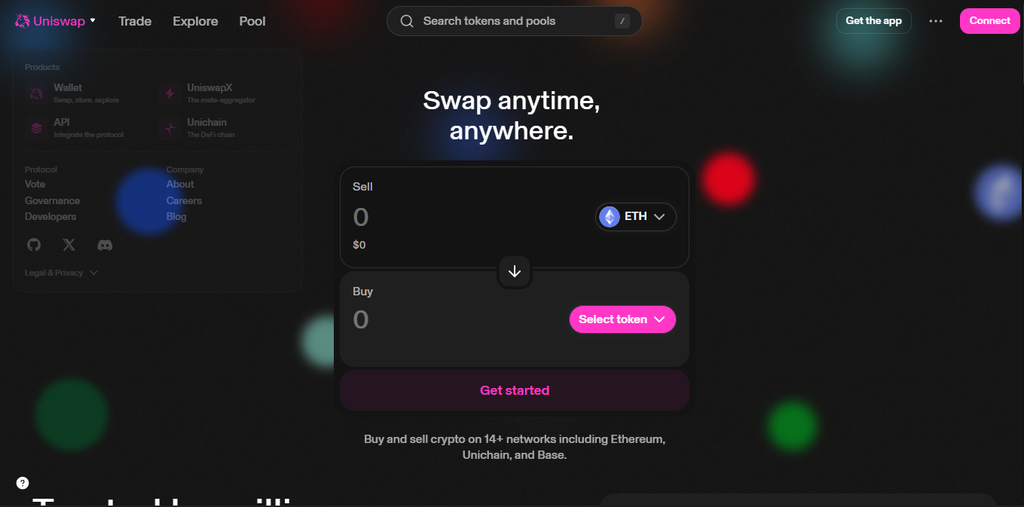
Using the Automated Market Maker (AMM) model, Uniswap has cemented itself as Ethereum’s leading decentralized exchange, offering smooth peer-to-peer trading without intermediaries. Launched in 2018 by Hayden Adams, the protocol quickly transformed decentralized finance by pioneering a permissionless method for swapping digital assets.
With a total value locked (TVL) of approximately $4.4 billion, Uniswap remains one of the most trusted and widely adopted decentralized finance (DeFi) platforms. Its impact is evident in the more than $3 trillion cumulative trading volume processed and over 119 million all-time swappers.
The platform supports thousands of tokens across 14 chains, empowering users with deep liquidity, permissionless access, and advanced features, including limit orders and liquidity provision.
Beyond the exchange, Uniswap Labs introduced a self-custody wallet, enabling users to swap, store, and explore tokens with ease. The governance and utility of the protocol are powered by the UNI token, making Uniswap a cornerstone of decentralized finance in 2026.
Aave – The Lending Powerhouse
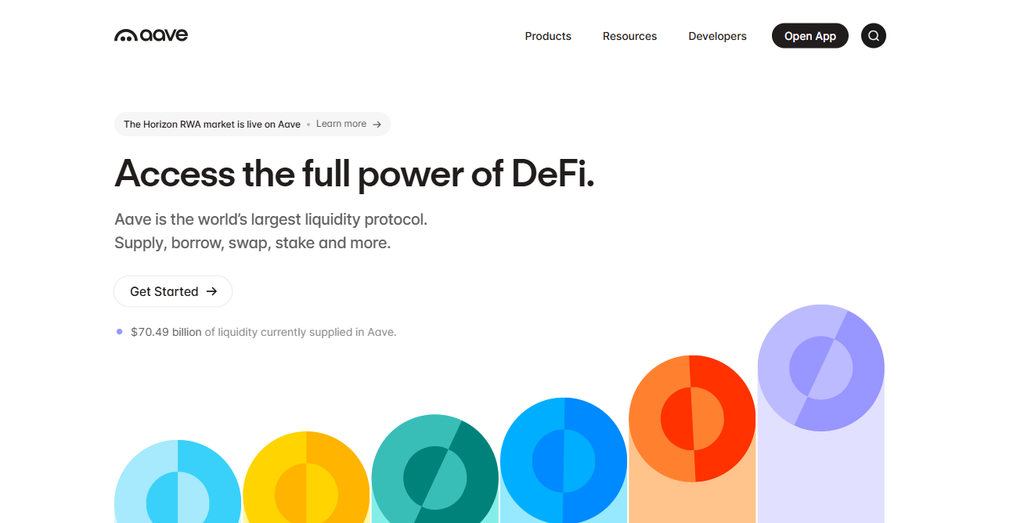
As one of the most prominent liquidity protocols in decentralized finance, Aave has established itself as the lending powerhouse of Ethereum and beyond.
Founded in 2017 by Finnish entrepreneur Stani Kulechov, Aave introduced a non-custodial framework that allows users to supply and borrow assets easily while maintaining complete control of their funds.
With over $70 billion in liquidity supplied across Ethereum and more than 12 EVM-compatible networks, it continues to rank as one of the largest DeFi protocols.
Key features include overcollateralized lending, real-time health factor tracking, staking rewards, transparent governance, and composability that enables developers to integrate Aave’s liquidity pools into diverse applications.
Aave also launched GHO, a decentralized, overcollateralized stablecoin native to the protocol, further strengthening its ecosystem. Governance is driven by the AAVE token, which can be staked within the Safety Module to support protocol security while earning rewards.
Sky (MakerDAO) – Pioneer in Stablecoins
Founded in 2014 by Rune Christensen, MakerDAO, now rebranded as the Sky Protocol, remains the pioneer of decentralized stablecoins in DeFi.
Initially known for launching DAI, the world’s first unbiased, price-stable cryptocurrency, the protocol has since evolved with the introduction of USDS and SKY as upgraded versions of DAI and MKR.
With a total value locked (TVL) of over $17.2 billion, the protocol secures one of the highest liquidity levels in decentralized finance. The ecosystem offers features such as the Sky Savings Rate of 4.75%, Sky Token Rewards, and a governance structure driven by the SKY token, giving holders authority over protocol decisions.
MakerDAO’s integration spans over 400 apps and services across wallets, DeFi platforms, and Layer 2 networks, including Arbitrum, Optimism, Base, and Unichain, through SkyLink, which reduces fees and accelerates transactions.
By continuing to provide a stable, community-governed digital currency, MakerDAO remains a trailblazer in stablecoin innovation.
Lido Finance – Leader in Liquid Staking
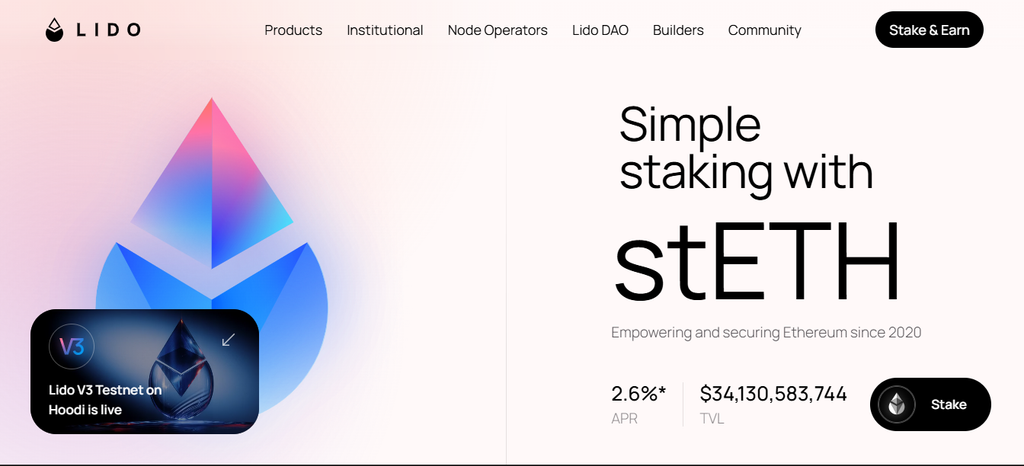
Launched in 2020, Lido Finance has established itself as the leader in liquid staking, providing Ethereum holders with a simple, decentralized way to stake their assets while maintaining liquidity.
With over $34 billion in total value locked (TVL), it remains the largest staking protocol in decentralized finance. The platform introduced stETH, a liquid staking token that represents staked ETH, allowing users to continue earning rewards while simultaneously using stETH across DeFi protocols for lending, trading, and yield strategies.
Additional products like Lido GGV and Lido DVV offer enhanced reward opportunities with TVLs of $146.8 million and $73.5 million, respectively, powered by strategies integrated with top-tier DeFi protocols and distributed validator technology.
Governance is community-driven through the Lido DAO, where LDO token holders vote on key protocol upgrades and decentralization initiatives. With over 800 validators worldwide, extensive security audits, and an open-source framework, Lido ensures non-custodial, transparent staking.
Its combination of liquidity, accessibility, and scalability has solidified Lido as Ethereum’s premier liquid staking protocol in 2026.
Raydium – Leading Decentralized Exchange on Solana
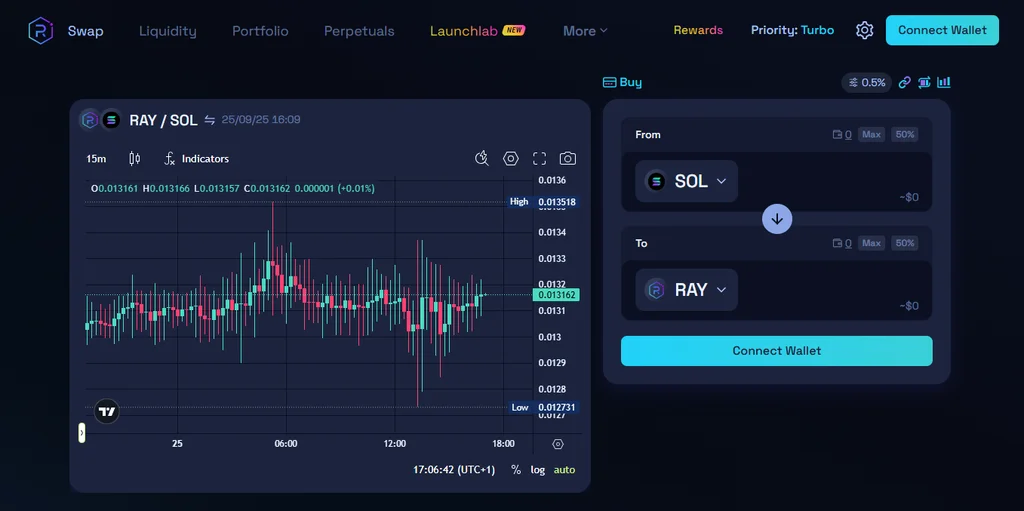
Raydium is the leading decentralized exchange on Solana, operating as an automated market maker (AMM) that connects directly with the central order book of Serum, enabling faster trades, shared liquidity, and advanced yield opportunities.
Launched in 2021, the protocol was founded by pseudonymous developers led by AlphaRay, who brings a background in algorithmic trading and liquidity provision.
With a total value locked (TVL) of $2.32 billion, Raydium is the largest DEX on Solana by TVL, providing traders and liquidity providers with efficient access to DeFi markets.
A key strength of Raydium lies in its integration with the OpenBook central limit order book, granting users and pools access to wider liquidity across the Solana ecosystem.
The platform supports low-cost, lightning-fast transactions thanks to Solana’s scalability, while also offering features such as TradingView chart integration, limit orders, and permissionless liquidity pool creation.
Raydium’s governance and utility are supported by the RAY token, which drives participation, incentives, and future protocol development within Solana’s expanding DeFi space.
Curve Finance – Liquidity Specialist
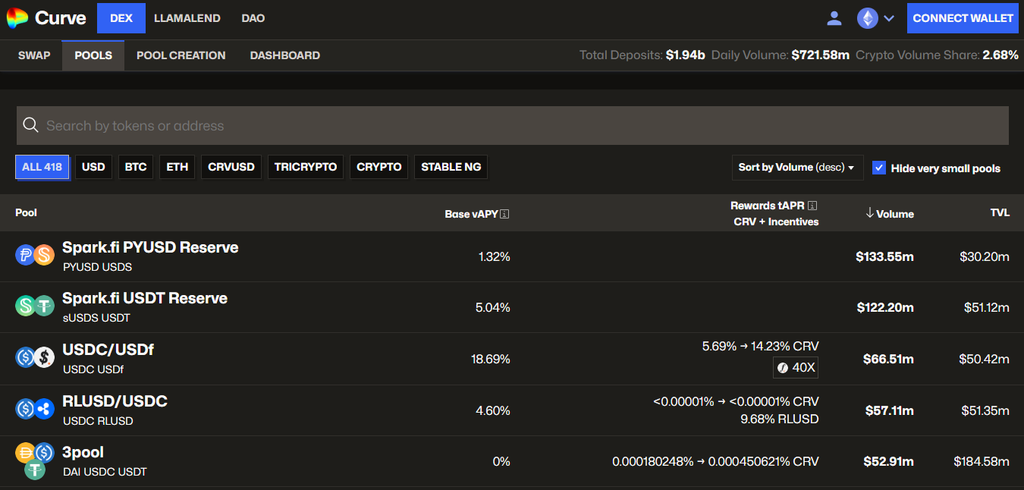
Curve Finance is widely recognized as the liquidity specialist in decentralized finance, offering an automated market maker (AMM) optimized for stablecoin trading with low fees and minimal slippage.
Launched in 2020 by Michael Egorov, Curve has grown into a cornerstone of DeFi with a total value locked (TVL) of $2.71 billion across major blockchains, including Ethereum, Arbitrum, Polygon, Base, Avalanche, Optimism, Kava, Gnosis, Fantom, Moonbeam, and Aurora.
The protocol enables users to exchange stable assets, such as DAI, USDC, and USDT, efficiently and securely. At the same time, liquidity providers earn both swap fees and additional interest through integrations with lending protocols, such as Compound.
Governance is powered by the CRV token, which uses a time-weighted voting system that rewards long-term holders with enhanced voting power through veCRV.
Locking CRV can boost liquidity pool rewards and even provide partial fee refunds. By balancing efficient trading, sustainable incentives, and multi-chain deployment, Curve Finance continues to define liquidity optimization within the DeFi ecosystem.
PancakeSwap – BNB Chain DeFi Leader
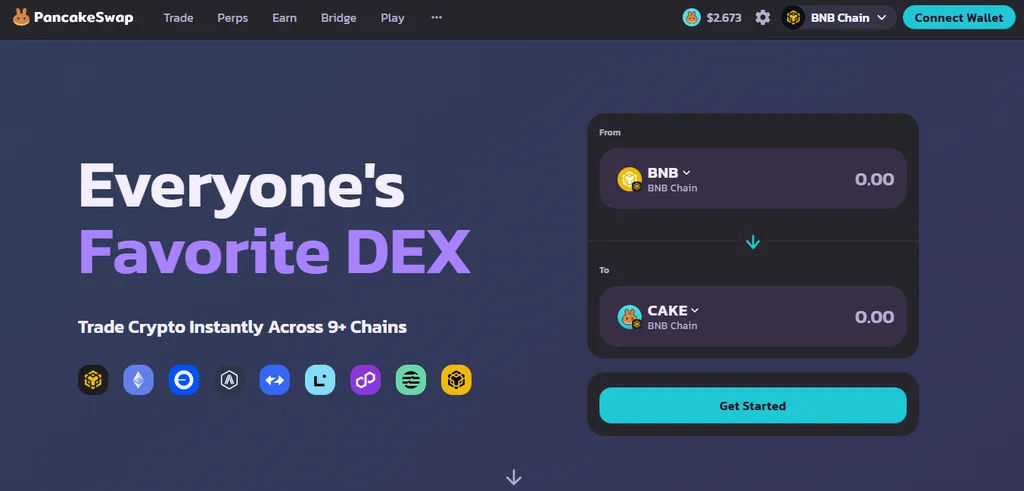
Like every other decentralized exchange built on automated market makers, PancakeSwap enables direct crypto trading without intermediaries, but it has grown into the undisputed DeFi leader on BNB Smart Chain (BSC).
Launched in September 2020 by an anonymous team of developers, the platform quickly gained trust for its low fees, user-friendly interface, and expansive liquidity pools.
Today, PancakeSwap boasts over $3.3 billion in total value locked (TVL), with millions of active users and tens of millions of trades processed monthly. Its native token, CAKE, powers governance, staking, and yield farming, while users earn additional rewards by providing liquidity.
PancakeSwap supports cross-chain functionality, bridging BSC with Ethereum and enhancing accessibility for traders. With fees starting as low as 0.01%, it has become a go-to choice for both casual traders and DeFi power users.
The release of PancakeSwap V4 introduces key improvements, including reduced slippage, support for native gas tokens, and native ETH integration, further solidifying its position as the flagship DEX on BNB Chain.
Jito – Top dApp on Solana Blockchain
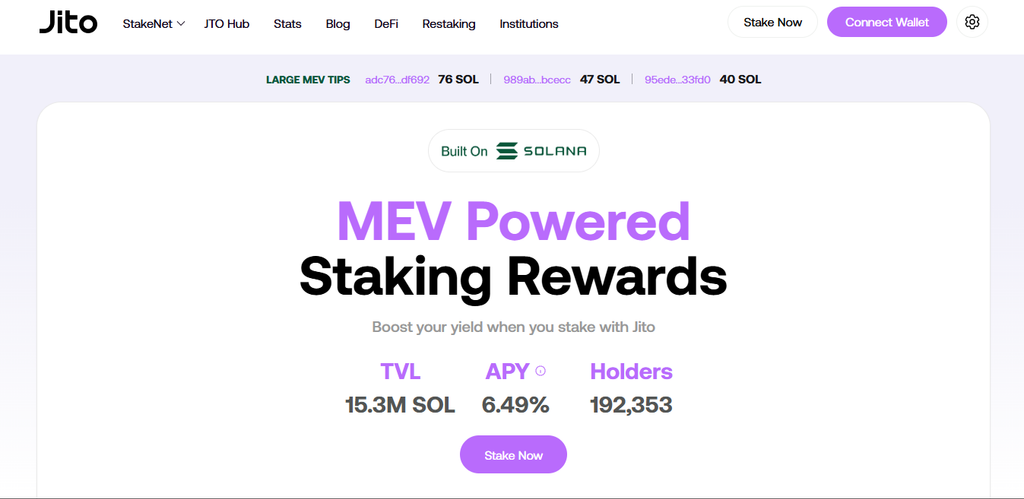
Here’s the first unique thing about Jito: it combines staking rewards with MEV (maximum extractable value) optimization, giving users on Solana unmatched yield opportunities.
Developed by Jito Labs and led by Lucas Bruder (CEO) and Zano Shermani (CTO), the protocol has grown rapidly into one of the top decentralized applications on Solana. With over 15.3 million SOL staked, an APY of 6.49%, and more than 192,000 holders, Jito stands out as the most liquid staking platform on the network.
Through its native JitoSOL liquid staking token, users receive rewards that continuously compound in value as staking and MEV earnings accumulate.
This design not only maximizes efficiency but also integrates deeply into Solana’s DeFi ecosystem, allowing JitoSOL holders to participate in lending, yield farming, and liquidity provision.
Governance is powered by the JTO token, supporting protocol decisions and incentives. By aligning MEV rewards with staker benefits and offering smooth DeFi utility, Jito has positioned itself as a category-defining leader on the Solana blockchain in 2026.
Just Lend – Biggest Lending Protocol on TRON
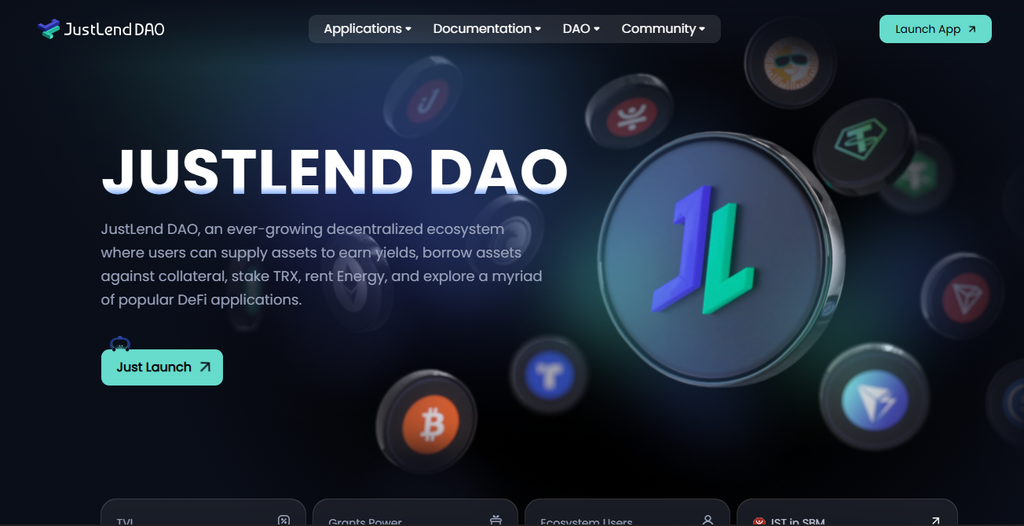
Just Lend is the biggest lending protocol on the TRON blockchain, offering users the ability to supply assets, earn yields, borrow against collateral, and access a wide range of ecosystem applications.
Backed and founded by Justin Sun, the protocol has grown into one of the largest decentralized finance platforms by scale, with a TVL of over $8.42 billion and nearly 476,000 users actively participating.
Launched as part of the broader JUST ecosystem, JustLend supports TRON, TRC-20 tokens, and stablecoins like USDT, allowing users to generate yields or borrow assets easily.
Its features include Supply & Borrow Markets (SBM) with visualized liquidation tools, TRX staking with APYs of up to 5.76%, an Energy rental system that reduces transaction costs, and a decentralized RWA investment platform.
At its core lies the JST token, powering governance and enabling community-driven decision-making. By combining high liquidity, efficient staking, and lending solutions, JustLend has firmly positioned itself as the most influential DeFi protocol on TRON.
Compound Finance – Lending & Borrowing Protocol
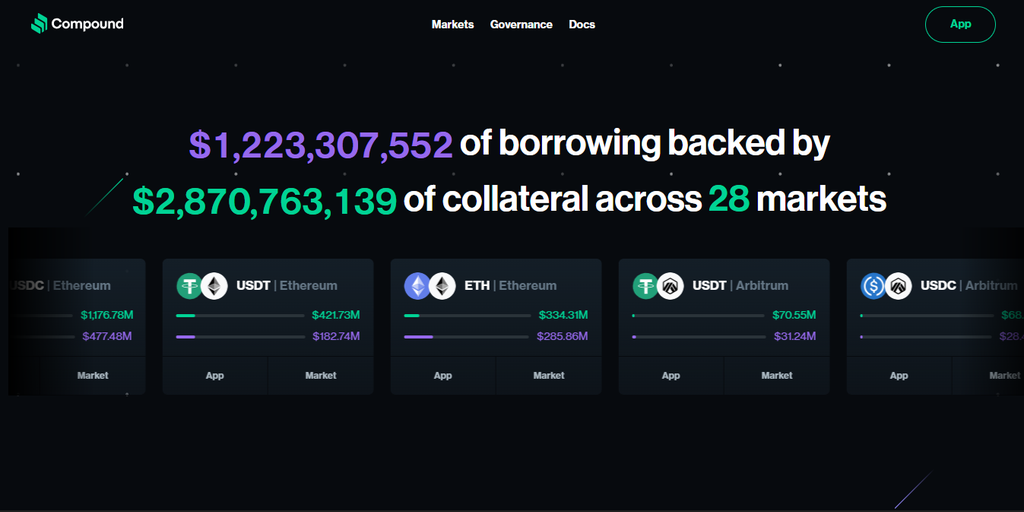
Compound Finance is one of the earliest and most influential lending and borrowing protocols in decentralized finance, launched in 2018 by Robert Leshner and Geoffrey Hayes under Compound Labs.
With a TVL of $2.92 billion, it allows users to easily lend cryptocurrencies to earn interest or borrow against collateral using an algorithmic, autonomous interest rate system. Operating across Ethereum, Polygon, Base, and Arbitrum, Compound has become a backbone for developers building financial applications.
The platform introduced the concept of cTokens, which represent supplied assets and continuously accrue value. Its governance is driven by the COMP token, enabling holders to propose and vote on upgrades that shape the protocol’s direction.
Known for its reliability and security, Compound integrates with trusted custodians like Coinbase Custody, Fireblocks, Anchorage, and Ledger, ensuring institutional-grade support for assets and governance. With low average APYs around 0.69%, Compound prioritizes safety and liquidity, standing as a proven leader in the lending and borrowing category of DeFi.
Risks and Challenges in the DeFi Sector
Decentralized Finance (DeFi) has redefined global financial services by offering open, permissionless alternatives to traditional banking. However, despite its rapid growth, the sector faces significant risks and challenges that could impact both users and the long-term sustainability of projects.
Smart Contract Vulnerabilities
Most DeFi protocols are powered by smart contracts, which, if not audited properly, can contain exploitable bugs. High-profile hacks and exploits have resulted in billions of dollars in losses.
Regulatory Uncertainty
Governments worldwide are still deciding how to regulate DeFi. Stricter rules on KYC/AML, taxation, or securities classification could affect innovation and user adoption.
Liquidity Risks
Protocols rely on user-supplied liquidity. In volatile markets, liquidity providers may withdraw funds quickly, causing slippage, reduced returns, or even protocol failure.
Scalability and Network Congestion
Popular chains like Ethereum have faced high gas fees and congestion during peak demand, making DeFi transactions costly and inefficient.
Market Risks
Price volatility, impermanent loss for liquidity providers, and over-collateralization requirements remain barriers for mainstream adoption.
Also Read: How to Choose the Best Crypto Wallet for Your Needs: Complete 2026 Guide
Final Thoughts
Decentralized Finance continues to expand as a powerful alternative to traditional systems, offering lending, borrowing, staking, and trading opportunities across multiple blockchains.
Protocols like Aave, Uniswap, Lido, and others highlighted in this post show how DeFi protocols are building accessible and transparent financial services powered by smart contracts.
Yet, risks remain, ranging from security vulnerabilities to regulatory questions, making research and informed participation essential. As capital flows into leading protocols with billions in TVL, DeFi is steadily proving its value. The future of finance is being coded today, and those who understand it early will benefit the most tomorrow.
Frequently Asked Questions
Which Is the Best Defi Project?
The best DeFi project depends on individual needs, Uniswap excels in trading, Aave and Compound lead in lending, Lido dominates liquid staking, and MakerDAO (Sky) provides stability with its USDS stablecoin.
What Is the Best Project on Solana?
The best DeFi project on Solana is Raydium, as it serves as the leading decentralized exchange with deep liquidity, fast transactions, and a $2.3B+ TVL, while Jito also stands out for MEV-powered liquid staking rewards.
How To Find Good DeFi Projects?
Look for DeFi projects with strong fundamentals such as high TVL, transparent governance, audited smart contracts, active communities, reliable teams or DAOs, and real utility across multiple blockchains.
Is Solana DeFi?
Yes, Solana is a DeFi ecosystem that supports decentralized applications, exchanges, lending platforms, and staking protocols built on its high-speed blockchain.
How Fast Is DeFi Growing?
DeFi is growing rapidly, with billions in total value locked across protocols and millions of active users engaging in trading, lending, staking, and stablecoin adoption across multiple blockchains.