For many people, crypto started as a way to trade, speculate, or chase fast profits. But in 2026, the conversation has shifted. More investors are now asking a different question:
“How can I make my crypto work for me every day, even when I’m not actively trading?” This is where crypto passive income comes in.
Instead of constantly watching charts or timing the market, passive income strategies allow you to earn rewards simply by holding, staking, lending, or providing liquidity. Your assets stay active in the background, generating returns while you focus on other things like your career, your business, or your personal goals.
What makes this even more exciting is the variety of options available. From beginner-friendly exchange staking to advanced DeFi strategies, there is something for every level of investor.
You can aim for slow and steady growth with stablecoins, build long-term wealth with blue-chip staking, or explore higher-yield opportunities if you’re willing to manage more risk.
Key Takeaway
- Quick profits are rare and risky. Sustainable earnings come from consistent strategies, trusted platforms, and patience.
- Staking blue-chip assets and lending stablecoins are safer, while yield farming and higher-risk strategies offer bigger rewards but greater chances of loss.
- Using strong passwords, hardware wallets, audited platforms, and insurance options can protect you from costly hacks and scams.
- Staking rewards and interest are usually taxable. Tracking your income early saves you stress and penalties later.
What Is Passive Income in Crypto?

Passive income in crypto is money you earn automatically by holding or locking your cryptocurrency in specific platforms or networks. Instead of trading every day, you deposit your coins into services that reward you over time.
Common ways to earn passive crypto income include:
- Staking: Locking coins to support a blockchain and earning rewards
- Lending: Lending your crypto to others and earning interest
- Yield farming: Providing liquidity to DeFi platforms for rewards
- Savings accounts: Earning interest through crypto platforms
For example, if you stake Ethereum or lend stablecoins like USDT, you may receive weekly or monthly rewards without doing extra work.
Why Crypto Passive Income Matters
In 2026, crypto passive income is more important than ever for several reasons.
First, traditional savings accounts still offer very low interest in many countries. Meanwhile, crypto platforms often provide higher returns when used wisely.
Second, blockchain technology has matured. Many platforms are now more secure, regulated, and user-friendly. This makes it easier for beginners to earn safely.
Third, inflation continues to reduce the value of money worldwide. Earning passive income through crypto helps protect purchasing power over time. Crypto passive income also matters because it:
- Creates an extra income stream
- Helps grow long-term wealth
- Reduces dependence on a single salary
- Supports financial independence
For many people in 2026, crypto is no longer just for trading. It has become a serious tool for building steady income.
Also Read: Spend and Stack: The 8 Best Crypto Card Cashback Rewards
How Passive Crypto Income Differs From Active Trading
Passive crypto income and active trading are two very different approaches to making money. Active trading involves:
- Buying and selling frequently
- Watching price charts daily
- Timing the market
- Managing high emotional stress
Traders aim to profit from short term price changes. While it can be profitable, it is risky and requires constant attention. Passive crypto income, on the other hand, focuses on:
- Holding assets long-term
- Earning steady rewards
- Minimal daily involvement
- Lower emotional pressure
Instead of worrying about daily price movements, passive investors focus on earning consistent returns over time.
Popular Passive Income Methods in Crypto
| Method | Typical APY Range | Risk Level | Skill Level | Best For |
| Staking | 3%-15% | Low-Medium | Beginner | Long-term holders |
| Crypto Lending | 4%-12% | Low-Medium | Beginner | Stable income seekers |
| Yield Farming | 5%-50% | High | Advanced | High return seekers |
| Dividend Tokens | 2%-13% | Medium | Intermediate | Long-term investors |
| Liquid Staking | 4%-18% | Medium | Intermediate | Flexible earners |
| Real-Yield Protocols | 6%-20% | Medium | Intermediate | Sustainable income seekers |
There are several proven ways to earn passive income in crypto. Each method works differently and suits different types of investors. Some focus on stability, while others aim for higher returns with higher risk.
Understanding these methods will help you choose the right strategy based on your goals, risk tolerance, and experience level.
Staking
Staking is one of the simplest ways to earn passive income in crypto. Instead of letting your coins sit idle in a wallet, you lock them into a blockchain network to help keep it running smoothly. In return, the network rewards you with more coins.
Some blockchains allow you to stake directly by running a validator, which usually requires technical skills and a large amount of capital. Others use delegated staking, where you simply choose a validator and assign your coins to them. They handle the technical work, while you earn a share of the rewards.
Over time, staking has also evolved. Today, many platforms offer flexible options, including liquid staking, which lets you earn rewards while still keeping your funds usable.
Popular staking coins in 2026 include Ethereum (ETH), Solana (SOL), Cardano (ADA), Polkadot (DOT), and Cosmos (ATOM). These networks are trusted, widely used, and supported by many platforms.
Pros of Staking:
- Easy way to earn regular rewards
- Suitable for beginners
- Supports long-term investing
- Often available on major platforms
Cons of Staking:
- Funds may be locked for some time
- Rewards depend on network performance
- Token prices can still fall
- Validator failures may affect earnings
Crypto Lending & Interest Accounts
Crypto lending works like a digital savings account. You deposit your crypto, and other users borrow it. In return, you earn interest.
On centralized platforms, everything is handled for you. You simply deposit your assets, and the platform manages the lending process. This is convenient but requires trusting the company with your funds.
On decentralized platforms like Aave or Compound, smart contracts handle lending automatically. You stay in control of your wallet, and everything is transparent on the blockchain.
Many investors prefer lending stablecoins such as USDT, USDC, or DAI because their prices do not fluctuate much. This makes income more predictable and reduces stress during market swings.
However, lending is not risk-free. If markets crash suddenly or platforms face liquidity problems, withdrawals may be delayed or funds may be lost.
Pros of Crypto Lending:
- Steady and predictable income
- Works well with stablecoins
- Easy on centralized platforms
- No need to trade daily
Cons of Crypto Lending:
- Risk of platform failure
- Smart contract vulnerabilities
- Possible withdrawal delays
- Interest rates can change quickly
Yield Farming & Liquidity Provision
Yield farming is a more active way of earning passive income. It involves providing liquidity to decentralized exchanges and earning rewards in return.
When you add two tokens to a liquidity pool, you receive LP tokens that represent your share. These LP tokens can then be staked in farming platforms to earn extra rewards.
Some platforms automatically reinvest your earnings through vaults. This means your profits compound over time without you doing anything manually.
However, yield farming comes with a major risk called impermanent loss. If token prices change sharply, you may end up with less value than if you had simply held your coins.
In recent years, new models like Pendle and dual-reward farms have emerged, offering more ways to earn. These systems can be profitable, but they require more knowledge and attention.
Yield farming is best for users who are comfortable with DeFi and willing to monitor their investments.
Pros of Yield Farming:
- High earning potential
- Multiple reward streams
- Works well with auto-compounding tools
- Great for advanced users
Cons of Yield Farming:
- Risk of impermanent loss
- Complex for beginners
- Smart contract risks
- Requires regular monitoring
Dividend & Revenue Sharing Tokens
Some crypto projects reward holders by sharing part of their profits, similar to dividends in traditional stocks.
These tokens give you a claim on platform revenue. As the project grows and earns more, your income increases.
Payments may come in stablecoins, native tokens, or fee discounts. This makes them attractive for investors who want regular payouts.
NFTs have also joined this model. Some NFTs earn royalties when resold, while others represent ownership in games, platforms, or digital businesses. In Web3 gaming and metaverse projects, NFTs can generate rent, rewards, or staking income.
This method works best for people who believe strongly in a project and want to benefit from its long-term success.
Pros of Revenue Sharing Tokens:
- Regular income from platform profits
- Works like digital dividends
- Encourages long-term holding
- Growing use in NFTs and Web3
Cons of Revenue Sharing Tokens:
- Depends on project success
- Income may fluctuate
- Some projects lack transparency
- Regulatory uncertainty
Top Passive Income Protocols
| Category | Name | Best For | APYs | Pros | Cons |
| CEX | Binance | Users who want many earning options in one place and are comfortable with advanced features | 3%–10%+ | Huge selection of earning products; Competitive APYs; Supports many cryptocurrencies; Easy switching between strategies | Complex interface for beginners; Regulatory issues in some regions; Account restrictions possible; Fully custodial |
| CEX | Kraken | Investors who prioritize security, transparency, and long-term stability | 3%–7% | Strong security reputation; Simple staking setup; Clear fee structure; Good regulatory standing | Fewer earning products; Lower yields than Binance; Limited advanced strategies; Smaller asset selection |
| CEX | Coinbase | Beginners and long-term investors who value trust and simplicity over high returns | 2.5%–5% | Extremely beginner-friendly; Strong regulatory compliance; Trusted brand reputation; Easy fiat integration | Lower APYs; Higher fees; Limited earning products; Less flexibility |
| DEX | Lido | Ethereum investors looking for staking rewards while keeping capital flexible | 3%–4% | Flexible staking with liquid derivatives; Well-established and trusted; Compatible with DeFi platforms | Moderate APY; Smart contract risks; Dependence on Ethereum performance |
| DEX | Aave | Investors seeking stable, reliable interest on stablecoins and crypto lending | 4%–7% | Simple non-custodial lending; Transparent audited smart contracts; Flexible withdrawals; Wide asset selection | Rates fluctuate; Smart contract risks; Moderate returns |
| DEX | Pendle | Advanced DeFi users looking to trade or maximize future yield exposure | Variable / High Yield | Enables sophisticated yield strategies; High flexibility; Access to unique DeFi yield markets | Complex for beginners; Higher risk exposure; Requires understanding of yield token mechanics |
| DEX | Rocket Pool | Users who want decentralized staking with smaller amounts of ETH | 3%–5% | Decentralized and community-driven; Low minimum staking; Compatible with restaking opportunities | APY lower than Lido sometimes; Less adoption; Ethereum dependency |
| DEX | Curve Finance | Users looking to provide stablecoin liquidity with minimal impermanent loss | 2%–10% | Stable returns; Low impermanent loss risk; Fee-sharing rewards | Returns lower than volatile farming; Requires LP understanding; Smart contract risk |
| DEX | Convex Finance | Curve LPs seeking higher yield without manual staking management | 5%–15%+ | Higher APY for Curve LPs; Easy-to-use platform; Yield optimization | Dependent on CRV value; Platform centralization risk; Limited to Curve ecosystem |
| DEX | Yearn Finance | Investors wanting automated yield strategies without active management | 4%–12% | Fully automated compounding; Saves time and gas fees; Access to multiple strategies | Smart contract risks; Limited customization; Returns depend on market conditions |
| DEX | EigenLayer | Advanced Ethereum stakers looking to maximize yield through multi-layer staking | 5%–15%+ | Amplifies staking rewards; Integrates with multiple protocols; New earning opportunities | Complex and high-risk; Exposure to multiple smart contracts; Requires deep DeFi knowledge |
| DEX | Compound | Users who want steady decentralized interest on major cryptocurrencies and stablecoins | 3%–6% | Non-custodial and transparent; Strong security track record; No lock-up period; Simple interface | Moderate returns; Variable interest rates; Smart contract risks; Limited high-yield opportunities |
A few crypto passive income protocols stand out because of their reliability, strong user base, and constant innovation.
Understanding how each one works helps you choose the best fit for your portfolio, whether you’re aiming for steady returns, higher yields, or hands-on DeFi experimentation.
Centralized Exchanges (CEX)
Binance (Earn, Staking & Savings Platform)
Best for: Users who want many earning options in one place and are comfortable with advanced features.
Binance runs the largest crypto ecosystem in the world, with an estimated TVL of over $80B+ across staking, Earn products, and internal liquidity pools. It offers some of the widest earning options, including locked staking, flexible savings, dual investment, and DeFi integration.
APYs on Binance vary widely depending on the asset and product. Stablecoins usually range from 4% to 10%, while staking major coins like ETH, SOL, and BNB typically sit around 3% to 8%.
Pros:
- Huge selection of earning products
- Competitive APYs
- Supports many cryptocurrencies
- Easy switching between strategies
Cons:
- Complex interface for beginners
- Regulatory issues in some regions
- Account restrictions possible
- Funds are fully custodial
Kraken (Staking & Earn Platform)
Best for: Investors who prioritize security, transparency, and long-term stability.
Kraken is known for its strong security culture and regulatory compliance. Its estimated stake and Earn TVL sits around $15B+, driven mainly by long-term users and institutional clients.
Kraken focuses more on simplicity than aggressive yields. Staking APYs are usually in the 3% to 7% range, with stablecoin rewards around 4% to 6% depending on market conditions.
Pros:
- Strong security reputation
- Simple staking setup
- Clear fee structure
- Good regulatory standing
Cons:
- Fewer earning products
- Lower yields than Binance
- Limited advanced strategies
- Smaller asset selection
Coinbase (Earn & Staking Services)
Best for: Beginners and long-term investors who value trust and simplicity over high returns.
Coinbase is one of the most trusted exchanges in the U.S. and Europe, with an estimated TVL of $20B+ across staking and custody services. It focuses heavily on compliance and user protection.
APYs on Coinbase are usually conservative. Staking ETH, SOL, or ADA typically earns 2.5% to 5%, while stablecoin yields often fall between 3% and 5%.
Coinbase’s biggest strength is usability. Everything is designed for beginners, from account setup to reward tracking. You rarely need technical knowledge to start earning.
Pros:
- Extremely beginner-friendly
- Strong regulatory compliance
- Trusted brand reputation
- Easy fiat integration
Cons:
- Lower APYs
- Higher fees
- Limited earning products
- Less flexibility
Decentralized Platforms (DeFi)
Lido (Liquid Staking)
Best for: Ethereum investors looking for staking rewards while keeping their capital flexible.
Lido has become a giant in Ethereum staking, with $34.8B TVL and the iconic stETH token. It allows users to stake ETH without locking it completely, meaning your funds remain flexible for DeFi use.
The current APY ranges from 3–4%, which is steady and reliable for long-term holders.
Pros:
- Flexible staking with liquid derivatives
- Well-established, secure, and widely trusted
- Compatible with multiple DeFi platforms for extra yield
Cons:
- APY is moderate compared to high-risk yield farms
- Smart contract risks, although audited
- Dependence on Ethereum network performance
Aave (Lending)
Best for: Investors seeking stable, reliable interest on stablecoins and crypto lending.
Aave is the go-to DeFi lending platform, with more than $35B in TVL. Users can lend their crypto, especially stablecoins, and earn interest between 4–7% APY. It’s straightforward for beginners but capable enough for advanced strategies.
Pros:
- Simple, non-custodial lending
- Transparent, audited smart contracts
- Flexible withdrawal options
- Wide selection of assets
Cons:
- Rates can fluctuate based on supply and demand
- Vulnerable to smart contract risks
- Moderate returns compared to aggressive farming
Pendle (Yield Trading)
Best for: Advanced DeFi users looking to trade or maximize future yield exposure.
Pendle is a yield tokenization protocol with several billion dollars in TVL, representing a large share of the DeFi yield trading sector. It allows users to separate principal and yield tokens, letting you trade or hedge future yield. This makes it highly composable across DeFi strategies.
Pros:
- Enables sophisticated yield strategies
- High flexibility and composability
- Access to DeFi yield markets not available elsewhere
Cons:
- Complex for beginners
- Higher risk due to market exposure
- Requires understanding of yield token mechanics
Rocket Pool (Liquid Staking)
Best for: Users who want decentralized staking with smaller amounts of ETH.
Rocket Pool is a decentralized Ethereum staking alternative, currently holding $4.6B TVL. It lets users stake ETH with smaller amounts than traditional validators and earn rewards without relying on a centralized entity.
Pros:
- Decentralized and community-driven
- Low minimum staking requirement
- Compatible with Ethereum restaking opportunities
Cons:
- APY slightly lower than Lido at times
- Less widely adopted than Lido
- Still dependent on Ethereum network conditions
Curve Finance (DEX)
Best for: Users looking to provide stablecoin liquidity with minimal impermanent loss.
Curve Finance is the stablecoin-focused AMM, with $2.7B TVL. It specializes in low-slippage stablecoin swaps and rewards liquidity providers with a share of trading fees.
Pros:
- Stable and predictable returns
- Low impermanent loss risk due to stablecoin focus
- Fee-sharing rewards on every trade
Cons:
- Returns limited compared to volatile assets
- Requires understanding LP token mechanics
- Exposure to smart contract risk
Convex Finance (Yield Aggregator)
Best for: Curve LPs seeking higher yield without manual staking management.
Convex Finance optimizes CRV rewards for Curve liquidity providers, with $3.9B TVL. It boosts yield for stakers while simplifying the process, allowing users to earn more CRV without managing multiple strategies manually.
Pros:
- Higher APY for Curve LPs
- Streamlined, easy-to-use platform
- Combines staking and yield optimization
Cons:
- Dependent on CRV token value
- Platform centralization risk
- Limited to Curve liquidity strategies
Yearn Finance (Vaults)
Best for: Investors wanting fully automated yield strategies without active management.
Yearn Finance offers auto-compounding vaults and currently holds $5.1B TVL. Users deposit assets, and Yearn automatically deploys them into optimized yield strategies, claiming and reinvesting rewards.
Pros:
- Fully automated compounding
- Saves time and gas fees
- Access to multiple yield strategies
Cons:
- Smart contract risk
- Limited customization for some strategies
- Returns depend on market conditions
EigenLayer (Restaking)
Best for: Advanced Ethereum stakers looking to maximize yield through composable, multi-layer staking.
EigenLayer introduces Ethereum restaking, adding an extra layer of yield opportunities. With $17.51B TVL, it allows ETH stakers to “re-use” their stake across multiple protocols, effectively multiplying earning potential.
Pros:
- Amplifies staking rewards
- Integrates with multiple protocols
- Opens new DeFi earning opportunities
Cons:
- Complex and high-risk strategy
- Exposure to multiple smart contracts
- Requires deep knowledge of Ethereum DeFi ecosystem
Compound (DeFi Lending Protocol)
Best for: Users who want steady, decentralized interest in major cryptocurrencies and stablecoins.
Compound is one of the most trusted decentralized lending platforms in crypto, with a total value locked (TVL) of several billion dollars.
It allows users to earn passive income by supplying assets like ETH, USDC, or DAI, which are then borrowed by other users. In return, lenders earn interest that adjusts automatically based on market demand, with typical stablecoin APYs ranging between 3% and 6%.
Pros:
- Non-custodial and transparent
- Strong security track record
- Simple and reliable interface
- No lock-up period
Cons:
- Returns are usually moderate
- Interest rates can change quickly
- Smart contract risks
- Limited high-yield opportunities
How to Choose the Right Crypto for Passive Income
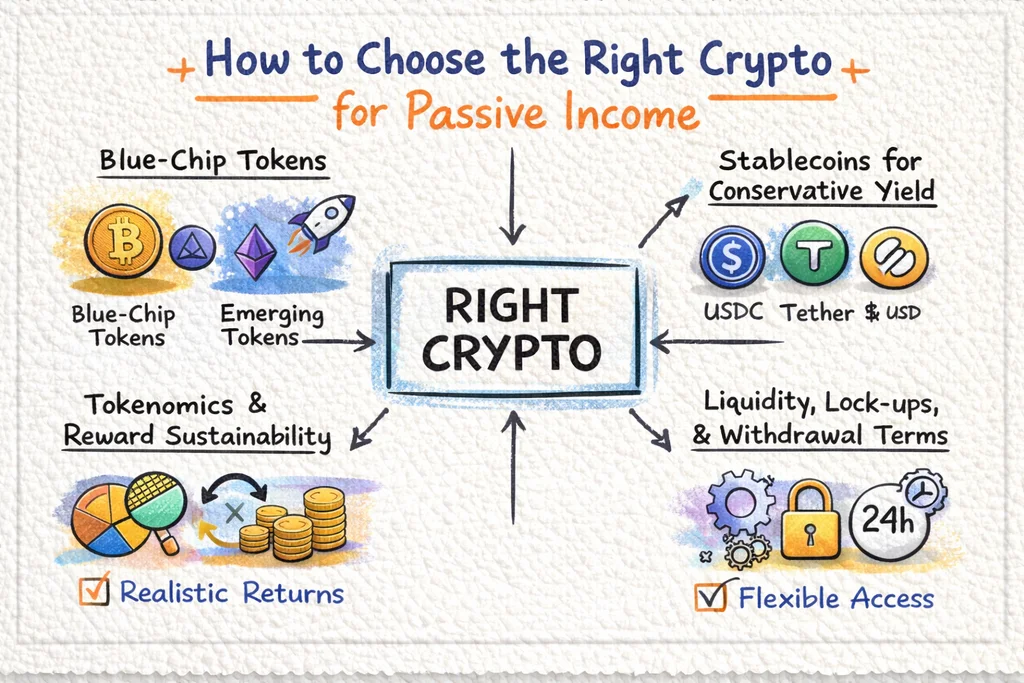
Earning passive income with crypto isn’t just about picking the asset with the highest APY. The key is choosing coins that fit your goals, risk tolerance, and strategy.
The right choice can make your portfolio grow steadily, while the wrong one can expose you to unnecessary risk. Here’s a breakdown of the factors you need to consider.
Blue Chip vs Emerging Tokens
Blue chip cryptocurrencies like Bitcoin, Ethereum, and Solana are generally safer bets for earning passive income.
They have proven track records, strong networks, and deep liquidity. Staking or lending these coins offers more predictable returns, and they’re less likely to lose significant value overnight.
Emerging tokens, on the other hand, can offer sky-high yields. Many DeFi projects and altcoins advertise APYs that seem too good to pass up. But with higher reward comes higher risk these tokens are prone to price swings, rug pulls, or protocol failures.
Stablecoins for Conservative Yield
If you want to earn passive income without worrying about market volatility, stablecoins like USDC, USDT, or DAI are your safest option. These coins are pegged to fiat currencies and usually generate yields from lending or liquidity provision.
Stablecoins typically earn 3–12% APY depending on the platform. They’re ideal if your goal is steady income, short term funding, or capital preservation.
Tokenomics & Reward Sustainability
Not all APYs are created equal. Understanding a token’s tokenomics, how it’s minted, distributed, and burned, is essential. Some projects reward users with new token emissions, which can inflate supply and reduce real value over time.
Others distribute revenue generated from fees or protocol activity, which tends to be more sustainable.
Look for platforms where rewards come from real yield (fees, interest, or revenue-sharing) rather than pure token inflation. This ensures your earnings aren’t wiped out by devaluation.
Liquidity, Lock-ups, & Withdrawal Terms
Before staking or depositing, always check liquidity and lock up conditions.
Some platforms require you to lock funds for weeks or months, which can limit flexibility and make it hard to react if prices drop. Others allow instant withdrawals but may offer lower APYs.
High liquidity ensures you can exit or move your assets without losing value. Lock-ups can boost APY but add risk. Withdrawal terms vary; some platforms charge fees or require advanced notice.
Tax, Regulation & Reporting in 2026

Earning passive income from crypto feels exciting, until you realize HMRC or your local revenue service wants a piece of that action too. Understanding tax and regulation isn’t optional if you want to keep your earnings and avoid surprises.
Global Tax Considerations
Across many countries, crypto is treated like a capital asset or financial instrument. That means when you earn from staking, lending, farming, or selling gains, tax authorities expect you to report and pay up.
For example, in the United States new rules require exchanges to share detailed reports with the IRS, including gains and losses via Form 1099-DA starting with the 2026 filing season, similar to how stocks are reported.
Nearly 50 countries including the UK and members of the Organisation for Economic Co-operation and Development (OECD) are enforcing frameworks like the Cryptoasset Reporting Framework (CARF), which ensures that platforms share user transaction data with tax authorities.
In short: whether you live in North America, Europe, Africa, or Asia, staying compliant means understanding local laws, documenting your income and gains carefully, and planning ahead.
Regulatory Risks to Watch
The regulatory environment around crypto continues to evolve. New laws are emerging that could affect everything from how you report to where you’re required to pay taxes:
- Data sharing agreements bind exchange reporting across borders.
- Platforms may require extra identity verification and tax status.
- Penalties for underreporting can escalate quickly, including fines and even legal action if authorities determine intent to evade tax.
Security Best Practices

Crypto passive income is attractive, but so are hackers. Whether you’re staking on DeFi or earning interest on exchanges, protecting your funds should be second nature.
Protecting Against Hacks & Scams
Every DeFi contract, wallet, and extension you interact with increases your attack surface. Hackers constantly scan for weak spots and once funds are gone, recovery is usually impossible.
Basic hygiene starts with strong unique passwords and never reusing them across platforms. Enable two-factor authentication (2FA) everywhere possible. Treat “free yield” offers with skepticism: if it sounds too rich for the risk, it probably is.
Cold Wallets & Multi-Sig
Keeping funds on exchanges or software wallets is convenient, but it exposes your keys to third party risks. A cold wallet hardware device like Ledger or Trezor stores keys offline, drastically reducing the chance of online compromise.
For serious earners, multi signature (multi-sig) wallets add another layer of protection. Instead of one key controlling the money, multiple keys are required. This makes unauthorized access far harder and is especially valuable for shared or high-value wallets.
Platform Audits and Insurance
Before depositing funds into any protocol, check whether the smart contracts have been audited by reputable firms. Audit reports don’t guarantee safety, but they show the team took security seriously.
Many DeFi projects also offer insurance options through third-party products (e.g., Nexus Mutual or InsurAce) that can reimburse losses from hacks or exploits. Choosing audited platforms with insurance coverage can protect you from rare but devastating failures.
Also Read: How Businesses Can Integrate Crypto Payments Into a Website
Tools & Tracking for Passive Crypto Income

Keeping tabs on your crypto income and security isn’t just smart, it’s essential. Fortunately, there are tools that make life far easier.
Portfolio Trackers
Tools like CoinTracker, Koinly, or Delta help you monitor all your crypto across exchanges and wallets in one place. They sync transactions automatically and show your overall portfolio value, performance, and changes in real time. Many also generate tax reports you can use during tax season.
DeFi Analytics Dashboards
DeFi can be messy with multiple chains, yield strategies, and token types. Analytics dashboards like Zerion, Debank, or Dune offer deep insights into positions, earnings history, and trends.
These dashboards visualize your passive income streams and can help you spot inefficiencies or opportunities to optimize your yield. They also make tracking DeFi interactions much simpler than chasing history through block explorers.
Automation Tools & Bots
Automation tools like Autonoly and others are emerging that automate parts of tax reporting or portfolio management. They can pull your transactions from wallets and exchanges, reconcile them, classify events like staking rewards or swaps, and even prepare audit-ready reports.
Conclusion
Crypto passive income is no longer just about chasing the highest APY or jumping on the newest trend. It is about building a system that works for you one that balances growth, safety, flexibility, and peace of mind.
The most successful earners aren’t the ones who gamble everything on risky platforms. They are the ones who understand their options, spread their capital wisely, and adapt as the market changes.
They combine stable assets with growth opportunities. They mix centralized platforms with DeFi. They prioritize security as much as profits. And they treat record-keeping and taxes as part of the process, not an afterthought.
If you approach crypto passive income with patience, discipline, and curiosity, it can become a powerful way to grow wealth over time. Not overnight. Not magically. But steadily, responsibly, and on your own terms.
Start smart. Stay secure. Think long-term. That’s how passive income becomes lasting income.
(FAQs)
Is crypto passive income really “passive,” or does it require work?
Crypto passive income can be mostly hands-off, but it isn’t completely automatic. You still need to choose good platforms, monitor performance, and adjust when markets or rules change. Think of it as “low-effort income,” not “set it and forget it.”
What is the safest way to earn passive income with crypto?
Generally, staking major coins and lending stablecoins on reputable platforms are among the safer options. They offer lower returns, but they also come with less volatility and fewer surprises compared to high-risk DeFi strategies.
How much money do I need to start earning passive income in crypto?
You don’t need a lot. Many platforms allow you to start with as little as $10–$50. What matters more than the amount is learning how the system works before increasing your investment.
Are crypto rewards and staking income taxable in 2026?
Yes, in most countries, staking rewards, lending interest, and farming income are taxable. Even if you don’t cash out, you may still owe taxes. Using tracking tools makes reporting much easier.
Can I lose money while earning passive income?
Yes. Risks include price crashes, platform hacks, smart contract failures, and scams. Higher yields usually mean higher risk. Diversifying and using secure platforms helps reduce potential losses.
Should I use centralized platforms or DeFi for passive income?
It depends on your experience and goals. Centralized platforms are easier and safer for beginners. DeFi offers higher potential returns and more control but requires technical knowledge and careful risk management. Many investors use both for balance.