


CPU mining is the process of using a computer’s central processing unit (CPU) to solve cryptographic puzzles required to validate blockchain transactions and earn cryptocurrency rewards. It was the original mining method – when Satoshi Nakamoto launched Bitcoin in 2009, the only way to mine was with a regular CPU, and early miners could earn 50 BTC per block using an ordinary laptop. As competition increased, miners moved to GPUs (2010), then FPGAs (2011), and finally ASICs (2013), making CPU mining unprofitable for Bitcoin. However, CPU mining remains viable for certain cryptocurrencies specifically designed to resist GPU and ASIC optimization, most notably Monero (XMR) with its RandomX algorithm, which is deliberately optimized for CPU performance.
Definition
CPU Mining uses a computer’s main processor to mine cryptocurrency:
| Aspect | Description |
| Hardware | Standard computer CPU (Intel Core, AMD Ryzen, etc.) |
| Method | CPU executes hash calculations to find valid block solutions |
| Performance | Significantly slower than GPU or ASIC mining for most algorithms |
| Best For | CPU-optimized algorithms like RandomX (Monero) |
| Profitability | Generally unprofitable for Bitcoin/Ethereum; viable for specific CPU-friendly coins |
| Historical Role | The original and only mining method from 2009-2010 |
Origin & History
“The proof-of-work also solves the problem of determining representation in majority decision making… one-CPU-one-vote.”
| Date | Event |
| January 2009 | Satoshi Nakamoto CPU-mines Bitcoin’s genesis block on a regular computer |
| 2009 | All Bitcoin mining is CPU-based; early miners use laptops and desktops to earn 50 BTC/block |
| October 2010 | First GPU mining software released; GPUs are 10-100x faster than CPUs at SHA-256 |
| 2011 | FPGA (Field-Programmable Gate Array) miners appear; CPU mining becomes uncompetitive for Bitcoin |
| 2013 | First Bitcoin ASIC miners ship; CPU mining for Bitcoin becomes completely unprofitable |
| 2014 | Monero launches using CryptoNight algorithm – designed to be CPU-friendly |
| 2017 | Multiple “ASIC-resistant” coins emerge, attempting to keep mining accessible to CPUs |
| 2019 | Monero adopts RandomX – specifically optimized for CPU mining, deliberately disadvantaging GPUs/ASICs |
| 2021 | Raptoreum launches with GhostRider algorithm, designed for CPU mining |
| 2022 | Ethereum moves to Proof of Stake; CPU mining no longer relevant for Ethereum |
| 2024 | CPU mining remains viable primarily for Monero (RandomX) and a handful of smaller coins |
How It Works
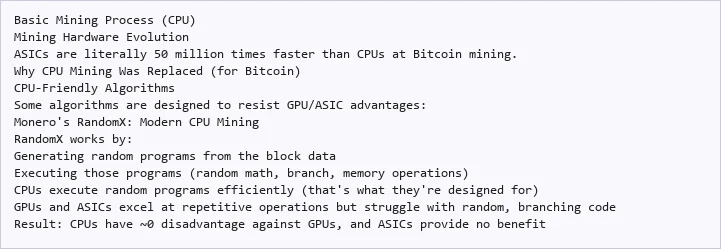
| Step | Process |
| 1. Receive block template | Mining software receives pending transactions and block data from the network |
| 2. Hash computation | CPU calculates the hash of the block header with different nonce values |
| 3. Difficulty check | If the hash meets the network’s difficulty target, the block is valid |
| 4. Submit solution | Valid block is broadcast to the network for verification |
| 5. Reward | If accepted, the miner receives the block reward + transaction fees |
| Era | Hardware | Performance (Bitcoin) | Power Cost |
| 2009-2010 | CPU (Intel Core 2) | ~2 MH/s | Low |
| 2010-2012 | GPU (AMD Radeon) | ~200 MH/s | Medium |
| 2011-2013 | FPGA | ~750 MH/s | Medium |
| 2013-present | ASIC (Antminer) | ~100+ TH/s | High |
| Factor | CPU | ASIC |
| Hash rate | ~2 MH/s | ~100 TH/s |
| Efficiency | ~1,000 W per MH/s | ~0.03 W per TH/s |
| Multiplier | 1x (baseline) | 50,000,000x faster |
| Profitability | Loses money on electricity | Profitable at scale |
| Algorithm | Coin | How It Stays CPU-Friendly |
| RandomX | Monero (XMR) | Uses random code execution that CPUs handle natively; GPUs get ~0 advantage |
| GhostRider | Raptoreum (RTM) | Rotates between multiple algorithms, using CPU cache |
| YescryptR16 | Various | Memory-hard algorithm optimized for CPU memory hierarchy |
In Simple Terms
- CPU mining is mining with your regular computer– the same chip that runs your web browser and games can also mine cryptocurrency, though not all coins are practical.
- It’s how Bitcoin started– Satoshi Nakamoto mined the first Bitcoin blocks on an ordinary computer. In 2009, anyone with a laptop could mine Bitcoin.
- For Bitcoin, it’s now obsolete– specialized ASIC machines are 50 million times faster than CPUs for Bitcoin mining. Using your CPU to mine Bitcoin today would be like trying to dig a tunnel with a spoon while others use excavators.
- But some coins are built for CPUs– Monero uses the RandomX algorithm, which is specifically designed so that CPUs are the most efficient hardware. This keeps mining accessible to regular people.
- The philosophy matters– CPU mining represents the democratic ideal of “one CPU, one vote” that Satoshi described. CPU-mineable coins try to prevent mining centralization by large ASIC farms.
Important: CPU mining for Bitcoin or other SHA-256/Ethash coins is completely unprofitable – you’ll spend more on electricity than you’ll ever earn. Only mine with CPUs on coins specifically designed for CPU mining (like Monero with RandomX) after calculating your electricity costs and expected earnings.
Real-World Examples
Scenario 1: Satoshi’s Original Bitcoin Mining
| Aspect | Details |
| Scenario | In January 2009, Satoshi Nakamoto launches the Bitcoin network |
| Implementation | Satoshi mines the first blocks using a standard desktop CPU. The difficulty is minimal – blocks are found easily. Satoshi is estimated to have mined approximately 1 million BTC in the early days |
| Outcome | CPU mining was not only viable but the only option. Those 1 million BTC (worth $60+ billion at peak prices) were mined on ordinary hardware anyone could have run |
Scenario 2: Monero CPU Mining (Modern)
| Aspect | Details |
| Scenario | A user wants to mine cryptocurrency profitably using their existing AMD Ryzen 9 7950X desktop |
| Implementation | They install XMRig (open-source Monero mining software), join a mining pool, and mine Monero using RandomX. Their 16-core CPU achieves ~25,000 H/s (hashes per second) |
| Outcome | At typical rates, they earn approximately $1-2 per day in XMR, with electricity costs of ~$0.50-1.00/day (depending on rates). Modest profit, but it proves CPU mining is still viable for the right algorithm |
Scenario 3: CPU Mining for Decentralization
| Aspect | Details |
| Scenario | The Monero community advocates for CPU-only mining to maximize network decentralization |
| Implementation | Monero has forked multiple times to maintain ASIC resistance: changing from CryptoNight to CryptoNight-R to RandomX. Each change was designed to invalidate ASICs and keep mining accessible to regular CPUs |
| Outcome | Monero’s network is one of the most decentralized Proof of Work networks, with mining distributed across thousands of individual CPU miners worldwide – fulfilling Satoshi’s “one-CPU-one-vote” vision |
Advantages
| Advantage | Description |
| Accessibility | Anyone with a computer can participate – no special hardware needed |
| Decentralization | Prevents mining centralization by large ASIC farm operators |
| Low barrier to entry | No significant upfront investment required |
| Dual use | Your CPU serves multiple purposes; mining is just one additional use |
| Democratic | Aligns with the “one-CPU-one-vote” principle |
Disadvantages & Risks
| Risk | Description |
| Low profitability | Generally low earnings compared to GPU/ASIC mining (for applicable coins) |
| Hardware wear | Continuous mining can reduce CPU lifespan and void warranties |
| Electricity costs | May exceed mining earnings, especially in high-electricity regions |
| Heat and noise | CPUs under full load generate significant heat and fan noise |
| Malware risk | Cryptojacking malware secretly uses victims’ CPUs to mine (usually Monero) |
FAQ
Can I mine Bitcoin with my CPU in 2024?
Technically yes, but practically no. Your CPU would earn a fraction of a penny per year while consuming several dollars in electricity daily. Bitcoin mining now requires specialized ASIC hardware costing thousands of dollars. CPU mining for Bitcoin has been unprofitable since approximately 2011.
What is the best cryptocurrency to CPU mine?
Monero (XMR) with its RandomX algorithm is by far the most established and profitable CPU-mineable cryptocurrency. Other options include Raptoreum (RTM), Wownero (WOW), and various smaller CPU-friendly coins. Always calculate profitability before mining.
Is CPU mining harmful to my computer?
Running your CPU at 100% load continuously generates extra heat and can reduce component lifespan. Ensure adequate cooling, monitor temperatures (keep below 85°C), and be aware that continuous mining may void your warranty. Many miners set their software to use only 50-75% of CPU threads.
What is cryptojacking?
Cryptojacking is malware that secretly installs CPU mining software on victims’ computers to mine cryptocurrency (usually Monero) for the attacker. The victim pays the electricity costs while the attacker collects the mining rewards. Browser-based cryptojacking (JavaScript miners) was also common during 2017-2018.