

Coin Control is an advanced feature in cryptocurrency wallets that allows users to manually select which specific unspent transaction outputs (UTXOs) to use when creating a transaction. Instead of letting the wallet automatically choose which coins to spend, coin control gives users granular control over their inputs – similar to choosing which specific bills in your wallet to hand over when making a purchase. This feature is essential for privacy-conscious users, fee optimization, and proper UTXO management. It was popularized by Bitcoin Core and is now available in many advanced wallets including Electrum, Wasabi, and Sparrow.
Definition
Coin Control enables manual UTXO selection in transactions:
| Aspect | Description |
| Core Function | Manually select which UTXOs (coins) to spend in a transaction |
| Default Behavior | Without coin control, wallets auto-select UTXOs (often poorly for privacy) |
| Primary Benefits | Enhanced privacy, fee optimization, and UTXO management |
| Applicable To | UTXO-based blockchains (Bitcoin, Litecoin, Bitcoin Cash, etc.) |
| Not Applicable To | Account-based blockchains (Ethereum, Solana) – they don’t use UTXOs |
| Available In | Bitcoin Core, Electrum, Wasabi, Sparrow, Samourai, and other advanced wallets |
Origin & History
“Coin control is arguably the most important privacy feature in a Bitcoin wallet.”
| Date | Event |
| 2009 | Bitcoin launches with UTXO model; early wallets have no coin control |
| 2013 | Bitcoin Core adds basic coin control feature, allowing users to select inputs for transactions |
| 2014 | Electrum wallet implements coin control with a user-friendly interface |
| 2015 | Privacy researchers demonstrate how automatic UTXO selection can link wallet addresses |
| 2017 | Increasing Bitcoin fees make coin control valuable for fee optimization (choosing smaller UTXO sets) |
| 2018 | Wasabi Wallet launches with coin control and CoinJoin integration – privacy-first design |
| 2020 | Sparrow Wallet provides one of the most intuitive coin control interfaces |
| 2021 | UTXO labeling (tagging the source/purpose of each UTXO) becomes a recommended privacy practice |
| 2023 | Coin control becomes standard in privacy-focused wallets; tutorials and educational content proliferate |
How It Works
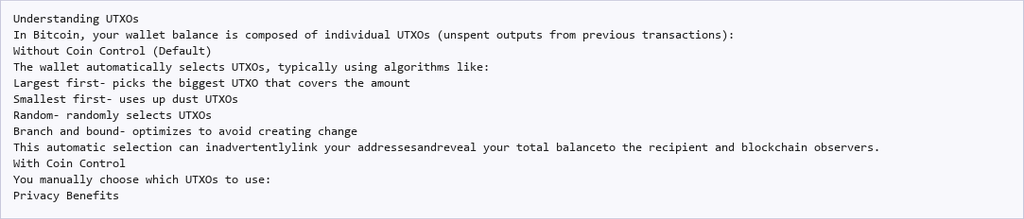
| UTXO # | Amount | Source | Age |
| UTXO 1 | 0.5 BTC | Exchange withdrawal | 30 days |
| UTXO 2 | 0.3 BTC | Payment from client | 15 days |
| UTXO 3 | 1.2 BTC | Mining reward | 60 days |
| UTXO 4 | 0.05 BTC | Change from purchase | 5 days |
| Total | 2.05 BTC |
| Scenario | Your Choice | Reason |
| Paying for a purchase | Select only UTXO 2 (0.3 BTC) | Don’t reveal your exchange withdrawal or mining income |
| Consolidating dust | Select UTXOs 4 and send to yourself | Clean up wallet during low-fee periods |
| Privacy separation | Never mix exchange UTXOs with P2P UTXOs | Prevent linking your exchange identity to private transactions |
| Fee saving | Select one large UTXO instead of many small ones | Fewer inputs = smaller transaction = lower fee |
| Without Coin Control | With Coin Control |
| Wallet may combine UTXOs from different sources | You choose UTXOs from the same source |
| Observer links your exchange account to P2P purchases | Sources remain separated |
| Change address reveals approximate total holdings | Only selected UTXO amount is revealed |
| Automatic selection may create unnecessary address links | You control which addresses appear in the transaction |
In Simple Terms
- Your wallet is like a physical wallet full of different bills– instead of having “a balance,” you actually have separate piles of coins (UTXOs) from different sources.
- Normally, the wallet picks bills for you– when you make a payment, the software automatically grabs whatever coins it wants. This is like a cashier reaching into your wallet and pulling out random bills.
- Coin control lets you choose– you decide exactly which “bills” to hand over, just like you would in real life when you carefully select which bills to use.
- Why does it matter? Privacy!– If you use a coin from your exchange withdrawal and a coin from a private sale in the same transaction, you’ve just told the world those two are connected to the same person.
- It also saves money– using fewer, larger UTXOs means a smaller transaction size, which means lower fees on the Bitcoin network.
Important: Coin control is one of the most effective privacy tools available to Bitcoin users. By carefully managing which UTXOs are spent together, users can prevent blockchain analysis from linking their different financial activities and identities.
Read Also: FPI in Crypto Explained: From Investment Flows to Stablecoins
Real-World Examples
Scenario 1: Separating Exchange and P2P Identity
| Aspect | Details |
| Scenario | A user buys Bitcoin on Coinbase (KYC’d) and also receives Bitcoin from freelance work (pseudonymous) |
| Implementation | Using coin control in Sparrow Wallet, they label each UTXO by source (“Coinbase,” “Freelance”). When spending, they never mix UTXOs from different sources in a single transaction |
| Outcome | Their exchange identity (linked to their real name) is never connected to their freelance identity on the blockchain |
Scenario 2: Fee Optimization During High-Fee Periods
| Aspect | Details |
| Scenario | Bitcoin fees spike to $50+ per transaction during a market rally |
| Implementation | The user uses coin control to select a single 0.5 BTC UTXO for a 0.4 BTC payment, creating a simple 1-input, 2-output transaction instead of the wallet’s default of combining five small UTXOs |
| Outcome | Transaction size is ~225 bytes instead of ~750 bytes, saving approximately 70% in fees |
Scenario 3: UTXO Consolidation During Low Fees
| Aspect | Details |
| Scenario | A Bitcoin miner has hundreds of small UTXOs from mining pool payouts |
| Implementation | During a weekend when fees are low (1 sat/vbyte), the miner uses coin control to select all small UTXOs and consolidate them into one large UTXO sent to their own address |
| Outcome | Future transactions will be cheaper and simpler; the consolidation cost is minimal due to low fees |
Advantages
| Advantage | Description |
| Enhanced privacy | Prevents linking of different financial activities and identities |
| Fee optimization | Choose optimal UTXO combinations to minimize transaction fees |
| UTXO management | Clean up dust, consolidate during low-fee periods |
| Financial separation | Keep business, personal, and anonymous funds separate |
| Full transparency | Understand exactly what your wallet is doing with your coins |
Disadvantages & Risks
| Risk | Description |
| Complexity | Requires understanding of UTXOs, transaction construction, and privacy concepts |
| User error | Incorrect UTXO selection can inadvertently worsen privacy |
| Time-consuming | Manual selection takes more effort than automatic wallet behavior |
| Limited wallet support | Not all wallets offer coin control features |
| Not applicable to all chains | Account-based blockchains (Ethereum) don’t use the UTXO model |
FAQ
Do I need coin control if I’m not concerned about privacy?
Even if privacy isn’t your primary concern, coin control can help optimize transaction fees by letting you choose efficient UTXO combinations. It’s also useful for keeping your wallet organized and avoiding the accumulation of dust UTXOs.
What wallets support coin control?
Bitcoin Core, Electrum, Sparrow Wallet, Wasabi Wallet, Samourai Wallet, and Blue Wallet (advanced mode) all support coin control. Sparrow and Wasabi are particularly recommended for their intuitive interfaces and privacy-focused design.
What is UTXO labeling and why is it important?
UTXO labeling is the practice of tagging each UTXO with information about its source (e.g., “Coinbase withdrawal,” “payment from Alice,” “CoinJoin output”). Labels make coin control practical by helping you remember the privacy implications of spending each UTXO.
Does coin control exist for Ethereum?
No. Ethereum uses an account model, not a UTXO model. Each address has a single balance, so there are no individual “coins” to control. Privacy on Ethereum requires different approaches like using multiple addresses or privacy protocols.