

Coin Burn (also called token burn) is the deliberate, permanent, and irreversible removal of cryptocurrency tokens from circulation. This is accomplished by sending tokens to a “burn address” – a wallet address with no known private key, making the tokens permanently inaccessible and effectively destroyed. Coin burning is a widely used tokenomics mechanism employed by projects like Binance (BNB), Ethereum (EIP-1559), and Shiba Inu to reduce supply, create deflationary pressure, increase scarcity, and potentially drive up the value of remaining tokens. Since Ethereum’s London upgrade in August 2021, over 4 million ETH (worth billions of dollars) has been burned through the base fee mechanism.
Definition
Coin Burn is the permanent removal of tokens from circulating supply:
| Aspect | Description |
| Mechanism | Sending tokens to a provably unspendable “burn address” |
| Common Burn Address | 0x000000000000000000000000000000000000dEaD (Ethereum) |
| Reversibility | Completely irreversible – burned tokens can never be recovered |
| Purpose | Reduce supply, increase scarcity, manage tokenomics |
| Verification | Publicly verifiable on the blockchain |
| Also Known As | Token burn, coin destruction, supply reduction |
Origin & History
“Burning tokens creates digital scarcity, applying the fundamental economic principle that reduced supply with constant demand increases value.”
| Date | Event |
| 2014 | Counterparty (XCP) becomes one of the first projects to use “Proof of Burn” – destroying Bitcoin to create XCP tokens |
| 2014 | The concept of deliberate supply destruction gains traction in altcoin communities |
| 2017 | Binance launches quarterly BNB burn program, committing to burn BNB until 50% of total supply (100 million) is destroyed |
| 2019 | Stellar (XLM) burns 55 billion tokens (over half its supply) in a single event to boost price and reduce inflation |
| 2019 | Tether (USDT) burns tokens to maintain its dollar peg when supply exceeds reserves |
| 2020 | Deflationary tokens gain popularity; burn mechanisms become standard in new token launches |
| 2021 | Ethereum EIP-1559 (London upgrade) introduces automatic burning of base fees – a landmark moment |
| 2021 | Shiba Inu community burns trillions of SHIB tokens through community-driven burn campaigns |
| 2021 | Vitalik Buterin burns 410 trillion SHIB tokens (worth $6.7 billion) sent to his wallet |
| 2022 | Ethereum transitions to Proof of Stake; combined with EIP-1559, ETH becomes periodically deflationary |
| 2023 | BNB Auto-Burn reaches 50 million BNB destroyed (target: 100 million total) |
| 2024 | Over 4 million ETH burned since EIP-1559 launch; sophisticated burn analytics track real-time deflation |
How It Works
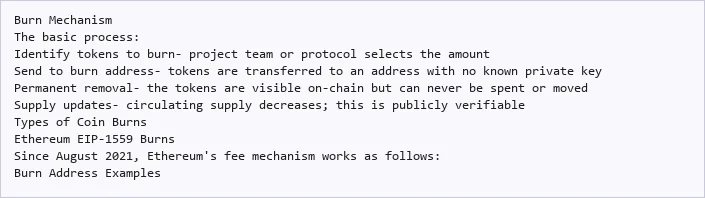
| Type | Description | Example |
| Scheduled burns | Regular, pre-planned burns on a set schedule | BNB quarterly burns |
| Automatic burns | Built into the protocol; burns occur with every transaction | Ethereum EIP-1559 base fee |
| Manual burns | One-time burns decided by the project team | Stellar’s 55B XLM burn |
| Buy-back and burn | Project buys tokens from the market and burns them | BNB using exchange profits |
| Proof of Burn | Users burn one cryptocurrency to receive another | Counterparty burning BTC for XCP |
| Community burns | Token holders voluntarily burn their own tokens | SHIB burn campaigns |
| Component | Description |
| Base fee | Algorithmically determined minimum fee – **burned completely** |
| Priority tip | Optional tip to validators – goes to block producer |
| Effect | Every Ethereum transaction permanently destroys ETH |
| Net result | During high activity, more ETH is burned than issued, making ETH deflationary |
| Blockchain | Burn Address | Tokens Held |
| Ethereum | 0x0000…dEaD | Billions in various tokens |
| Ethereum | 0x0000…0000 (null address) | Used by EIP-1559 |
| Bitcoin | 1CounterpartyXXXXXX… | BTC burned for XCP |
| BNB Chain | Black hole address | 50M+ BNB destroyed |
In Simple Terms
- Coin burn is like destroying cash– imagine taking dollar bills and shredding them permanently. The money supply shrinks, and each remaining dollar becomes slightly more valuable.
- Tokens are sent to a dead-end address– think of a mailbox that nobody has the key to. You can send letters (tokens) to it, but nobody can ever retrieve them.
- It creates scarcity– basic economics says that when supply goes down and demand stays the same, price goes up. That’s the fundamental idea behind burning.
- Some burns happen automatically– on Ethereum, a portion of every transaction fee is burned automatically, like a built-in deflationary mechanism running 24/7.
- It’s provably permanent– anyone can verify the burn on a blockchain explorer. The tokens sit in the burn address forever, visible but permanently inaccessible.
Important: Coin burning does not guarantee price increases. Price depends on many factors, including demand, utility, market conditions, and overall adoption. A project that burns tokens but has declining demand may still see price decreases.
Real-World Examples
Scenario 1: Ethereum EIP-1559 Deflationary Mechanism
| Aspect | Details |
| Scenario | Ethereum wants to improve its fee market and introduce deflationary tokenomics |
| Implementation | EIP-1559 (August 2021) burns the base fee of every transaction, with the burn rate increasing during periods of high network usage |
| Outcome | Over 4 million ETH burned by 2024. During peak usage, Ethereum becomes net-deflationary (more ETH burned than issued), fundamentally changing ETH’s economic model |
Scenario 2: BNB Quarterly Burns
| Aspect | Details |
| Scenario | Binance committed to reducing BNB supply from 200 million to 100 million tokens |
| Implementation | Each quarter, Binance uses a portion of its exchange profits to buy back and burn BNB. The “Auto-Burn” formula determines the amount based on BNB price and blocks produced |
| Outcome | By 2024, over 50 million BNB has been burned, representing 25% of the original supply, worth tens of billions of dollars |
Scenario 3: Vitalik’s SHIB Burn
| Aspect | Details |
| Scenario | Shiba Inu developers sent 50% of total SHIB supply (410 trillion tokens) to Ethereum creator Vitalik Buterin’s wallet without asking |
| Implementation | In May 2021, Buterin burned 90% of his SHIB holdings by sending them to a dead address, stating he didn’t want the power to influence SHIB’s market |
| Outcome | The burn removed $6.7 billion worth of SHIB from circulation; Buterin donated the remaining 10% to India’s COVID relief fund |
Advantages
| Advantage | Description |
| Deflationary pressure | Reduces supply, potentially increasing value of remaining tokens |
| Signal of commitment | Shows project team’s long-term vision and willingness to reduce their own holdings |
| Predictable economics | Scheduled burns create transparent, predictable tokenomics |
| Spam reduction | Burning small transaction fees discourages network spam |
| Market confidence | Demonstrated burns can increase investor confidence in a project |
Disadvantages & Risks
| Risk | Description |
| No price guarantee | Burns reduce supply but don’t guarantee demand or price appreciation |
| Potential manipulation | Teams may announce burns as marketing hype without meaningful impact |
| Lost utility | Burned tokens can’t be used for ecosystem development or rewards |
| Concentration risk | If insiders hold large portions, burns primarily benefit them |
| Irreversibility | Accidental burns or excessive burns cannot be undone |
FAQ
How can I verify a coin burn?
Coin burns are publicly verifiable on blockchain explorers. Look up the burn address on Etherscan (for Ethereum tokens) or the relevant blockchain explorer. You’ll see the total tokens sent to the address and the transaction history. The burn address balance continuously grows but can never decrease.
Does coin burning guarantee the price will go up?
No. Coin burning reduces supply, which creates deflationary pressure, but price is determined by supply AND demand. If demand for the token is declining, burns alone won’t prevent price decreases. Burns are one factor among many in token economics.
What is the difference between coin burn and Proof of Burn?
Regular coin burning is a supply management technique where a project destroys tokens. Proof of Burn is a consensus mechanism where users burn one cryptocurrency (like Bitcoin) to earn the right to mine or receive another cryptocurrency – essentially converting value between blockchains.
Can burned tokens ever be recovered?
No. Tokens sent to a verified burn address (one with no known private key) are permanently and irrecoverably destroyed. This is by design – the entire point of burning is to guarantee that the tokens can never re-enter circulation.
Why did Ethereum start burning ETH?
EIP-1559 was introduced to improve Ethereum’s fee market by making fees more predictable (base fee algorithm) and to give ETH a deflationary mechanism. By burning the base fee, Ethereum aligned the interests of ETH holders with network usage – more network activity means more ETH burned, potentially increasing ETH’s value.