



Crypto investing in 2026 is very different from the early days of the market. The industry has grown from a highly speculative space into a global financial ecosystem supported by institutions, ETFs, governments, and blockchain innovation.
Today, investors are no longer focusing only on hype and quick profits. More attention is now placed on long-term strategies, portfolio management, and sustainable wealth building.
The crypto market has also expanded far beyond just Bitcoin and Ethereum. New sectors like AI crypto, decentralized finance, Layer-2 scaling, and tokenized real-world assets are creating fresh investment opportunities.
At the same time, growing institutional adoption and clearer regulations are making the market more mature and competitive.
Instead of relying on luck or social media hype, successful crypto investors in 2026 are focusing more on research, patience, and structured investing.
Understanding how different strategies work can help investors avoid costly mistakes and take advantage of long-term opportunities in a rapidly evolving market.
Key Takeaways
- Crypto investing in 2026 is more structured and driven by institutions and ETFs.
- There is no single best strategy, only the one that fits your risk level and financial goals.
- Strong risk management is essential to protect capital during market volatility.
- Emerging sectors like AI crypto, DeFi, and tokenized assets are key growth drivers.
- Long-term discipline and consistency are more important than short-term market timing.
What Is a Crypto Investment Strategy?
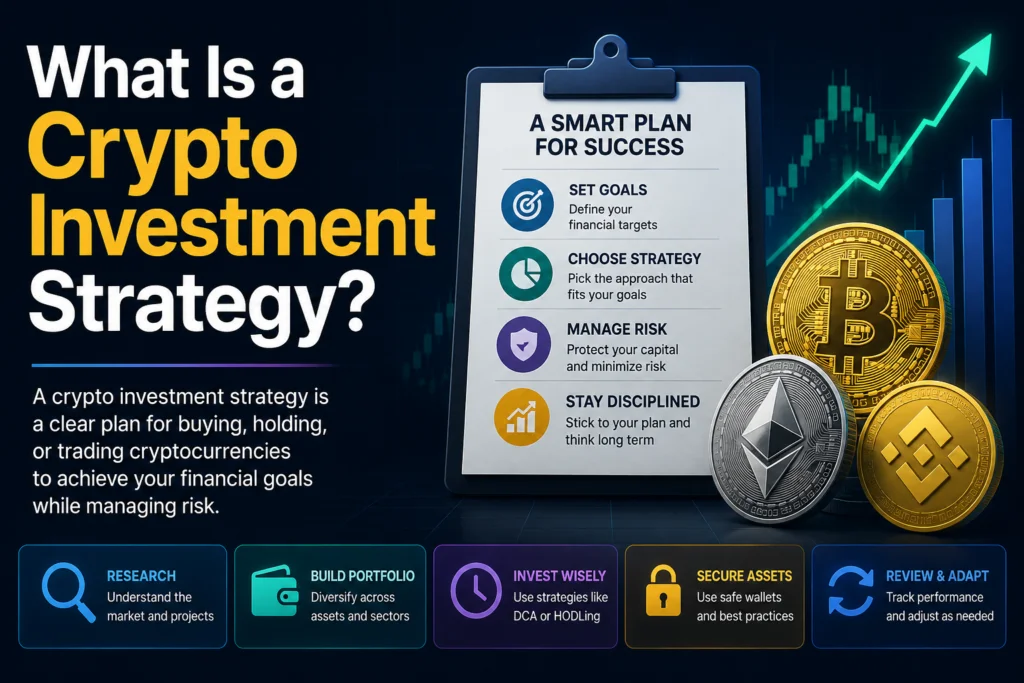
A crypto investment strategy is a structured plan that guides how an investor buys, manages, and sells cryptocurrencies or blockchain-related assets. Instead of making emotional decisions based on market hype or fear, a strategy helps investors follow a consistent process designed around their financial goals and risk tolerance.
In simple terms, a crypto investment strategy answers important questions such as:
- What cryptocurrencies should you invest in?
- How much money should you allocate?
- Should you invest for the long term or trade short-term?
- How do you reduce risks during market crashes?
- When should you buy, hold, or sell?
Without a strategy, many investors fall into common traps such as panic selling during market declines, buying into hype too late, or investing too much in risky assets.
Crypto markets move quickly, and emotions often lead to poor decisions. A proper strategy creates discipline. It helps investors stay focused even when prices fluctuate dramatically.
For example, some investors use long-term holding strategies focused on major assets like Bitcoin and Ethereum because they believe these networks will continue growing over time.
Others use dollar-cost averaging, where they invest fixed amounts regularly regardless of market conditions. More advanced investors may combine trading, staking, decentralized finance, and tokenized asset exposure into diversified portfolios.
The 7 Core Crypto Investment Strategies for 2026
| Strategy | Core Principle | Best For | Typical Allocation / Approach | Expected Return Potential | Risk Level | Main Pros | Main Cons |
| Long-Term HODLing | Buy strong crypto assets and hold long term through volatility | Risk-averse investors, beginners, 3–5 year investors, minimal time commitment | 60% Bitcoin, 30% Ethereum, 10% top altcoins | Very high long-term growth potential | Medium | Simple strategy, lower stress, tax advantages, historically strong returns | Requires patience, large drawdowns, and slower short-term gains |
| Dollar-Cost Averaging (DCA) | Invest fixed amounts regularly regardless of price | All investor types, beginners, systematic investors | Weekly or monthly recurring investments into BTC, ETH, and selected altcoins | Moderate to high long-term returns | Medium | Reduces timing risk, removes emotions, beginner-friendly | Slower gains during strong bull markets require consistency |
| Portfolio Diversification | Spread capital across multiple crypto sectors and assets | Balanced investors, professional-style portfolio management | Conservative, moderate, or aggressive allocations across BTC, ETH, stablecoins, DeFi, AI, and Layer-2s | 25%–200%+ depending on allocation | Low to High | Reduces overall risk, exposure to multiple sectors, and better stability | More research required, lower upside than concentrated bets |
| DeFi Yield Farming & Staking | Earn passive income by staking or providing liquidity | Passive income seekers, DeFi users, and experienced investors | Staking ETH, SOL, AVAX or farming liquidity pairs like USDC/USDT | 5%–100%+ APY depending on strategy | Medium to High | Passive income, compounding returns, maximizes idle assets | Smart contract risks, impermanent loss, protocol hacks |
| Tactical Trading | Actively trade market trends and momentum | Experienced traders, active investors, and high-risk tolerance | Swing trading, momentum trading, and technical analysis setups | Fast short-term profit potential | High | Can profit from volatility, flexible strategy | Stressful, time-intensive, most traders lose money |
| Sector Rotation | Rotate funds into trending crypto sectors with strong momentum | Sophisticated investors, trend-focused investors | Focus on Layer-2s, AI crypto, RWA tokens, and DeFi sectors | High growth potential | Medium to High | Captures emerging narratives early, flexible capital allocation | Requires constant monitoring, timing mistakes can hurt returns |
| Risk-Adjusted Position Sizing | Control risk by limiting exposure per investment | All experience levels, capital preservation investors | Use 1–5% position sizing rules and stop-loss management | Improves long-term portfolio survival | Low to Medium | Protects capital, reduces catastrophic losses, and improves discipline | Can limit maximum gains, may feel conservative during bull runs |
Below are the seven core crypto investment strategies shaping the market in 2026.
Long-Term HODLing
Best For: Risk-averse investors, long-term wealth builders, investors with a 3–5 year time horizon.
Long-term HODLing is one of the simplest and most popular crypto investment strategies. The word “HODL” originally came from a misspelled word for “hold,” but it eventually became a term representing long-term conviction investing.
The strategy involves buying strong cryptocurrencies and holding them through market volatility for several years rather than trying to trade short-term price movements.
This strategy is best suited for risk-averse investors, beginners, investors with full-time jobs, people with a 3–5 year investment horizon, or Investors who do not want daily market stress
The main idea behind HODLing is simple: despite short-term volatility, adoption of blockchain technology continues growing over time. Historically, this strategy has produced some of the largest returns in modern investing history.
Pros
- Simple and beginner-friendly
- Requires less time and emotional stress
- Historically strong long-term performance
- Lower trading fees and taxes
- Reduces emotional decision-making
Cons
- Large temporary drawdowns can occur
- Requires patience during bear markets
- Misses short-term trading opportunities
- Requires strong conviction during volatility
Dollar-Cost Averaging (DCA)
Best For: All investor types, beginners, investors who want to reduce timing risk, and people who prefer systematic investing.
Dollar-cost averaging, commonly called DCA, is one of the safest and most effective ways to build a crypto portfolio consistently over time. Instead of investing a large amount all at once, investors buy a fixed amount of cryptocurrency at regular intervals regardless of market price.
For example, an investor may purchase $200 worth of Bitcoin every month, whether prices are rising or falling. This strategy helps reduce the stress of trying to perfectly time market tops and bottoms.
DCA works especially well in crypto because the market is highly volatile. Prices can move dramatically within short periods, making it extremely difficult to predict the best entry points. By investing consistently, investors naturally buy more crypto during market dips and less during expensive periods.
Pros
- Reduces timing risk
- Removes emotional investing
- Beginner-friendly
- Works well during volatility
- Encourages long-term discipline
Cons
- Slower gains during strong bull runs
- Requires patience
- Can underperform lump sum investing in rapidly rising markets
- Needs long-term consistency
Portfolio Diversification
Best For: Investors seeking balanced risk and reward, professional portfolio management, and portfolios above $10,000.
Portfolio diversification is one of the most important principles in investing, and it is especially important in crypto because different assets carry very different levels of risk and volatility.
Instead of putting all funds into a single cryptocurrency, diversification spreads investments across multiple assets and sectors. In 2026, diversified crypto portfolios are commonly divided into conservative, moderate, and aggressive structures depending on risk tolerance.
A conservative portfolio focuses heavily on stability and capital preservation. Investors typically allocate most of their funds to Bitcoin and Ethereum because these assets have the strongest institutional adoption and longest track records.
Moderate portfolios aim to balance growth and stability. Investors usually combine Bitcoin and Ethereum with sectors like DeFi, Layer-2 networks, and tokenized assets. This strategy offers stronger growth potential while reducing some volatility risk.
Aggressive portfolios focus mainly on high-growth altcoins and emerging crypto trends. Investors often allocate more funds to AI crypto projects, DeFi protocols, and Layer-2 ecosystems. Although this strategy can generate massive profits, it also carries very high volatility and larger potential losses during bear markets.
Diversification also requires regular portfolio rebalancing. However, diversification also requires more research and portfolio management because investors must monitor multiple projects and narratives simultaneously.
Pros
- Reduces overall investment risk
- Protects the portfolio from one bad-performing asset
- Gives exposure to multiple crypto sectors
- Creates a more balanced portfolio
Cons
- Can reduce maximum profits
- Requires more research and monitoring
- Some altcoins may still fail completely
- Managing many assets can become stressful
DeFi Yield Farming and Staking
Best For: Crypto holders seeking passive income and investors comfortable with smart contracts and DeFi risks
DeFi yield farming and staking have become major sources of passive income in the crypto market. Instead of simply holding crypto assets in wallets, investors can deploy them into decentralized finance protocols to generate ongoing returns.
Staking involves locking cryptocurrencies into proof-of-stake networks to help secure the blockchain. In return, investors receive rewards. Assets such as Ethereum, Solana, Avalanche, and Cosmos offer staking yields that vary depending on network demand and staking participation.
One of the biggest innovations in staking is liquid staking. Platforms like lido.fi and rocketpool.net allow users to stake Ethereum while still maintaining liquidity through derivative tokens such as stETH and rETH.
This allows investors to continue participating in decentralized finance while simultaneously earning staking rewards.
Yield farming goes a step further by allowing users to provide liquidity to decentralized exchanges and lending platforms. Investors earn fees and token rewards in exchange for supplying assets to liquidity pools.
Pros
- Generates passive income
- Maximizes idle capital
- Exposure to DeFi growth
- Compounding opportunities
Cons
- Smart contract risks
- Impermanent loss
- Complex for beginners
- Potential hacks and exploits
Tactical Trading
Best For: Experienced traders, active investors, risk-tolerant individuals, and people willing to spend significant time monitoring markets.
Tactical trading focuses on actively buying and selling cryptocurrencies based on market trends, momentum, and technical analysis. Unlike long-term investing, tactical traders aim to profit from shorter-term price movements.
One common approach is swing trading, where positions are typically held for several days or weeks. Traders analyze support and resistance levels, moving averages, RSI indicators, and market sentiment to identify potential entry and exit points.
Momentum trading is another popular strategy in 2026. Momentum traders focus on assets experiencing strong upward trends and attempt to ride the momentum until reversal signals appear. This strategy requires constant market monitoring and fast decision-making.
Tools like tradingview.com, glassnode.com, and santiment.net are commonly used for chart analysis, on-chain data, and sentiment tracking.
Although tactical trading can generate fast profits, it also carries substantial risk. Studies consistently show that most day traders lose money because of emotional mistakes, overtrading, and poor risk management.
Pros
- Potential for faster profits
- Can perform well in volatile markets
- More opportunities than passive investing
Cons
- Extremely stressful
- Time-intensive
- Most traders lose money
- Emotional mistakes common
Sector Rotation
Best For: Sophisticated investors, trend-focused investors, and people tracking emerging crypto narratives and sectors.
Sector rotation is a more advanced investment strategy focused on identifying crypto sectors with strong growth potential and rotating capital into those narratives before they become overcrowded.
In 2026, Layer-2 scaling remains one of the strongest sectors because Ethereum transaction costs continue driving demand for faster and cheaper networks such as Arbitrum, Optimism, and Polygon.
Tokenized assets, commonly called RWAs, are also attracting significant attention. Projects like Ondo Finance, Chainlink, and Avalanche focus on bringing traditional assets such as bonds, real estate, and treasury products onto blockchain networks.
Many analysts believe this sector could become one of the largest long-term growth opportunities in crypto.
Successful sector rotation requires research, patience, and timing. Investors typically identify promising narratives early, accumulate positions gradually, hold during growth phases, and eventually rotate profits into newer sectors before enthusiasm fades.
Pros
- Captures emerging narratives early
- Higher growth potential
- Flexible strategy
Cons
- Requires constant research
- Timing mistakes can hurt returns
- Narratives can fade quickly
Risk-Adjusted Position Sizing
Best For: All experience levels, capital preservation-focused investors, and investors seeking professional risk management.
Risk-adjusted position sizing is one of the most important but often overlooked aspects of crypto investing. Even strong investment ideas can fail if position sizes are too large.
The core principle is simple: never risk too much capital on any single investment.
Many investors follow the 1–5% rule. Highly speculative positions may only represent 1–2% of a portfolio, while larger allocations are reserved for more established assets such as Bitcoin and Ethereum. This approach protects investors from catastrophic losses if one investment performs poorly.
More advanced investors sometimes use the Kelly Criterion, a mathematical formula that helps determine optimal position sizes based on historical win rates and risk-reward ratios. While the formula can improve long-term portfolio growth, it requires strong data analysis and disciplined execution.
Pros
- Protects capital
- Reduces catastrophic losses
- Improves long-term consistency
- Encourages disciplined investing
Cons
- Limits maximum gains
- Requires patience and discipline
- Can feel conservative during bull markets
Emerging Investment Opportunities for 2026
The crypto market in 2026 is moving beyond the simple buying and selling of coins. Investors are now focusing on sectors with utility, institutional adoption, and long-term growth potential.
Some of the biggest opportunities are coming from blockchain infrastructure, AI integration, tokenized assets, and revenue-generating DeFi platforms. Understanding these sectors can help investors position themselves early in fast-growing areas of the market.
Opportunity #1: Layer-2 Scaling Solutions
Layer-2 networks are designed to make blockchain transactions faster and cheaper while still using Ethereum’s security.
They reduce transaction fees from expensive Ethereum costs to just a few cents. This makes crypto more accessible for everyday users and developers.
As blockchain adoption grows, more transaction activity is moving from Ethereum’s main network to Layer-2 ecosystems. Many investors believe these networks will capture massive long-term value as usage increases. Because most Layer-2 projects are still relatively new, many see them as early-stage investment opportunities.
- Arbitrum (ARB)
Arbitrum is currently one of the largest Layer-2 networks by total value locked. It has strong ecosystem growth, a large treasury, and growing involvement in tokenized real-world assets. Many investors allocate a portion of their altcoin portfolio to Arbitrum because of its leadership position.
- Optimism (OP)
Optimism focuses heavily on developer growth and public goods funding. Its technology is also used by Coinbase’s Base network, increasing long-term adoption potential. Investors view Optimism as one of the strongest Ethereum scaling ecosystems.
- Polygon (POL)
Polygon remains one of the most recognized scaling projects in crypto. It has built partnerships with major companies and continues expanding its zero-knowledge technology infrastructure. Many investors value Polygon for its strong enterprise adoption.
Opportunity #2: Tokenized Real-World Assets (RWA)
Tokenized real-world assets are becoming one of the fastest-growing sectors in crypto. This market focuses on bringing traditional assets like real estate, treasury bills, and commodities onto blockchain networks. Many analysts believe this sector could grow into a multi-trillion-dollar market over the next few years.
One major advantage of tokenization is fractional ownership. Investors can own small portions of expensive assets instead of needing large amounts of capital. Blockchain also improves liquidity by allowing assets to trade globally 24/7.
- Chainlink (LINK)
Chainlink provides the data infrastructure needed to connect real-world information to blockchain systems. Its oracle technology is considered essential for tokenized assets and cross-chain transfers. Many investors see Chainlink as one of the core infrastructure projects for the future of RWAs.
- Ondo Finance (ONDO)
Ondo Finance focuses on tokenized treasury products and institutional-grade financial infrastructure. The project has attracted attention because of partnerships connected to major financial firms. Investors see Ondo as a strong player in the growing RWA ecosystem.
- Avalanche (AVAX)
Avalanche offers fast and low-cost blockchain infrastructure that is attractive for institutional asset tokenization. Its subnet architecture makes it suitable for permissioned financial applications. Many investors consider Avalanche a strong long-term infrastructure play.
Opportunity #3: AI-Crypto Integration
AI crypto has become one of the fastest-growing sectors in the digital asset industry. These projects combine blockchain technology with artificial intelligence, decentralized computing, and data infrastructure.
Many analysts believe the combination of AI and crypto could create enormous long-term opportunities.
- Bittensor (TAO)
Bittensor focuses on decentralized machine learning and AI collaboration. Users contribute computing power and AI models while earning rewards through the network. Many investors see Bittensor as one of the leading AI blockchain projects.
- Render (RENDER)
Render provides decentralized GPU computing for AI, 3D rendering, and visual effects. As demand for AI processing power grows, Render continues attracting attention from both crypto and technology communities. Investors view it as a major infrastructure project for decentralized computing.
- Fetch.ai (FET)
Fetch.ai develops autonomous AI agents that can automate tasks across industries such as finance and supply chains. The project is also part of the Artificial Superintelligence Alliance. Many investors see strong growth potential in AI automation networks.
- The Graph (GRT)
The Graph helps organize and index blockchain data for decentralized applications. It is often described as a search engine for blockchain ecosystems. Investors view The Graph as important infrastructure for future Web3 and AI applications.
Opportunity #4: DeFi 2.0 Revenue Generating Protocols
The decentralized finance sector is evolving from speculative yield farming into more sustainable business models. Many DeFi platforms are now generating real revenue from lending, trading fees, and financial services.
Investors are increasingly focusing on projects with strong cash flow and long-term utility.
- Aave (AAVE)
Aave is one of the largest decentralized lending platforms in crypto. The protocol generates revenue through lending fees and continues expanding across multiple blockchain ecosystems. Many investors view Aave as one of the strongest long-term DeFi projects.
- Uniswap (UNI)
Uniswap remains the largest decentralized exchange by trading volume. The platform processes billions of dollars in daily transactions and may eventually distribute more protocol revenue to token holders. Investors see Uniswap as a core infrastructure project within decentralized finance.
- MakerDAO (MKR)
MakerDAO powers the DAI stablecoin ecosystem and generates revenue through stability fees and lending activity. The protocol also uses token buyback mechanisms to strengthen its ecosystem. Many investors consider MakerDAO one of the most established DeFi platforms in crypto.
Risk Management and Security for Crypto Investment Strategies
Crypto investing offers strong growth potential, but it also comes with high volatility and security risks. Managing risk properly helps investors protect capital, avoid emotional decisions, and survive market downturns more effectively.
Volatility Control and Capital Protection
Crypto prices can rise or fall very quickly, making risk management extremely important. Investors often reduce risk by diversifying across assets like Bitcoin, Ethereum, stablecoins, and selected altcoins.
Dollar-cost averaging also helps reduce the risk of buying at market peaks. Many investors keep part of their portfolio in stablecoins so they can buy opportunities during market corrections.
Safe Custody and Wallet Practices
Crypto investors are responsible for protecting their own assets. Smaller portfolios may stay on trusted exchanges like coinbase.com or kraken.com with strong passwords and two-factor authentication enabled.
Larger portfolios are often stored on hardware wallets like Ledger Nano X and Trezor Model T. Recovery phrases should always be stored securely offline.
Security Risks and Countermeasures
Common crypto risks include phishing scams, fake apps, wallet drainers, and exchange hacks. Investors should always verify websites before connecting wallets or entering sensitive information.
Using audited DeFi platforms and enabling two-factor authentication can improve security significantly. Separating long-term holdings from trading wallets also helps reduce overall risk.
Psychological and Behavioral Discipline
Emotional investing is one of the biggest reasons many investors lose money in crypto. Fear and greed often cause people to buy during hype and panic sell during market crashes.
Successful investors usually follow long-term plans, maintain discipline, and avoid emotional trading decisions. Patience and proper risk management are critical for long-term success
2026 Market Predictions & Scenarios
The Base Case scenario is the most discussed outlook for 2026. This scenario helps investors understand possible market directions and prepare their portfolios accordingly.
Base Case Scenario (55% Probability)
The Base Case is currently viewed as the most likely outcome for 2026. In this scenario, the crypto market stabilizes and resumes steady growth after a volatile first half of 2026, without renewed extreme euphoria or further major shocks.
Under this outlook, Bitcoin is projected to trade well below the highs it set in late 2025. After reaching an all-time high near $126,000, Bitcoin fell sharply in 2026 to around $63,000 by mid-year as spot-ETF flows turned to outflows and macro pressure weighed on prices. Any recovery from here would depend on ETF demand returning and long-term accumulation resuming.
The continued growth of Bitcoin ETFs from firms like BlackRock and other institutional products may help stabilize the market and reduce extreme volatility.
Ethereum reached a high near $4,950 in 2025 and fell to around $1,900 by mid-2026, so a recovery would depend on Layer-2 adoption continuing to grow and staking participation increasing.
Ethereum’s ecosystem expansion, combined with successful upgrades like Pectra, may strengthen long-term demand for the network. Layer-2 ecosystems such as Arbitrum, Optimism, and Polygon may experience gains between 50% and 100% as blockchain usage expands.
DeFi projects like Aave, Uniswap, and MakerDAO could benefit from improving institutional confidence and rising DeFi activity.
AI-focused crypto projects such as Bittensor, Render, and Fetch.ai may continue attracting investors as AI adoption expands globally.
The tokenized real-world asset sector may also see strong growth. Projects like Ondo Finance and Chainlink are expected to benefit from increasing institutional interest in blockchain-based financial products.
Under this scenario, conservative portfolios may return around 25% to 40%, moderate portfolios may generate 40% to 80%, while aggressive portfolios could potentially return 60% to 120%.
Conclusion
Successful investing requires choosing a strategy (such as HODLing, DCA, DeFi yields, or Sector Rotation) that aligns with your financial goals, risk tolerance, and investment timeline.
FAQs
What is a crypto investment strategy?
A crypto investment strategy is a structured plan for buying, holding, or trading cryptocurrencies. It helps investors manage risk, choose assets, and decide when to enter or exit the market.
Which crypto strategy is best for beginners in 2026?
Dollar-cost averaging (DCA) and long-term HODLing are the best for beginners. They reduce emotional decisions and help build positions gradually over time.
Is crypto still profitable in 2026?
Yes, crypto can still be profitable in 2026, driven by new sectors and increasing utility. However, returns depend heavily on your risk management and disciplined strategy.
How much should I invest in crypto?
It depends on your financial situation and risk tolerance. Many investors allocate between 5% and 20% of their net worth, while keeping the rest in safer assets.
What are the biggest risks in crypto investing?
The main risks include market volatility, scams, exchange hacks, emotional trading, and poor risk management. Security and discipline are essential for survival.
Do I need multiple strategies or just one?
You can combine strategies. Many investors use HODLing for core assets, DCA for steady investing, and diversification for balance across different crypto sectors.