Crypto Credit refers to the ability to borrow funds, access credit lines, or obtain financial products using cryptocurrency holdings as collateral or as a basis for creditworthiness. Unlike traditional credit systems that rely on credit scores, income verification, and employment history, crypto credit primarily relies on the value of digital assets pledged as collateral – making it accessible to anyone with crypto holdings, regardless of their traditional credit profile. The crypto credit ecosystem spans both centralized platforms (like Nexo, Ledn, and formerly BlockFi/Celsius) that offer crypto-backed loans with familiar interfaces, and decentralized protocols (like Aave, Compound, and MakerDAO) that enable permissionless borrowing through smart contracts. Additionally, newer models are emerging that build on-chain credit scores based on wallet history, DeFi activity, and repayment behavior – potentially creating a new, blockchain-native credit system that operates alongside traditional credit bureaus.
Read Also: Crypto Loan
Definition
Crypto Credit enables borrowing based on digital asset holdings:
| Aspect | Description |
| What It Is | Borrowing power derived from cryptocurrency collateral or on-chain creditworthiness |
| How It Differs | Based on asset value (collateral), not credit scores or income verification |
| Primary Model | Over-collateralized loans – deposit more crypto than you borrow |
| Typical LTV | 50-80% – borrow $50K-$80K against $100K in crypto collateral |
| Interest Rates | 0-15% APR depending on platform, collateral type, and LTV |
| Platforms | CeFi: Nexo, Ledn |
Origin & History
“Crypto credit eliminates the gatekeepers of traditional lending. If you have collateral, you have access – no credit check, no bank approval, no discrimination.”
| Date | Event |
| 2017 | MakerDAO launches on Ethereum – allows users to mint DAI stablecoins by depositing ETH as collateral; the first DeFi credit system |
| 2018 | BlockFi launches crypto-backed lending for retail users; SALT Lending offers institutional crypto loans |
| 2018-2020 | Compound and Aave launch permissionless lending protocols on Ethereum |
| 2020 | DeFi summer – total value locked in lending protocols surges past $10 billion; Nexo and Celsius gain millions of users |
| 2021 | Peak crypto credit – over $50 billion in outstanding DeFi loans; CeFi platforms offer aggressive terms |
| 2022 (May) | Terra/Luna collapse triggers cascade of crypto credit failures – overleveraged positions liquidated |
| 2022 (Jun-Nov) | Three Arrows Capital, Celsius, Voyager, BlockFi collapse – exposing systemic risks in crypto credit |
| 2023 | Industry rebuilds; on-chain credit scoring projects (Spectral, Credora, Rocifi) gain attention |
| 2024-2026 | Regulated crypto lending resumes; DeFi lending protocols reach new highs; undercollateralized DeFi lending experiments grow |
How It Works
| Type | Description | Collateral Required | Examples |
| Over-Collateralized CeFi | Centralized platform loans backed by crypto | 120-200% of loan value | Nexo, Ledn |
| Over-Collateralized DeFi | Smart contract-based lending | 120-150% of loan value | Aave, Compound, MakerDAO |
| Under-Collateralized | Institutional loans based on reputation/creditworthiness | Less than 100% of loan value | Maple Finance, Goldfinch |
| Credit Lines | Revolving credit against crypto portfolio | Varies | Nexo credit line |
| Flash Loans | Uncollateralized, single-transaction loans | None (repaid in same tx) | Aave flash loans |
| On-Chain Credit Scoring | Credit based on wallet history and DeFi activity | Behavioral (non-asset) | Spectral, Rocifi |
| Step | Action | Example |
| 1. Deposit | Lock crypto as collateral in a smart contract or platform | Deposit 10 ETH (~$30,000 value) |
| 2. Borrow | Receive loan up to the maximum LTV ratio | Borrow $15,000 USDC at 50% LTV |
| 3. Monitor | Track collateral ratio; add collateral if price drops | If ETH drops, ratio approaches liquidation |
| 4. Interest | Pay ongoing interest on the borrowed amount | 5% APR = ~$750/year |
| 5. Repay | Return borrowed amount plus interest | Repay $15,000 + interest |
| 6. Unlock | Receive collateral back | Get 10 ETH returned |
In Simple Terms
- Crypto credit lets you borrow money using your crypto as collateral– like getting a home equity loan, but instead of your house, you’re using your Bitcoin or Ethereum as security.
- The main advantage is avoiding selling– if you believe your BTC will appreciate, you can borrow against it to get cash for expenses without selling and triggering taxes.
- You typically need to over-collateralize– to borrow $50,000, you might need to deposit $100,000 worth of crypto. This protects the lender if prices drop.
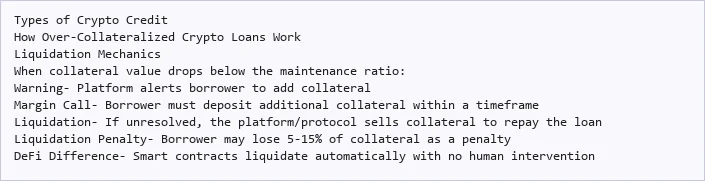
- If your collateral drops in value, you get liquidated– this is the biggest risk. If Bitcoin’s price crashes 50% while you have a loan, your collateral may be sold automatically to repay the debt.
- DeFi makes crypto credit permissionless– anyone with a crypto wallet can borrow from protocols like Aave or MakerDAO without filling out applications, providing ID, or having a credit score.
Important: The 2022 collapse of Celsius, BlockFi, and other CeFi lenders showed that crypto credit platforms can fail catastrophically. DeFi protocols are more transparent but carry smart contract risk. Never borrow more than you can afford to repay.
Real-World Examples
MakerDAO – The Pioneer of DeFi Credit
- Scenario: MakerDAO created a decentralized credit system where users can mint DAI stablecoins by depositing crypto collateral into “Vaults”
- Implementation: Users deposit ETH, WBTC, or other approved assets into smart contracts with a minimum 150% collateralization ratio; they mint DAI against this collateral and pay a stability fee (interest)
- Outcome: MakerDAO became the foundation of DeFi credit with over $10 billion in collateral at peak; DAI maintains its $1 peg through automated liquidations and incentive mechanisms
Celsius Network – Cautionary Tale of CeFi Credit
- Scenario: Celsius offered crypto-backed loans and high-yield deposits, managing over $20 billion in assets and serving 1.7 million users
- Implementation: Celsius lent customer deposits to institutional borrowers and DeFi protocols; offered aggressive LTV ratios and used customer collateral for risky yield strategies
- Outcome: When crypto prices crashed in 2022, cascading liquidations and counterparty failures (Three Arrows Capital) created a $4.7 billion shortfall; Celsius froze withdrawals and filed for bankruptcy
Aave – Transparent DeFi Lending
- Scenario: Aave protocol enables permissionless lending and borrowing across multiple crypto assets on Ethereum and other chains
- Implementation: Fully transparent smart contracts; real-time collateral ratios visible on-chain; automated liquidations prevent bad debt; governance token (AAVE) holders manage protocol parameters
- Outcome: Processed over $100 billion in cumulative loans; survived the 2022 crash with minimal bad debt due to over-collateralization and automated liquidation – demonstrating DeFi’s resilience vs. CeFi’s opacity
Advantages
| Advantage | Description |
| No Credit Check | Access based on collateral, not credit scores – inclusive and permissionless |
| Tax Efficiency | Borrowing against crypto avoids selling (which would trigger capital gains tax) |
| Speed | DeFi loans are instant; CeFi loans often approved within hours |
| Global Access | Anyone with crypto can access credit, regardless of location or banking status |
| Transparency | DeFi lending is fully auditable on-chain – collateral ratios and liquidation thresholds are public |
| Composability | DeFi credit can be combined with other protocols for complex financial strategies |
Disadvantages & Risks
| Risk | Description |
| Liquidation Risk | Crypto price drops can trigger liquidation, causing significant losses |
| Over-Collateralization | Must lock up more value than you borrow – capital inefficient |
| Platform Risk | CeFi lenders can fail (Celsius, BlockFi) – your collateral may be lost |
| Smart Contract Risk | DeFi protocols can have bugs or exploits that result in fund loss |
| Interest Rate Volatility | DeFi rates fluctuate based on supply/demand – borrowing costs are unpredictable |
| No Consumer Protection | No FDIC insurance, limited legal recourse compared to traditional lending |
FAQ
Can I get a crypto loan without a credit check?
Yes – most crypto lending platforms (both CeFi and DeFi) don’t require credit checks. Your borrowing capacity is determined by the value of the crypto collateral you deposit, not your credit history.
What happens if I can’t repay my crypto loan?
If you can’t repay, the platform/protocol will eventually liquidate your collateral to cover the debt. In DeFi, this happens automatically through smart contracts. In CeFi, the platform may give you a grace period but will ultimately sell your collateral.
What is the typical interest rate for crypto loans?
Rates vary widely: 0-5% APR for stablecoin borrowing on DeFi protocols during low-demand periods, 5-12% on CeFi platforms, and higher for volatile assets or undercollateralized loans. Rates are influenced by market conditions, platform, and collateral type.
Is it smart to borrow against my Bitcoin?
It can be tax-efficient if you want liquidity without selling (avoiding capital gains tax). However, the risk is that if Bitcoin’s price drops significantly, your collateral could be liquidated, resulting in both a loss of your Bitcoin AND the borrowed funds still owing. Only borrow if you can afford to add more collateral or repay the loan if prices drop.