




Crypto trading is changing fast, and artificial intelligence is playing a major role in that shift. The AI crypto trading bot market is growing from about $607 million in 2023 to a projected $4.5 billion by 2032. At the same time, automated systems now account for nearly 40% of daily crypto trading activity.
Despite this growth, many traders still don’t fully understand how these systems work or the risks involved. In August 2025, scammers used deepfake videos on YouTube to promote fake “AI trading bots,” stealing over $1 million from unsuspecting users.
At the same time, legitimate platforms allow traders to automate their strategies and take advantage of market opportunities around the clock. This contrast shows an important truth: while AI trading can improve efficiency, it also comes with real risks.
Traditional crypto trading is demanding. Markets run 24/7, prices change rapidly, and traders often make emotional decisions during volatility. Even basic automated bots have limitations, as they rely on fixed rules that don’t adjust when market conditions shift.
AI driven trading aims to solve these challenges by analyzing large amounts of data, adapting strategies in real time, and reducing emotional decision making. However, it also introduces concerns such as scams, security vulnerabilities, and evolving regulations.
Understanding both the benefits and the risks is essential before getting started and that’s what this guide is designed to help you do.
Key Takeaway
- AI crypto trading helps automate decisions, analyze large data, and trade 24/7, making it more efficient than manual trading.
- Choosing the right platform matters factors like security, real AI capability, pricing, and ease of use can directly impact your results.
- AI bots use multiple strategies (like grid, DCA, and arbitrage) and can adjust them based on market conditions for better performance.
- Proper setup is critical connecting exchanges safely, selecting the right strategy, and managing risk settings can determine success or failure.
- While AI offers advantages, risks like scams, deepfake promotions, and security vulnerabilities make it important to stay cautious and informed.
What is AI Crypto Trading?

AI crypto trading is the use of artificial intelligence to analyze cryptocurrency market data, identify patterns, and automatically execute trades. It combines machine learning, real-time data processing, and automation to make faster and more accurate trading decisions.
Instead of relying on human judgment, AI systems continuously monitor the market and place trades based on data driven insights and pre-defined strategies.
Read Also: Best Open Source Crypto Trading Bots
The Core Components Explained
To fully understand how AI crypto trading works, it helps to break it down into three key components: artificial intelligence, automation, and crypto trading itself. Each plays a distinct role, but together they create a powerful system that can operate efficiently in crypto markets.
- Artificial Intelligence
Artificial intelligence is the “brain” behind AI crypto trading. It uses advanced techniques like machine learning to study large amounts of market data and uncover patterns that are often difficult for humans to detect.
How AI Trading Differs from Traditional Rule Based Bots
| Aspect | Traditional Rule-Based Bots | AI-Powered Trading Bots |
| Strategy | Fixed rules (if X, then Y) | Adaptive, learns from data |
| Market Adaptation | Fails when conditions change | Dynamically adjusts strategies |
| Data Processing | Limited indicators | Analyzes thousands of data points |
| Learning | No improvement over time | Reinforcement learning improves performance |
| Sentiment Analysis | Cannot process news/social media | NLP analyzes sentiment signals |
| Decision Speed | Fast but predictable | Millisecond execution with pattern recognition |
| Example | Buy when RSI < 30 | Analyze 80+ factors, predict trend, adapt position sizing |
Why AI Crypto Trading Matters in 2026
AI crypto trading has become more important than ever because the market is faster, more competitive, and always active.
Market efficiency: One major reason is market efficiency. AI trading bots now handle a large share of crypto transactions, actively influencing prices by reacting instantly to supply and demand.
Institutional adoption: Another key factor is institutional adoption. Hedge funds and asset managers are increasingly using AI to manage large portfolios, often worth over $100 million. These firms rely on AI for its ability to analyze complex data and execute trades with precision.
Retail accessibility: At the same time, retail accessibility has improved. Platforms like Pionex provide built-in AI trading bots, making it easier for beginners to get started without advanced technical skills.
24/7 global market: Crypto markets also run 24/7, unlike traditional markets. AI ensures you don’t miss opportunities by constantly monitoring and trading, even while you sleep.
Volatility management: Finally, AI helps with volatility management. Crypto prices can change rapidly, but AI systems adapt much faster than humans, helping traders respond quickly and reduce potential losses.
The Complete History of AI in Crypto Trading
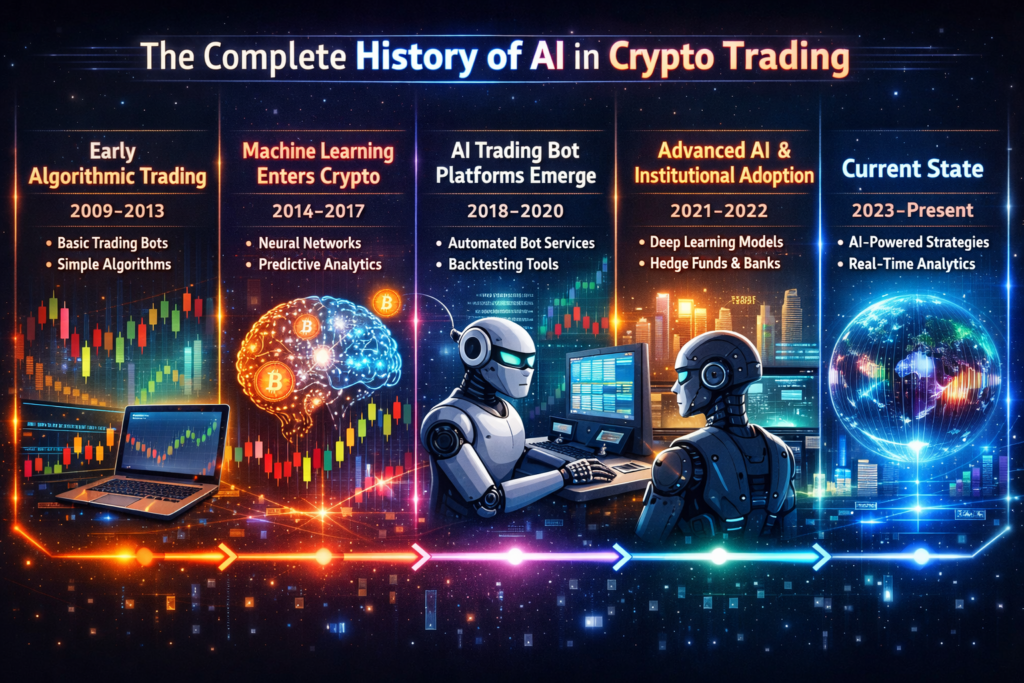
AI crypto trading didn’t appear overnight. It developed gradually, moving from simple automated scripts to advanced systems used by both everyday traders and large institutions. Here’s a simplified breakdown of how it evolved.
Early Algorithmic Trading (2010–2015)
When Bitcoin first emerged, most trading was done manually. However, as interest in crypto grew, traders began experimenting with automation to make the process faster and more efficient.
During this period, early trading bots were built using simple algorithms. These bots followed fixed instructions based on basic technical indicators like moving averages and the Relative Strength Index (RSI). For instance, a bot could be programmed to buy when the price dropped below a certain level and sell when it increased.
Machine Learning Enters Crypto (2016–2018)
As the market grew, developers started applying machine learning to predict price movements. Researchers used models like LSTM networks to analyze trends and improve accuracy.
However, limited data and high volatility made it difficult to build reliable systems. Many models worked well only in bullish conditions. Still, some achieved around 60–70% accuracy in predicting price direction, showing clear potential.
AI Trading Bot Platforms Emerge (2018–2020)
Between 2018 and 2020, AI trading became more accessible through platforms like 3Commas, Cryptohopper, and TradeSanta.
These platforms introduced cloud based bots that required little technical skill. Traders could now automate strategies easily, leading to rapid adoption. The 2020 DeFi boom further increased demand for bots due to fast-moving market opportunities.
Advanced AI & Institutional Adoption (2021–2023)
AI trading became more advanced with improved models and wider adoption.
By 2023, AI bots accounted for a large share of trading activity, with institutions increasingly relying on them. However, risks also emerged, including increased regulatory attention from the Commodity Futures Trading Commission.
Current State (2025 and Beyond)
Today, AI crypto trading is more advanced and widely used. Modern systems include sentiment analysis, reinforcement learning, and multi-strategy execution.
Regulators like the Securities and Exchange Commission and Commodity Futures Trading Commission are working toward clearer rules, while the industry continues to grow rapidly.
At the same time, risks like AI-related scams have increased. Overall, AI trading has shifted from simple tools to powerful systems shaping the future of crypto markets.
How AI Crypto Trading Works
AI crypto trading operates through a continuous cycle where data is collected, analyzed, acted upon, and improved over time. This continuous loop allows AI trading systems to improve over time and adapt to changing market conditions.
Data Collection & Processing
- Market Data
AI systems collect real-time information such as price movements, trading volume, order book depth, and available trading pairs. This helps the system understand current market activity and liquidity conditions.
- On-Chain Data
This includes blockchain-level insights like whale wallet movements, gas fees, decentralized exchange liquidity, and staking rates. For example, large transfers involving Bitcoin or Ethereum can signal potential market shifts before they reflect in price.
- Sentiment Data
Using natural language processing (NLP), AI scans platforms like Twitter, Reddit, and news websites to gauge market sentiment. Positive or negative discussions can influence short-term price trends.
- Technical Indicators
The system tracks indicators such as RSI, MACD, Bollinger Bands, and Fibonacci retracements. These help identify trends, entry points, and possible reversals.
- Global Events
AI also considers external factors like regulatory announcements, macroeconomic data, and exchange listings. These events can significantly impact market direction.
Machine Learning Analysis
- Pattern Recognition
AI identifies recurring chart patterns such as head and shoulders, double tops, and support/resistance levels. These patterns are used to anticipate potential price movements.
- Predictive Modeling
Neural networks analyze historical and real time data to forecast future price trends. Advanced systems can achieve high accuracy in detecting directional movement under certain conditions.
- Anomaly Detection
The system flags unusual activities like flash crashes, pump and dump schemes, or sudden large trades from whales. This allows it to react quickly to unexpected risks or opportunities.
- Strategy Selection
Based on its analysis, AI chooses the most suitable trading strategy. For example, it may apply grid trading in a sideways market or switch to trend following strategies during strong upward or downward movements.
Trade Execution
- Order Placement
The AI connects directly to exchanges like Binance, Coinbase, and Kraken through APIs to execute trades instantly using market or limit orders.
- Slippage Management
AI calculates the optimal order size and timing to reduce slippage, ensuring trades are executed as close as possible to the intended price.
- Multi Exchange Routing
The system can scan multiple exchanges at once and choose the best available price, improving efficiency and profitability.
- Execution Speed
Trades are executed in milliseconds (typically 50–200 ms), allowing AI to respond faster than human traders in rapidly changing markets.
Continuous Learning & Adaptation
- Reinforcement Learning
The AI reviews past trades and outcomes to improve future decisions. It learns what works and adjusts accordingly.
- Performance Metrics
Key metrics such as win rate, Sharpe ratio, and maximum drawdown are tracked to evaluate how well the strategy is performing.
- Strategy Adjustment
The system adapts to market conditions by switching strategies. For example, it may move from grid trading to dollar-cost averaging (DCA) when volatility increases.
- Real World Example
Platforms like Cryptohopper use advanced systems that can switch between multiple strategies automatically based on market conditions.
Ai Platform Selection Criteria and Guide to Setting Up an AI Trading Bot
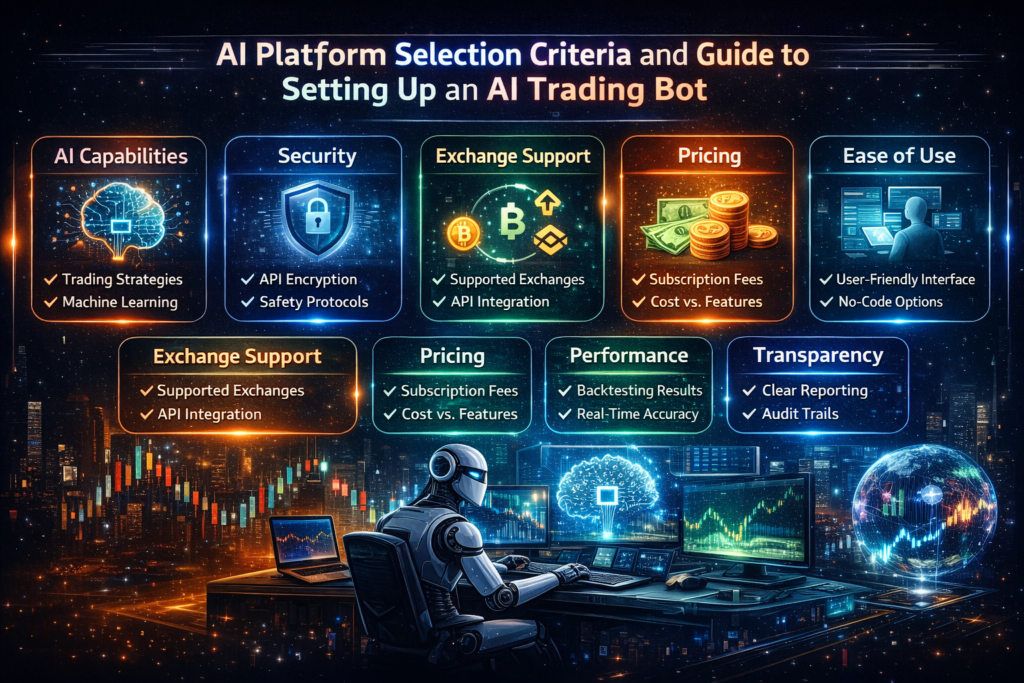
Choosing the right AI crypto trading platform is important because not all tools offer the same level of intelligence, security, or reliability. Here are the key factors to consider before making a decision:
AI Capabilities
Not every “AI bot” is truly powered by artificial intelligence. Some platforms only use rule based automation. Look for systems that use machine learning, adaptive strategies, and real time data analysis, rather than fixed “if X, then Y” rules.
Security
Since you’ll connect your exchange account, security is critical. Choose platforms that offer API key encryption, two-factor authentication (2FA), and non-custodial setups (meaning they don’t hold your funds directly).
Exchange Support
A good platform should integrate with major exchanges like Binance, Coinbase, and Kraken. More integrations mean better flexibility and access to different markets.
Pricing
Some platforms offer free tiers, while others require monthly subscriptions. Always check for hidden fees, such as trading commissions or premium strategy costs.
Ease of Use
Beginners should look for simple dashboards and pre-built strategies, while advanced users may prefer customization and deeper analytics tools.
Performance
Review historical performance data and user feedback. While past results don’t guarantee future success, they give insight into reliability.
Transparency
Trustworthy platforms often provide audit reports, clear documentation, or even open source code, helping you understand how the system works.
Once you’ve chosen a platform, the setup process is usually straightforward. Follow these easy steps to get started.
Step 1: Create an Account
Begin by signing up on your chosen AI trading platform and completing any verification required. Make sure your account is secured with a strong, unique password to protect it from unauthorized access.
Step 2: Connect Your Exchange
Generate an API key from your exchange account, such as Binance, and link it to your trading bot platform. Ensure that withdrawal permissions are disabled so the bot can execute trades without having access to move your funds.
Step 3: Choose a Trading Strategy
Select a trading strategy based on your experience and market conditions. Beginners may start with grid trading for sideways markets or DCA (Dollar-Cost Averaging) for gradual entry, while more advanced traders can use trend-following strategies that react to strong price movements. Many platforms provide pre-built strategies to simplify this process.
Step 4: Configure Risk Settings
Set clear risk controls before activating your bot. Define stop-loss levels to limit potential losses, establish take-profit targets to lock in gains, and determine the maximum investment per trade to control exposure and manage overall portfolio risk.
Step 5: Backtest or Use Demo Mode
If available, test your strategy using historical data or a demo account. This allows you to evaluate how your strategy would have performed in the past and make adjustments before committing real capital to live trading.
Step 6: Launch the Bot
Once all settings are configured and tested, activate your bot. It will begin monitoring the market and executing trades automatically according to your chosen strategy while continuously following the rules and risk parameters you set.
Read Also: Best AI Trading Apps in 2026: Top Picks for Crypto and Stock Traders
Trading Strategies AI Bots Execute
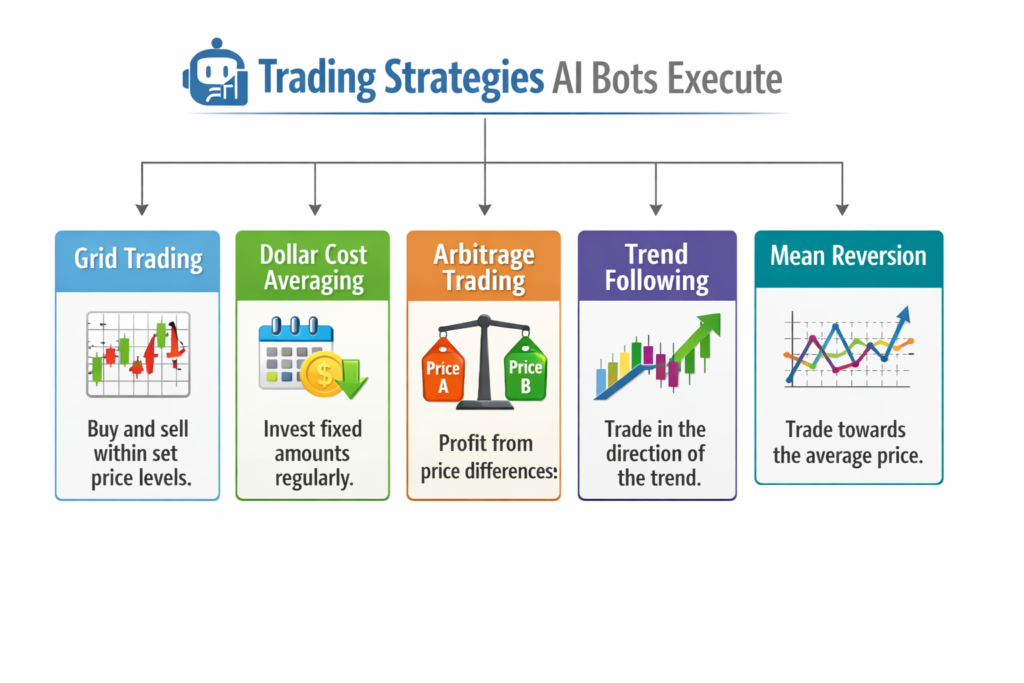
AI trading bots don’t just trade randomly, they follow specific strategies designed to match different market conditions. The advantage of AI is that it can enhance these strategies by adjusting them in real time based on data and market behavior.
Grid Trading (Range Markets)
Grid trading places buy and sell orders at fixed intervals within a price range, aiming to profit from repeated small movements.
AI improves this by adjusting grid spacing based on volatility, wider in unstable markets and tighter in stable ones. It works best when assets like Bitcoin move sideways within a range. Platforms like Pionex use this to generate steady returns during non-trending markets.
Dollar Cost Averaging (DCA)
DCA involves buying a fixed amount regularly to average out entry prices over time.
AI enhances this by increasing or reducing purchase size based on indicators like RSI or momentum. This makes it ideal for long-term accumulation of assets like Bitcoin and Ethereum. Tools like 3Commas automate this by buying more during dips.
Arbitrage Trading
Arbitrage takes advantage of price differences across exchanges by buying low on one and selling higher on another.
AI optimizes this by factoring in fees, slippage, and execution speed to maximize profit. Since opportunities are short lived, fast execution is key. Platforms like Bitsgap specialize in scanning multiple exchanges for these gaps.
Trend Following
This strategy buys when a clear trend is forming and exits when the trend weakens.
AI detects trends earlier using pattern recognition and data analysis, helping traders enter sooner. It works best in strong bull or bear markets but can struggle in sideways conditions due to frequent reversals.
Mean Reversion
Mean reversion assumes that prices return to their average after extreme moves.
AI identifies oversold conditions and predicts better entry points after sharp drops. This strategy is effective with established assets like Bitcoin and Ethereum, and is commonly used by platforms like TradeSanta to capture rebounds.
Top 8 AI Trading Platforms
| Platform | Best For | Monthly Cost (USD) | AI Sophistication | Beginner-Friendly |
| 3Commas | Overall best | 22-75 | High | 4/5 |
| Cryptohopper | Customization | 29-99 | Very High | 3/5 |
| Pionex | Free bots | 0 | Medium | 5/5 |
| Bitsgap | Grid/Arbitrage | 23-110 | High | 3/5 |
| Coinrule | No-code | 0-59 | Medium | 5/5 |
| HaasOnline | Professionals | 25-85 | Very High | 1/5 |
| TradeSanta | Swing trading | 18-50 | Medium | 4/5 |
| Octobot | Open-source | 0-50 | High | 2/5 |
AI trading platforms have made it easier than ever to automate crypto strategies and trade more efficiently. From beginner friendly tools to advanced systems used by professionals, each platform offers unique features and capabilities.
3Commas: Best Overall
Best for: Beginners to intermediate traders looking for a reliable, all in one platform
3Commas is one of the most widely used AI crypto trading platforms, known for its balance between simplicity and powerful features. Its SmartTrade terminal allows users to set take profit, stop loss, and trailing orders all at once, giving better control over trades.
The platform supports multiple bot types, including DCA, grid, and signal bots, all optimized with AI-driven insights. With integration across 20+ exchanges and TradingView support, it offers flexibility for different trading styles.
Pros
- User-friendly interface with strong learning resources
- Wide exchange support and mobile app access
- Copy trading with verified traders
Cons
- Higher pricing compared to some competitors
- Advanced features are locked behind higher tiers
- Past API security incident affected trust
Cryptohopper
Best for: Intermediate to advanced traders who want deep control over strategies
Cryptohopper stands out for its advanced customization and AI driven “Algorithm Intelligence,” which automatically switches strategies based on market conditions. It offers a large marketplace where users can buy, sell, or copy trading strategies. With strong backtesting tools and AI trend detection, it feels closer to a professional trading system used by hedge funds.
Pros
- Highly customizable strategies
- Strong community and educational resources
- Advanced AI that adapts to market changes
Cons
- Steeper learning curve for beginners
- Quality of marketplace strategies varies
- Full features require higher-tier plans
Pionex
Best for: Beginners and cost conscious traders
Overview:
Pionex is unique because it offers completely free built-in trading bots. It operates as its own exchange, so there’s no need for API connections. With 16 pre-built bots, including grid and DCA strategies, users can start trading immediately. Its AI assistant (PionexGPT) helps users choose suitable strategies based on market conditions.
Pros
- Free bots with low trading fees
- Very beginner-friendly setup
- No need for external exchange integration
Cons:
- Limited to the Pionex ecosystem
- Fewer advanced customization options
- Less powerful than premium platforms
Bitsgap
Best for: Traders focused on grid and arbitrage strategies
Overview:
Bitsgap is designed for traders who want to take advantage of price differences across exchanges. Its AI assistant recommends strategies based on your risk level, while its grid bot automatically adjusts to market volatility. The platform also includes a demo mode, making it easier to test strategies without risk.
Pros
- Strong arbitrage and grid trading tools
- Fast execution speeds
- Detailed analytics dashboard
Cons:
- Interface can feel complex at first
- Learning curve for new users
- Mid-range pricing
Coinrule
Best for: Beginners and non-technical users
Coinrule focuses on simplicity by allowing users to build trading strategies without coding. Its drag-and-drop system and 250+ pre-built templates make it easy to automate trades quickly. The platform also provides AI-based suggestions and built-in safety features like stop loss and position limits.
Pros
- No coding required
- Large library of ready-made strategies
- Clean and easy-to-use interface
Cons
- Limited advanced AI capabilities
- Less powerful than developer-focused tools
- Restricted features on the free plan
HaasOnline
Best for: Professional traders and developers
HaasOnline is built for users who want full control over their trading systems. It offers a proprietary scripting language (HaasScript) and advanced tools for building complex algorithms. With institutional-grade features and deep backtesting capabilities, it’s one of the most powerful platforms available.
Pros
- Extremely customizable
- Advanced analytics and backtesting
- Strong security features
Cons
- Very steep learning curve
- Expensive pricing
- Not suitable for beginners
TradeSanta
Best for: Traders who prefer medium-term strategies
TradeSanta is a cloud-based platform that focuses on simplicity and reliability. It supports both long and short strategies, allowing users to profit in rising and falling markets. Its trailing stop-loss and take-profit features help maximize gains while managing risk.
Pros
- Affordable pricing
- Easy setup and reliable performance
- Good for swing trading strategies
Cons
- Less advanced AI capabilities
- Limited exchange integrations
- Smaller user community
OctoBot
Best for: Developers and privacy-focused traders
OctoBot is an open-source trading bot that offers full transparency. Users can run it on their own systems or in the cloud, giving them complete control over their data and strategies. It includes pre-built bots and a customizable framework for building unique trading systems.
Pros
- Open source and transparent
- Free self hosted option
- Active developer community
Cons
- Requires technical knowledge
- Fewer integrations than commercial platforms
- Less polished user interface
Risks, Scams & Security (Use Case)
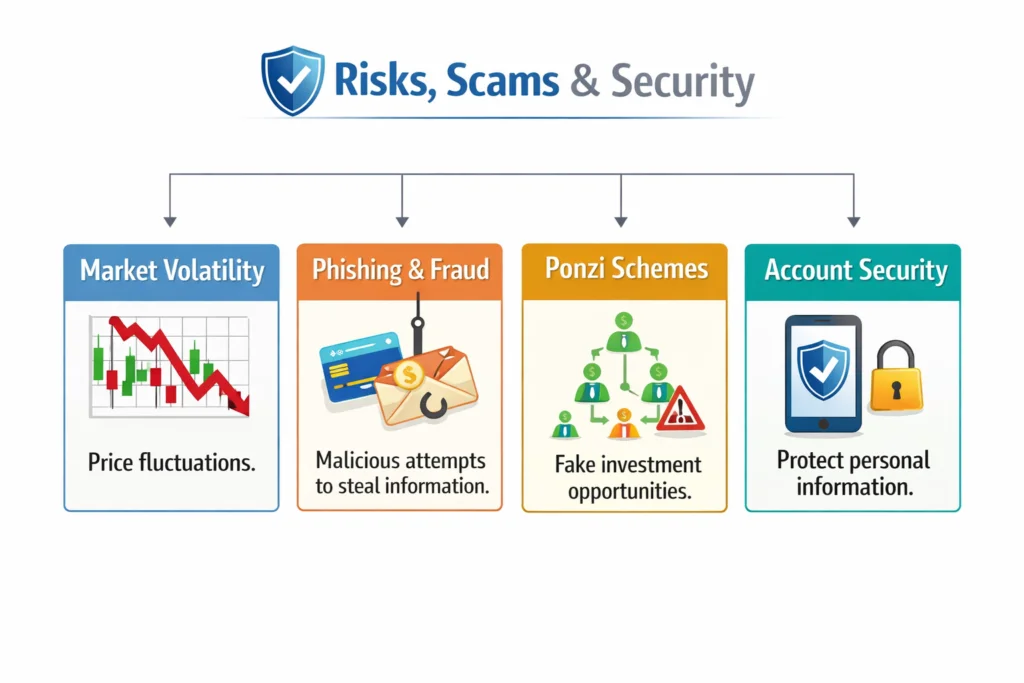
As AI crypto trading grows, so do the risks, especially scams powered by advanced technologies like deepfakes. According to the 2025 Anti-Scam Report by Bitget, SlowMist, and Elliptic, crypto-related scams reached an alarming $4.6 billion in 2024, marking a 24% increase from the previous year.
Even more concerning, around 40% of high value fraud cases involved deepfake technology, showing how AI is now being weaponized against users.
How to Detect Deepfake Scams
Deepfake scams use AI generated videos or audio to impersonate trusted figures. These scams are becoming more convincing and harder to detect, especially for beginners.
One of the most common tactics is celebrity endorsement fakes. Scammers create realistic videos of well known figures like Elon Musk, Donald Trump, or MrBeast promoting fake AI trading platforms. These videos are often shared through YouTube ads or TikTok, directing users to phishing websites.
In one example, a fake Elon Musk video claimed that Tesla had developed a new AI crypto trading system, tricking users into signing up on a fraudulent site. Another tactic involves government impersonation. Scammers have used deepfake videos of leaders like Lee Hsien Loong to promote fake investment platforms.
These are usually spread through Telegram or WhatsApp groups, exploiting the trust people place in official figures.
There are also platform executive impersonations, where scammers create fake announcements from crypto leaders such as Changpeng Zhao or Brian Armstrong. These videos often promote “exclusive AI trading tools” and direct users to fake websites designed to steal login credentials.
How to Stay Safe
To stay safe, it’s important to know how to spot these scams. Deepfake videos often have subtle flaws, such as unnatural facial movements, limited blinking, or slightly mismatched lip sync. Lighting may also appear too perfect or unrealistic.
Another red flag is when the message pushes urgency or promises guaranteed profits. Always verify information through official channels. Check announcements directly on company websites or verified social media accounts.
Pay close attention to URLs, as scam sites often use slightly altered domain names to appear legitimate.
Data from Chainalysis shows that about 60% of funds sent to scam wallets are linked to scams using AI tools, and the share of AI-driven scams increased significantly in 2024.
Conclusion
AI crypto trading is no longer something reserved for experts or large institutions, it’s becoming a core part of how the crypto market operates today. From automating trades to analyzing massive amounts of data in seconds, AI has made trading faster, more efficient, and more accessible to everyday users.
At the same time, it’s important to understand that AI is not a shortcut to guaranteed profits. While it can reduce emotional decision-making and improve consistency, it still depends on the strategy you choose, how well you manage risk, and the platform you use.
One of the biggest takeaways is balance. AI trading works best when you combine automation with awareness. You don’t need to monitor the market every second, but you also shouldn’t completely ignore what your bot is doing. Regular checks, small adjustments, and proper risk settings can make a big difference over time.
It’s also clear that as AI grows, so do the risks. Scams, fake bots, and security issues are becoming more common. This makes it essential to stay informed, verify platforms carefully, and avoid anything that promises unrealistic returns.
FAQs
What is AI crypto trading in simple terms?
AI crypto trading uses automated systems powered by artificial intelligence to analyze market data and execute trades on your behalf. Instead of manually watching charts, the system studies price movements, trends, and other signals, then makes trading decisions based on that information. It helps reduce emotional decisions and allows trading to happen 24/7.
Is AI crypto trading profitable?
AI trading can be profitable, but it is not guaranteed. The results depend on factors like the strategy used, market conditions, and how well the bot is configured. While AI can improve efficiency and consistency, it still requires proper risk management and realistic expectations.
Is AI crypto trading safe to use?
AI trading can be safe if you use trusted platforms and follow security best practices. This includes enabling two-factor authentication (2FA), using secure API keys without withdrawal access, and avoiding unknown or suspicious platforms. However, risks like scams and hacking still exist, so caution is important.
Do I need experience to use AI trading bots?
No, beginners can use AI trading bots, especially platforms that offer pre-built strategies and simple dashboards. However, having a basic understanding of how crypto trading works will help you make better decisions and avoid common mistakes.
How much money do I need to start AI crypto trading?
You can start with a small amount, depending on the platform and exchange requirements. Many traders begin with an amount they can afford to lose while testing strategies. Starting small allows you to learn how the bot works before increasing your investment.
Can AI trading bots run completely on their own?
AI bots can operate automatically, but they shouldn’t be left completely unattended. Markets change, and strategies may need adjustments over time. It’s important to monitor performance regularly and make updates when necessary to keep the bot effective.