



Every card in your wallet was issued by a bank. Not the brand on the front, but a bank sitting quietly behind it. The Delta card is an American Express product.
The Amazon card is Chase. The Apple Card is Goldman Sachs. The brand gets the real estate; the bank holds the license.
For decades, that license was the wall that kept startups permanently on the spending side of a card, never the issuing side. Crypto card issuing platforms for startups just changed which side you stand on.
How Crypto Card Issuing Works: The API Core
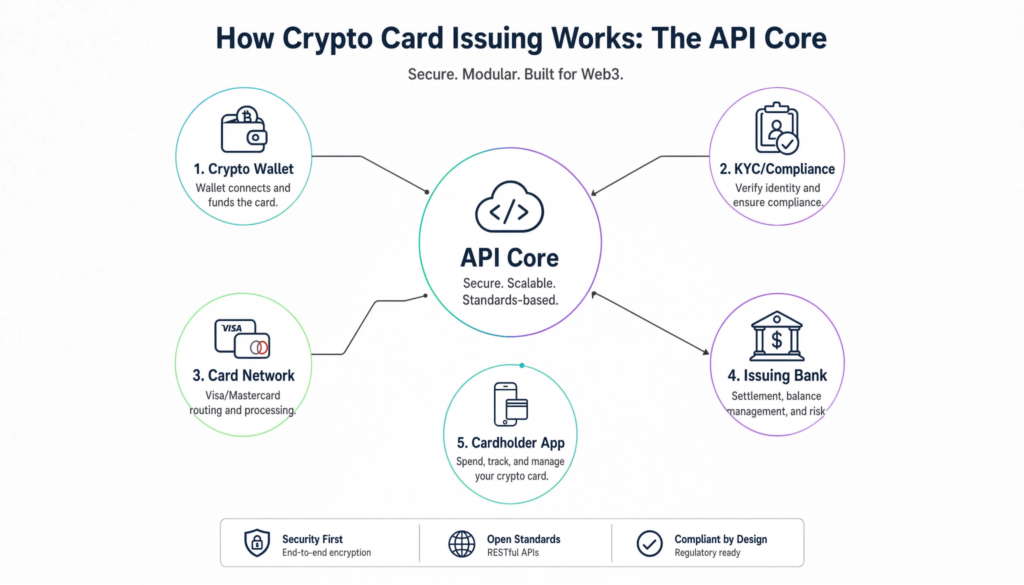
Modern card issuing platforms use flexible software architectures and API-driven systems to deploy tailored financial products.
Application programming interfaces (APIs) connect a startup’s cryptocurrency wallet directly to global payment networks.
The following sequence describes how crypto cards facilitate an automated, smooth transaction flow, converting digital assets into usable fiat in milliseconds:
- The Swipe: A cardholder swipes their card at a merchant terminal.
- The Check: The platform runs a real-time balance check on the user’s digital assets.
- The Liquidation: The platform triggers an instant crypto-to-fiat liquidation for the exact purchase amount.
- The Settlement: The merchant receives traditional fiat currency without ever having to touch digital assets directly.
Read Also: How to earn crypto passively.
Compliance & Responsibility: KYC, AML, and Security
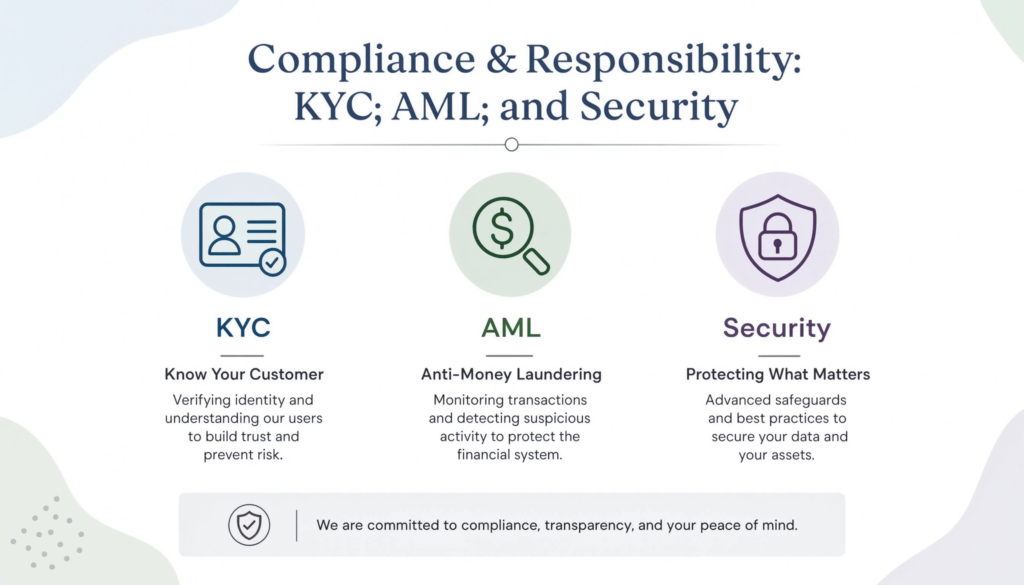
The interaction between digital assets and traditional commercial networks requires strict adherence to global financial regulations. Brands must establish a compliance baseline to operate legally:
- User Onboarding: Startups must implement strong Know Your Customer (KYC) protocols.
- Transaction Monitoring: Anti-Money Laundering (AML) checks must constantly evaluate transactions for suspicious behavioral patterns.
- Data Protection: Adherence to the Payment Card Industry Data Security Standard (PCI DSS) is non-negotiable for card issuers.
“Compliance is not a one-time checkbox. For startups entering the card issuing space, KYC and AML obligations are ongoing operational responsibilities that sit with the program manager, not just the platform provider.” Financial Action Task Force (FATF), Guidance on Virtual Assets
Critical Compliance Note: While partnering with a white-label issuing platform helps manage these operational hurdles, startups cannot fully bypass regulatory obligations.
Established providers hold necessary legal licenses and banking relationships to handle certain technical aspects, but startups retain significant compliance responsibilities.
This includes independent KYC and AML verification to ensure the program aligns with local laws.
Read Also: What Does 5x Mean in Crypto?
Crypto Card Issuing Platforms for Startups Platform Overview
| Platform | Best For | Technical Focus |
| UPay | End-to-end Crypto Programs | Managed infrastructure, instant stablecoin conversion |
| Marqeta | High-volume Enterprise | Programmable infrastructure, complex JIT funding |
| Lithic | Early-stage/MVPs | Developer-friendly, reliable sandbox, speed |
| Paymentology | Cross-border Scaling | Cloud-native, hyper-localized processing |
| Cross River | Bank-grade Compliance | Chartered banking, fiat/crypto hybrid |
| Reap | Web3 Corporate Spend | Bridging Web3 treasury to traditional vendors |
Startups must carefully evaluate card issuing platforms to find a provider that aligns with their product roadmap, treasury goals, and geographical expansion targets.
Note on Mobile Wallets: Feature availability, such as Apple Pay and Google Pay integration, is not universal. Integration capabilities depend heavily on specific issuers and regional regulations; therefore, startups should verify these details with their provider based on their target markets.
- UPAY: A card issuing and payment platform that supports digital payments by allowing users to deploy virtual or physical cards.
The platform handles transaction routing and security validations, providing real-time conversion at the point of sale with native support for major stablecoins like USDT and USDC.
It serves as an options gateway alongside enterprise infrastructure.
- Marqeta: A provider of programmable card infrastructure known for its Just-In-Time (JIT) funding solution.
Marqeta primarily focuses on enterprise-level and high-volume solutions, which may make it less suitable for early-stage startups with lower transaction volumes compared to other providers that cater specifically to smaller operations.
- Lithic: Lithic offers a developer-friendly infrastructure with reliable sandbox environments and clear documentation.
It is built for companies prioritizing speed and coding simplicity. You can expect out-of-the-box debit and credit ledgers that guarantee flawless money movement, significantly reducing the engineering time needed to launch virtual cards.
“The fastest path from idea to issued card runs through developer-first infrastructure. Sandbox environments, clear API documentation, and modular ledger systems are not luxuries. They are table stakes for any serious card issuing platform.” Lithic Developer Documentation
- Paymentology: This platform is optimized for fintech startups pursuing aggressive cross-border scaling. Paymentology features a cloud-native processing engine that’s not burdened by legacy banking mainframes.
It focuses on delivering real-time data feeds and hyper-localized card products across multiple geographic regions simultaneously.
- Cross River: This provider delivers a powerful API-based banking infrastructure backed by a fully chartered commercial bank.
It offers a highly compliant and bank-grade ecosystem that combines direct access to traditional fiat clearing rails with crypto-native asset support.
- Reap: Reap acts as a vital bridge for growing Web3 companies. Its corporate cards allow blockchain-native enterprises to pay traditional commercial vendors (like SaaS or cloud providers) directly from their digital treasuries without creating accounting friction.
Read Also: Coin Ticker: The Three Letters That Speak for a Whole Crypto Project.
How to Choose: The Right Crypto Card Platform for Your Startup
| Step / Consideration | Key Focus | What to Check / Ask |
| 1. Growth Stage | Match platform complexity to business maturity. | Speed and sandbox environments for early-stage; high-volume stability for scaling enterprises. |
| 2. Compliance | Understand regulatory and licensing obligations. | Banking licenses, modular KYC/AML toolkits, and data residency processes. |
| 3. Technical Needs | Evaluate architecture and funding mechanisms. | API flexibility, Just-In-Time (JIT) funding, and stablecoin support (USDT/USDC). |
| 4. Scalability | Plan for cross-border and international growth. | Multi-currency settlement and global card issuance architecture. |
Read Also: Tips on how to convert crypto to cash.
Frequently Asked Questions
What is the difference between a white-label card issuing platform and a payment processor?
A payment processor routes transactions after a card is swiped, moving funds between the acquiring and issuing banks. A white-label card issuing platform gives your startup the infrastructure to build and manage its own branded card program, including spending controls, funding logic, and user accounts.
How do card issuing platforms handle crypto price volatility at the point of sale?
Just-In-Time (JIT) funding, pioneered by Marqeta, solves this by triggering crypto liquidation at the exact moment of a card swipe rather than converting funds in advance. This keeps digital assets in crypto form until the last possible moment, limiting exposure to price swings. Platforms with native stablecoin support, like UPAY, reduce this risk further since USDT and USDC are already pegged to fiat values.
Conclusion
Most startups spend years building something fast enough to compete globally, then hand the payment layer to infrastructure that wasn’t designed for them and hope it keeps up. It doesn’t.
The correspondent bank still takes three days. The FX fee still quietly eats the margin. The wire still fails on a Friday afternoon in a timezone nobody accounted for.
Choosing the right crypto card issuing platforms for startups is not a back-office decision.
It is a growth decision. The platform determines whether your card program scales with your user base or fights it, whether contractors in Lagos get paid on Tuesday or Thursday, whether your treasury asset becomes spending power in minutes or days.
The gap between decentralized assets and everyday commerce is closing.
The startups that close it deliberately, with infrastructure built for speed and global reach rather than inherited from a banking era that predates them, are the ones that stop explaining payment delays and start compounding on the time they saved.