


Definition
A bear market is a financial market condition characterized by a sustained, broad-based decline in asset prices — conventionally defined as a fall of 20% or more from a recent significant high — accompanied by widespread investor pessimism, negative sentiment, increasing risk aversion, and often deteriorating economic fundamentals. The 20% threshold is the most widely used formal definition, distinguishing a bear market from a shorter “correction” (a decline of 10–20%) and signaling a deeper, more sustained structural shift in market psychology and underlying economic conditions.
Bear markets affect all tradeable asset classes: equities, bonds, real estate, commodities, and cryptocurrencies. In crypto markets, where volatility is extreme by traditional standards, bear markets — colloquially called “crypto winters” — are characterized by Bitcoin and major altcoin prices declining 70–80% or more from all-time highs, developer activity contracting, retail interest collapsing, and media coverage turning intensely negative. The 2022 crypto bear market, triggered by the collapse of the Terra/LUNA ecosystem in May 2022, combined with aggressive Federal Reserve rate hikes, saw Bitcoin fall approximately 77% from its November 2021 high of ~$69,000 to a low of approximately $16,000 in November 2022.
While bear markets are painful — they destroy wealth, erode consumer confidence, and can trigger recessions — they serve a necessary economic function. They correct overvalued assets back toward fundamental values, purge speculative excess, force weak businesses to fail or restructure, and ultimately create the low-price entry points that generate the best long-term investment returns. The average S&P 500 bear market since 1929 has lasted approximately 286 days and resulted in an average decline of approximately 36% — significantly shorter and shallower in both duration and magnitude than the bull markets that precede and follow them. Historically, patient investors who stayed invested through bear markets have been richly rewarded when the subsequent bull market arrived.
Read Also: Stellar (XLM)
Origin & History
| Date | Event |
| Early 1700s | “Bear” market terminology emerges in London’s early stock markets; a “bearskin jobber” was a speculator who sold shares he did not yet own, betting on falling prices — giving rise to the bear = falling prices association |
| October 1929 – June 1932 | The Great Depression bear market — the most severe in US history — sees the Dow Jones Industrial Average fall approximately 89% over nearly three years; S&P 500 loses approximately 83% from peak to trough |
| January 1973 – October 1974 | Oil embargo-driven stagflation bear market; S&P 500 falls approximately 48% — one of the most painful post-WWII US equity declines |
| March 2000 – October 2002 | Dot-com bubble burst; S&P 500 falls approximately 49% over 2.5 years as inflated technology valuations collapse following the internet boom |
| October 2007 – March 2009 | Global Financial Crisis bear market; S&P 500 falls approximately 57% in 408 days — the second-deepest post-WWII US equity bear market — triggered by the subprime mortgage collapse |
| January–March 2020 | COVID-19 pandemic triggers an extremely fast bear market: S&P 500 falls 34% in just 23 trading days (February 19 – March 23, 2020), the fastest 30%+ decline in history; remarkably, fully recovered by August 2020 |
| November 2021 – November 2022 | Crypto bear market: Bitcoin falls from ~$69,000 to ~$16,000 (approximately 77% decline) over 12 months; Terra/LUNA collapse (May 2022) and FTX collapse (November 2022) mark major contagion events |
| January 2022 – October 2022 | Equity bear market: S&P 500 falls approximately 25% as the Federal Reserve begins its most aggressive rate-hiking cycle since the Volcker era (raising rates from 0.25% to 4.50% in under 12 months) |
“Be fearful when others are greedy, and greedy when others are fearful.” — Warren Buffett, Chairman and CEO of Berkshire Hathaway — the single most quoted investment maxim for navigating bear markets.
How It Works
| Characteristic | Bear Market | Bull Market | Correction |
| Price decline | -20% or more from recent high | +20% or more from recent low | -10% to -20% from recent high |
| Sentiment | Fear, pessimism, panic | Optimism, confidence, FOMO | Uncertainty, nervousness |
| Duration (S&P 500 avg) | ~286 days | ~1,011 days | Days to weeks |
| Accompanying economy | Often recession or contraction | Often expansion | Often mid-cycle slowdown |
| Crypto analog | “Crypto winter” (-70% to -90%) | “Bull run” (multiples) | “Crypto dip” (-20% to -40%) |
| Opportunity | Accumulation / dollar-cost averaging | Profit-taking / rebalancing | Selective buying |
In Simple Terms
- Prices are going down significantly and for a sustained period.A bear market is not a bad week or a rough month — it is a prolonged decline of at least 20% that reflects genuine deterioration in investor confidence and often in underlying economic conditions. In crypto, “prolonged” can mean Bitcoin declining 70–80% over 12+ months.
- The name comes from how a bear attacks — paws swiping downward.The terminology traces back to 18th-century London speculators who sold borrowed shares hoping to profit from falling prices — bearish bets on falling markets eventually gave bears their name in financial vocabulary.
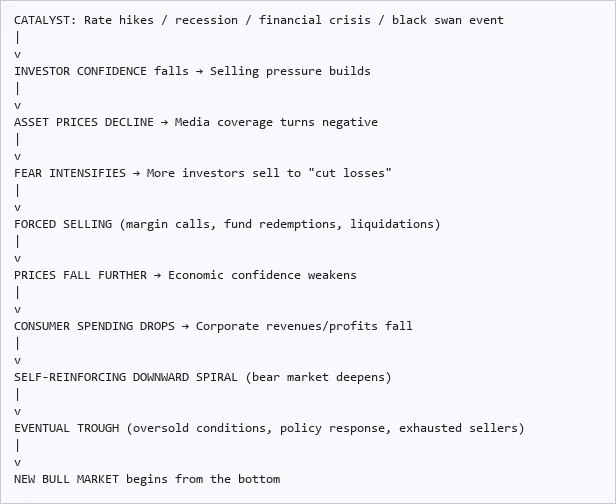
- Fear drives selling, which drives more fear.Bear markets create a self-reinforcing cycle: falling prices frighten investors into selling, which pushes prices lower, which frightens more investors. Margin calls and forced liquidations accelerate the decline, often pushing prices well below fundamental value before the bottom is reached.
- They are shorter than bull markets but feel longer.The average US equity bear market lasts about 286 days — less than 10 months — compared to over 1,000 days for the average bull market. But the psychological intensity of losses makes bear markets feel far longer and more severe than they statistically are.
- Bear markets create the best long-term buying opportunities.Warren Buffett’s fortune was built largely on buying quality assets during bear markets when prices are deeply discounted. Investors who consistently purchased S&P 500 index funds during the 2009 bear market trough held assets that returned approximately 400% by 2020.
Real-World Examples
| Scenario | Implementation | Outcome |
| 2008–2009 Global Financial Crisis bear market | Subprime mortgage crisis triggers bank failures (Lehman Brothers, September 15, 2008); S&P 500 falls 57% over 408 days from October 2007 peak to March 2009 trough | Most severe post-WWII equity bear market; prompted unprecedented Federal Reserve intervention (QE, near-zero rates); the subsequent 2009–2020 bull market returned approximately 400% from the trough |
| 2022 crypto bear market (Terra/LUNA collapse) | Terra’s algorithmic stablecoin UST de-pegs in May 2022, triggering the collapse of LUNA from ~$80 to near zero; contagion spreads to crypto hedge funds (Three Arrows Capital), lenders (Celsius, BlockFi), and ultimately FTX exchange (November 2022) | Bitcoin falls 77% from ~$69,000 to ~$16,000 over 12 months; estimated $2 trillion in crypto market cap erased; the crisis accelerated regulatory scrutiny and industry restructuring |
| 2000–2002 dot-com bear market | Internet company valuations collapse as earnings fail to materialize; Nasdaq falls approximately 78% from March 2000 peak; major companies (Pets.com, Webvan) fail entirely | S&P 500 declines approximately 49% peak-to-trough; the bear market lasts approximately 2.5 years; investors who averaged down through the decline were fully recovered by 2007 (before the next bear market) |
Advantages
| Advantage | Detail |
| Attractive asset prices for long-term buyers | Bear markets create deeply discounted entry points; assets bought at bear market troughs typically yield the best long-term returns in the subsequent bull cycle |
| Purging of speculation and excess | Unsustainable valuations, fraudulent projects, and poorly managed businesses are eliminated, leaving a healthier, more sustainable market structure |
| Dollar-cost averaging opportunities | Regular investors can accumulate more shares or crypto units for the same dollar investment during price declines, improving long-term average entry prices |
| Forces financial discipline | Companies cut costs, improve efficiency, and focus on profitability; investors reassess risk tolerances and portfolio construction — disciplines that serve them well in recovery |
| Policy responses can accelerate recovery | Bear markets typically trigger central bank rate cuts, fiscal stimulus, and policy innovation that can set the stage for the next bull market |
Disadvantages & Risks
| Risk | Detail |
| Significant portfolio losses | Even a 25–30% decline requires a 33–43% gain just to return to breakeven; deep bear markets (50–80%) require 100–400% recoveries and can take years to fully reverse |
| Panic selling at the worst time | The most common investor mistake is selling at market lows, locking in losses and then missing the subsequent recovery — the most expensive emotional decision in investing |
| Contagion and cascading failures | In interconnected markets, a decline in one asset class (e.g., mortgage-backed securities in 2008, Terra/LUNA in 2022) can trigger forced selling and failures across seemingly unrelated sectors |
| Extended bear markets can coincide with economic recessions | Unemployment rises, consumer spending falls, and businesses contract — creating real-world financial hardship beyond just paper portfolio losses |
Risk Management Tips:
- Maintain an emergency fund in cash or stablecoins before investing, so you never need to sell assets at bear market lows to cover living expenses
- Diversify across uncorrelated asset classes (equities, bonds, real estate, crypto) to reduce the severity of any single market’s bear market on your overall portfolio
- Establish a systematic dollar-cost averaging (DCA) plan before a bear market starts — commit to regular purchases regardless of price direction rather than trying to time the bottom
- In crypto specifically, avoid leverage during bear markets — margin liquidations can wipe out positions before a recovery; the bottom is always lower than it appears
- Distinguish between temporary bear markets (cyclical, recoverable) and structural deterioration in specific assets (projects that will not recover); the former rewards patience, the latter requires cutting losses
FAQ
How is a crypto bear market different from a stock market bear market?
Both share the 20%+ decline definition, but crypto bear markets are typically far more severe in magnitude. Bitcoin has experienced declines of 77–93% in past bear markets (2018: -84%; 2022: -77%; 2015: -85%), compared to the worst S&P 500 bear market of approximately -57% (2008–2009). Crypto bear markets also tend to be faster and more volatile — with sudden 20–40% single-day drops possible — while equity bear markets typically unfold more gradually over months.
Q: How long do crypto bear markets typically last?
Historically, major Bitcoin bear markets have lasted between 12 and 18 months from peak to trough, with the total recovery back to all-time highs taking 2–4 years from the bottom. The 2018 bear market lasted approximately 12 months; the 2022 bear market approximately 12–13 months (November 2021 peak to November 2022 trough). However, each cycle is influenced by different macro conditions, regulatory environments, and adoption curves.
Should I sell my crypto during a bear market?
This is a personal financial decision, but historically, panic-selling at bear market lows has been the most costly mistake for long-term crypto investors. Bitcoin has recovered from every historical bear market and reached new all-time highs in subsequent cycles. That said, individual projects (altcoins, failed platforms) may not recover. Distinguishing between high-conviction, established assets and speculative positions is crucial. Never invest more in crypto than you can afford to leave untouched through a full bear cycle.
How can UPay help me navigate a bear market?
UPay allows you to quickly convert crypto holdings to stablecoins (preserving dollar value while remaining in the crypto ecosystem) or to fiat currency to reduce volatility exposure. You can also continue using crypto for everyday payments through UPay even if the broader market is declining — keeping crypto utility separate from the price volatility question. Additionally, UPay’s educational resources help you stay informed and rational rather than making fear-driven decisions.
Sources
- Hartford Funds: “10 Things You Should Know About Bear Markets”
- Morningstar: “Stock Market Crashes: A Look at 150 Years of Bear Markets”
- CNBC: “Why the 2022 ‘Crypto Winter’ Is Unlike Previous Bear Markets”
- Glassnode Insights: “A Bear of Historic Proportions” (2022 crypto bear market analysis)
- Sensible Financial Planning: “98 Years of S&P 500 Bull and Bear Markets”