Definition
Fiat currency is a type of government-issued money that derives its value not from any physical commodity such as gold or silver, but from the authority and decree of the government that issues it. The word “fiat” comes from Latin, meaning “let it be done” — a fitting description, since the currency’s value exists by official declaration rather than intrinsic worth. Today, every major currency in the world — the US dollar, the euro, the British pound, the Japanese yen — is a fiat currency. Its acceptance as a medium of exchange rests entirely on institutional trust, legal tender laws, and the collective agreement of the societies that use it.
The value of fiat money is determined by the interplay of supply and demand, the fiscal discipline of the issuing government, and the credibility of the central bank managing monetary policy. Unlike commodity-backed currencies where the money supply is constrained by how much gold a government holds, fiat systems allow central banks to expand or contract the money supply in response to economic conditions. This flexibility is both fiat currency’s greatest strength and its most significant vulnerability: responsible management enables economic stabilization, while irresponsible money printing can lead to hyperinflation and currency collapse.
From a practical standpoint, fiat currency serves the three classical functions of money: it acts as a medium of exchange (used to buy and sell goods and services), a unit of account (provides a standard measure of value), and a store of value (can be saved and retrieved in the future, though inflation gradually erodes this function). The global financial system — including banking, international trade, bond markets, and central bank reserves — is built almost entirely on fiat foundations, making it the most consequential monetary innovation in modern history.
Read Also: Bug Bounty
Origin & History
| Date | Event |
| 7th century AD | Tang Dynasty China introduces paper money (“jiaozi”), the earliest known fiat-like currency not directly tied to metal on hand |
| 1661 | Sweden’s Stockholms Banco issues the first European banknotes, redeemable but not always fully backed by metal reserves |
| 1944 | Bretton Woods Agreement establishes a gold-exchange standard: 44 nations peg their currencies to the US dollar, which is fixed at $35 per troy ounce of gold |
| 1971 (August 15) | President Nixon suspends US dollar convertibility to gold (the “Nixon Shock”), effectively ending the Bretton Woods system and transitioning the world to pure fiat currency |
| 1973 | G-10 nations formally abandon fixed exchange rates; floating exchange rate system begins globally |
| 1990s–2000s | Euro introduced (1999–2002), becoming the world’s second-largest reserve currency — the largest multinational fiat currency experiment in history |
| 2008–2009 | Global financial crisis prompts unprecedented fiat money creation (quantitative easing) by the Federal Reserve, ECB, and Bank of England |
| 2009 | Bitcoin launches as a direct response to fiat currency’s dependence on centralized trust and the risks of unconstrained money printing |
“We have gold because we cannot trust governments.” — President Herbert Hoover, in a statement to Franklin D. Roosevelt, 1933 — a sentiment that encapsulates the enduring debate between commodity-backed and fiat money systems.
How It Works
| Feature | Fiat Currency | Gold-Backed Currency | Cryptocurrency |
| Backing | Government authority | Physical gold reserves | Cryptographic consensus / code |
| Supply control | Central bank discretion | Limited by gold supply | Algorithmic (fixed or scheduled) |
| Inflation risk | High if mismanaged | Lower (gold supply grows ~1.5%/yr) | Varies; Bitcoin is deflationary by design |
| Flexibility | Very high | Very low | Medium |
| Legal tender | Yes (forced acceptance) | Historically yes | No (in most jurisdictions) |
| Transaction speed | Fast (digital) | Slow (physical settlement) | Fast to near-instant |
In Simple Terms
- Government says it has value, so it does. Unlike gold you can hold, fiat currency is essentially an IOU from the government. People accept it because the law says they must, and because everyone else accepts it too — a self-reinforcing cycle of trust.
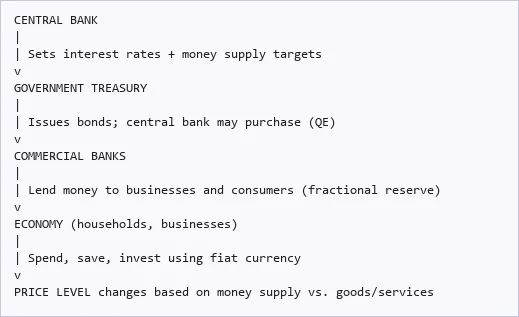
- The central bank controls how much exists. By raising or lowering interest rates and buying or selling government bonds, central banks like the US Federal Reserve manage how much money flows through the economy — influencing inflation, employment, and growth.
- It’s not backed by anything physical.If you tried to exchange your $100 bill for gold at the US Treasury today, you’d be turned away. Since August 15, 1971, the dollar has been purely fiat — its value is a social contract, not a warehouse receipt.
- Too much of it causes inflation.When governments print significantly more money than the economy produces in goods and services, prices rise. Zimbabwe’s 231,000,000% inflation rate in 2008 is the most extreme modern example of what happens when that trust breaks down completely.
- It powers the entire modern financial system.Every bank account, mortgage, salary, credit card, and bond in the world is denominated in fiat currency. Crypto payments use fiat as the reference point for pricing — even Bitcoin’s price is quoted in USD.
Real-World Examples
| Scenario | Implementation | Outcome |
| US Federal Reserve response to COVID-19 (2020) | The Fed expanded its balance sheet from ~$4.2 trillion to over $8.9 trillion through quantitative easing, injecting fiat dollars into the economy | Prevented economic collapse in the short term; contributed to post-pandemic inflation peaking at 9.1% CPI in June 2022 before easing to 2.4% by early 2026 |
| Zimbabwe hyperinflation (2007–2009) | Government printed massive quantities of Zimbabwean dollars to fund budget deficits; inflation reached 231,000,000% by mid-2008 | Currency became worthless; Zimbabwe abandoned its dollar in 2009 and adopted USD and South African rand as legal tender |
| Euro adoption across Europe (1999–2002) | 12 EU member states replaced their national fiat currencies with a single shared fiat currency managed by the European Central Bank | Created the world’s largest currency union; the euro became the second most-held reserve currency globally, demonstrating that fiat value can transcend individual nation-state authority |
Advantages
| Advantage | Detail |
| Monetary policy flexibility | Central banks can adjust money supply to respond to recessions, crises, or inflationary spikes — impossible under a gold standard |
| Cost-efficient production | Paper and digital currency costs far less to produce and distribute than commodity-backed equivalents |
| Supports modern banking | Fractional reserve banking, credit creation, and global trade finance all rely on fiat’s scalability and divisibility |
| Government fiscal tools | Enables deficit spending to fund infrastructure, social programs, and emergency responses without being constrained by physical reserves |
| Universal acceptance | Legal tender laws ensure wide acceptance across all transactions within a jurisdiction, providing transactional certainty |
Disadvantages & Risks
| Risk | Detail |
| Inflation and purchasing power erosion | Unchecked money supply growth reduces the real value of savings over time; even moderate 2–3% annual inflation halves purchasing power in roughly 25–35 years |
| Hyperinflation risk | Political mismanagement or fiscal crises can trigger catastrophic currency collapse (Zimbabwe 2008, Venezuela 2018–2021 with inflation exceeding 1,000,000%) |
| Centralization and political risk | Fiat systems depend on government and central bank integrity; sanctions, political instability, or corruption can undermine currency stability |
| No intrinsic value floor | Unlike gold, fiat currency can theoretically fall to zero value if institutional trust completely collapses |
Risk Management Tips:
- Diversify savings across multiple currencies and asset classes (equities, real estate, commodities)
- Hold a portion of wealth in inflation-resistant assets: gold, real estate, or deflationary cryptocurrencies like Bitcoin
- Monitor central bank policy signals (interest rate decisions, quantitative easing announcements) as leading indicators of inflation pressure
- For businesses accepting international payments, use hedging instruments or stablecoins to manage foreign exchange exposure
FAQ
Is cryptocurrency a replacement for fiat currency?
Not currently in mainstream commerce, though it is an alternative store of value and payment layer. Most crypto assets are still priced in fiat (USD, EUR, etc.), and stablecoins — the most common crypto payment medium — are pegged directly to fiat currencies. Crypto and fiat increasingly coexist rather than compete.
Why does UPay still deal with fiat currencies if crypto is the future?
UPay operates at the intersection of crypto and traditional finance. Converting between fiat and crypto (on/off ramps) is essential for merchants and users who need to pay bills, settle taxes, or receive salaries in local currency. Understanding fiat helps UPay users navigate both worlds effectively.
Can a fiat currency ever truly be “safe” from inflation?
No currency is completely immune, but well-managed fiat systems with independent central banks and strong institutions (like the Swiss franc or Singapore dollar) maintain remarkably stable purchasing power. The key variable is institutional credibility, not the currency system itself.
How does crypto volatility compare to fiat inflation?
Fiat currencies typically lose 2–4% of value per year through managed inflation, a slow and predictable erosion. Cryptocurrencies can gain or lose 50–80% of value within months, representing a very different risk profile. Stablecoins attempt to bridge this gap by combining crypto’s programmability with fiat’s price stability.
Sources
- International Monetary Fund (IMF): “From the History Books: The Rethinking of the International Monetary System” (2021)
- Federal Reserve History: “Nixon Ends Convertibility of U.S. Dollars to Gold and Announces Wage/Price Controls”
- US Department of State, Office of the Historian: “Nixon and the End of the Bretton Woods System, 1971–1973”
- Wikipedia: “Fiat money”